
How Much Do Cash for Gold Places Pay?
By Issac Makdessian, Owner and Head Refiner at Bay Area Metals. Operating the family-owned South San Francisco refinery since 2012. Specialist in gold, silver, platinum, and palladium refining for public sellers and B2B clients across the Bay Area.
Key Takeaways
A cash-for-gold offer is a middleman price. The shop resells your gold to a refinery and sets what it pays you below what it expects to collect.
The percentage you get mostly tracks what the buyer can prove. A counter with an XRF gun and no furnace has to price an ambiguous piece for the worst case. A refinery melts and assays, so it pays on what the metal actually is.
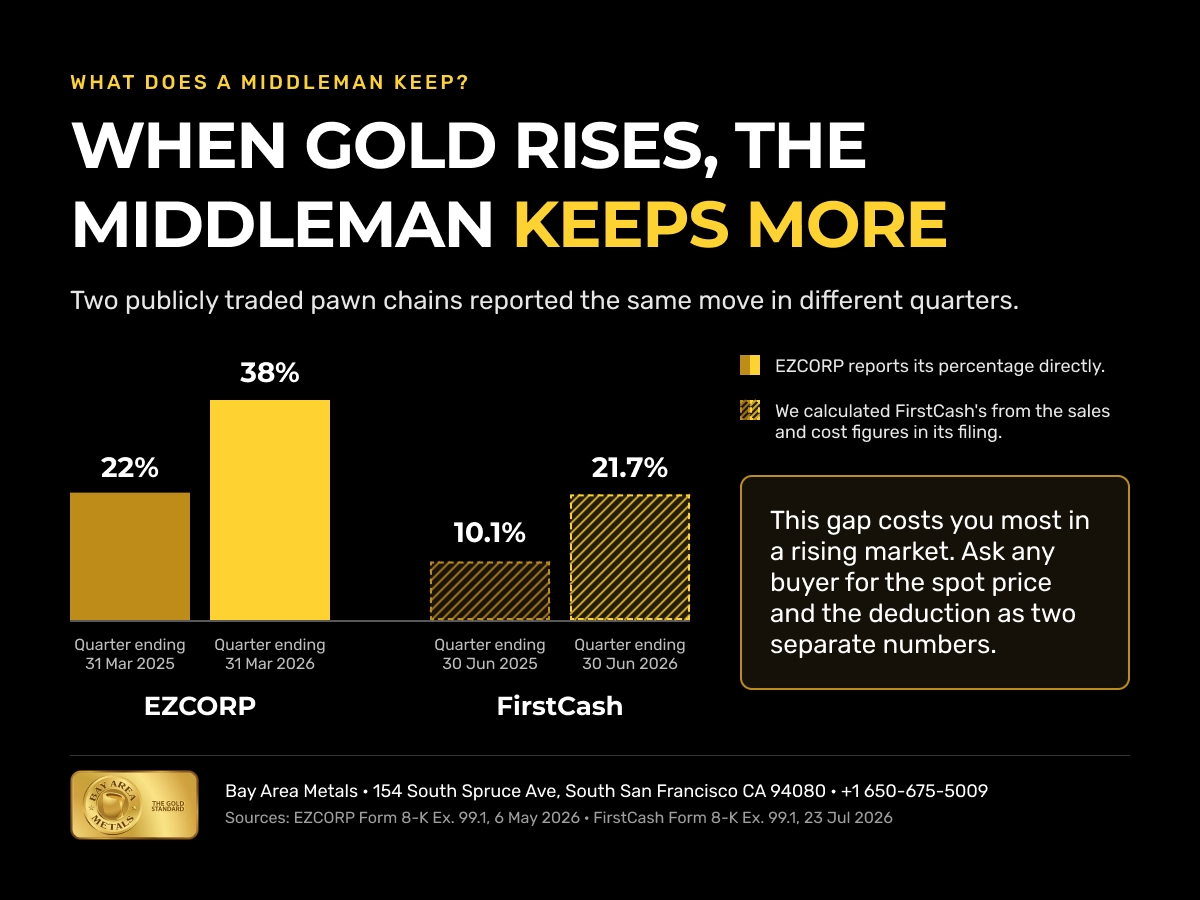
The middleman's cut widens when gold rises. Two public pawn chains reported their scrap gold margins roughly doubling year over year, to 38% and 21.7% (SEC filings, May and July 2026).
Make the offer legible before you accept it. Ask any buyer for the spot price, the assayed purity and the deduction as three separate numbers.
Going direct to the refinery removes the middleman layer. Bay Area Metals publishes up to 99% of daily LBMA spot for gold, and up to 90% for silver, platinum and palladium.
Walk into a cash-for-gold storefront and you will have a number in about ninety seconds. It reads like a verdict on your gold. But it’s mostly a verdict on what the buyer could not check.
We refine for pawnshops and trade clients across the Bay Area from our South San Francisco furnace, so the gold those shops buy often ends up on our intake tray. We do not see what a shop paid its customer. What we do see is what the metal actually assays and what the shop accepts from us for it, which is the far end of the same chain. The money in between covers four things, and two publicly traded pawn chains disclosed how much of it they keep.
What do cash for gold places actually pay?
Published payouts run from roughly 60% to 95% of the metal's spot value, and the spread is that wide because the phrase "cash for gold" covers refineries, pawnshops, walk-in storefronts and mail-in buyers, which do not carry the same costs. A 2026 refining charges guide from Africa Gold Suppliers puts the wider buyer market, storefronts and pawnshops included, in that band, while refiners handling clean karat scrap commonly credit 95% to 99% of assayed fine gold.
Most published ranges describe one shop's policy rather than a market. What decides your number is what the buyer in front of you has to cover before the metal becomes money, and how much of your piece they can identify.
Where does the rest of the money go?
A storefront buyer is not the end of the chain. They buy your gold, hold it, and sell it onward to a refinery, and their margin has to cover the whole distance. Four costs sit in that gap:
The onward sale. The shop sells to a refinery at a wholesale rate. They set everything they pay you below what they expect to collect.
Price risk between buying and settling. Gold moves daily and sometimes hourly. A shop that buys today and settles in three weeks carries that movement, so it prices in a fall that may never come.
Retail overhead. A walk-in storefront on a commercial street carries rent, staff, security and advertising, and every transaction has to cover its share.
Uncertainty about the metal itself. The first three are costs a shop can add up. This one is a guess, and the guess runs in the shop's favor.
A storefront is a middleman, and its margin is the price of selling on a street you were already walking down. The filings show how wide that gap ran in 2026.
What two pawn chains disclosed in 2026
Two publicly traded pawn chains disclosed scrap gold gross margins of 38% and 21.7% in 2026, and both roughly doubled in a year. We know what sits behind those numbers, because pawnshops are one of the client groups we refine for. A shop brings in mixed karat scrap it bought over its own counter, we assay it, and we pay the shop on fine gold content. The shop's profit is the distance between what it paid its customer and what we pay the shop.
EZCORP's second-quarter results for the period ending March 31, 2026 state it directly: "Jewelry scrap sales increased 288%, and jewelry scrap sales gross margin increased from 22% to 38% due to increase in gold price and jewelry purchases" (SEC filing, May 6, 2026).
FirstCash publishes no margin percentage, but it discloses both halves. For the quarter ending June 30, 2026 it reported $152.1 million in wholesale scrap jewelry sales against $119.1 million in cost of wholesale scrap jewelry sold (SEC filing, July 23, 2026), a gross margin of 21.7%. The same quarter a year earlier: $38.8 million against $34.9 million, or 10.1%.
Both roughly doubled in twelve months. EZCORP's filing names two causes rather than one, a rising gold price and higher jewelry purchases, and it does not say how much of the move belongs to each. A quote a buyer writes today has to survive the days between purchase and settlement, so it carries a cushion against the market moving underneath it. When gold climbs steadily, that cushion is worth more to the buyer than it was on the day they set it.
Two limits sit on that figure. A pawn chain books much of its scrap as forfeited loan collateral at loan value rather than as gold it bought over a counter, so 38% is not the discount a walk-in seller took. Gross margin also sits above rent, staff and advertising, so it is not the shop's profit. What the filings establish is how far apart a middleman's cost and a refinery's price sat in 2026, and that the distance widened fast.
The percentage tracks what the buyer can prove
When a buyer cannot confirm what a piece is, they price it for the worst case, and that discount never appears on the ticket they hand you.
The common testing tool is an X-ray fluorescence analyzer. On flat, homogeneous karat gold it lands within about 1% of a fire assay, but it reads only the outer 10 to 50 microns of a surface (VRAY XRF). On a gold-filled piece it can return an 18-karat reading at the test point while the object holds a fraction of that by weight. The FTC's Jewelry Guides let a seller call a piece "gold filled" when the gold layer is 1/20 of its metal weight, and "gold plated" at 1/40.
So a counter with an XRF gun and no furnace has a problem on anything unstamped, clad, soldered or oddly light. Guess high and they lose money on their own onward sale. Guess low and they keep the difference. The size of the discount tracks the size of the doubt.
A refinery does not have to guess. We cut, melt and cupel the ambiguous pieces, and we price on what the metal assays. Our companion guide to the refining process walks through what happens after intake. Refinery payout rates follow from that capability. Bay Area Metals publishes up to 99% of daily LBMA spot for gold, and up to 90% for silver, platinum and palladium.
What to ask before you hand anything over
Four questions separate a priced quote from a guessed one:
"What spot price are you using, and at what time?" Spot at 9am is not spot at 3pm. If they will not name the figure they started from, they cannot show you the math that follows it.
"Are you buying for yourself, or reselling to a refinery?" This single answer tells you how many margins sit between you and the metal price.
"Can I watch the weighing and the test?" At our refinery you read the scale yourself and you can stay through the assay and the smelt. When the gold goes into a back room, you are trusting a number you cannot check.
"What is the deduction, as a number?" A percentage or a dollar figure is a deduction. "Market rate" is not.
A California buyer taking in secondhand jewelry will also ask for photo ID, certification of ownership and a fingerprint, and will report the sale to the state under Business and Professions Code §21628, which exempts coins and bullion. For the wider process, including what to bring and what tax you will owe, see our guide to selling gold in the Bay Area. If you are comparing specific buyers, our checklist for selling gold in San Francisco covers how to vet one before you walk in.
Bring your gold in for a weighed, assayed quote at 154 South Spruce Ave, South San Francisco CA 94080. You will watch the scale, see the spot price we are working from and the deduction as a number, and most lots settle same day or next day. If the number does not suit you, take the gold home. Contact Us: +1 650-675-5009.
Frequently Asked Questions
Author
Issac Makdessian is the owner and head refiner at Bay Area Metals, the family-owned precious-metals refinery at 154 South Spruce Ave, South San Francisco CA 94080, operating since 2012. He refines gold, silver, platinum and palladium for public sellers and for the region's jewelry, dental, pawnshop, electronics and solar trades. Bay Area Metals holds an A+ rating with the Better Business Bureau.