
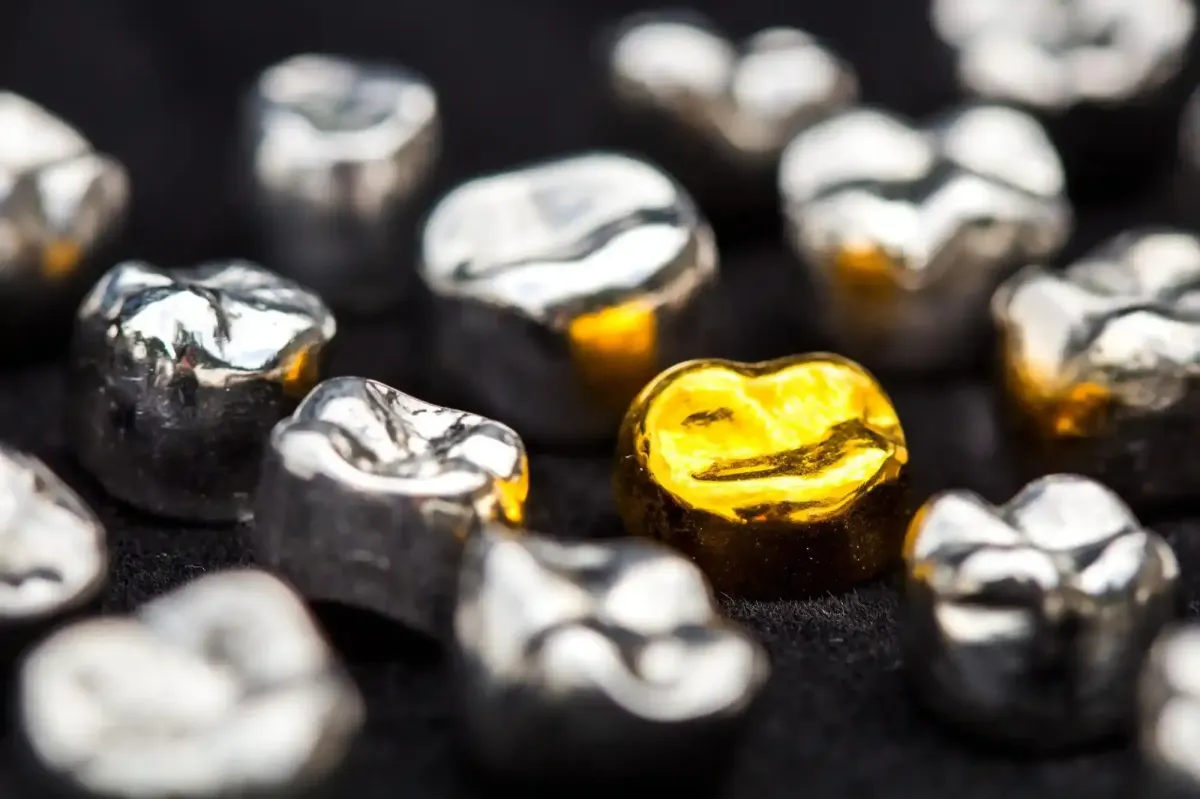
How Much Is a Gold Tooth Worth? Value, Price, and Where to Sell It
A gold tooth can have real value.
But there is no single fixed price for every gold tooth.
In most cases, a “gold tooth” is a dental crown, cap, or restoration made from a metal alloy. That alloy may contain gold, but it may also contain silver, platinum, palladium, or non-precious metals.
That is why one gold tooth can be worth much more than another, even if they look similar. A precise value usually depends on weight, composition, and assay, not appearance alone.
For Bay Area Metals, this topic matters because the company buys crowns, bridges, fillings, and PFMs through a dental-scrap refining service in South San Francisco, California.
Table of contents:
What is a gold tooth?
A gold tooth is usually a dental crown or cap placed over a tooth.
A dental crown is a tooth-shaped cap used to restore a decayed, broken, weak, or worn-down tooth. Crowns can be made from different materials, including metal alloys. In everyday search language, people often call a gold dental crown a “gold tooth.”
A gold tooth may be:
a full metal crown
a gold-colored dental cap
part of a bridge
a porcelain-fused-to-metal restoration with a metal substructure
That distinction matters because value depends on what the piece actually contains.
Is a gold tooth real gold?
Sometimes yes. Sometimes no.
A gold tooth can contain real gold. But it is not automatically pure gold, and it may not even contain much gold at all. Garfield notes that some metal crowns are made entirely of base metals and contain no gold or precious metal.
That means:
a gold-looking tooth can contain real gold
a gold-looking tooth can contain only a small amount of gold
a gold-looking tooth can sometimes contain no gold at all
Quick answer table
What may a dental gold tooth be made of?
A dental gold tooth is usually a dental alloy.
That alloy may contain:
gold
silver
platinum
palladium
copper
nickel
chromium
other metals used for strength and durability
The ADA explains that dental gold restorations are commonly alloyed with other metals because pure gold is too soft for many clinical uses. MGS and Garfield both note that dental crowns can vary widely in metal composition.
Why composition matters
Composition affects:
purity
melt value
scrap price
final payout
whether a refiner or buyer sees the piece as high-value dental scrap or lower-value mixed material
What affects gold tooth value?
Gold tooth value usually comes down to a few core variables: the alloy inside the piece, the amount of recoverable precious metal, the total weight, whether any porcelain or other non-metal material is attached, and how the item is tested before an offer is made.
In practice, the biggest difference usually comes from composition, not appearance. MGS and Garfield both make the same basic point: dental scrap has to be evaluated by what is actually in the alloy, and some gold-looking pieces may contain little precious metal or none at all.
Why two gold teeth can have very different values
Two gold teeth can look almost the same and still produce very different payouts. One may be a higher noble alloy. Another may contain more base metal. One may be a full metal crown, while another may be a mixed restoration with less recoverable precious metal.
That is why visual inspection is not enough. Garfield specifically notes that dental scrap can range from high noble to non-noble, and some metal crowns contain no gold or precious metal at all.
What does scrap value mean here?
For a gold tooth, scrap value means the value of the recoverable precious metals inside the piece after proper evaluation.
It does not mean what the dentist originally charged, what a replacement crown costs today, or what the item looks like it should be worth. In this context, value is usually tied to assay, metal content, weight, and market conditions at the time of evaluation. That is why scrap value and resale value are not the same thing.
Gold tooth value factors table
Who buys gold teeth?
Possible buyer types include:
local buyers
pawn shops
jewelers
cash-for-gold buyers
dental scrap buyers
precious metals refiners
But they do not all use the same valuation logic.
MGS states that precious metal refineries buy and recycle dental gold and other filler metals such as silver, platinum, and palladium. APMEX also notes that pawn shops and local jewelers can be convenient, but crowns and bridges are difficult to evaluate accurately without specialized testing, especially when porcelain is attached or the alloy is unknown.
What usually pays based on refinery logic?
A refinery is the strongest fit when the item is dental scrap and the goal is to value the metal content accurately.
That is why the direct-refinery route matters more here than a casual walk-in quote.
If your item is a crown, cap, bridge section, or similar dental restoration, Bay Area Metals gives you a way to sell dental gold scrap direct to the refinery. That page specifically covers crowns, bridges, fillings, and PFMs.
Seller options comparison table
What to do before selling
Before you sell a gold tooth, slow down and check the basics.
Use this process:
identify whether the item is a crown, cap, bridge part, or another dental piece
keep the item intact if you are not sure what is attached
do not assume color tells you purity
ask how the buyer evaluates dental scrap
ask whether the piece will be assayed
compare buyer type before accepting an offer
Consider these limitations
a gold-looking tooth is not always high-gold material
a heavier piece is not always a higher-payout piece
original dental cost does not equal scrap value
porcelain and mixed construction can reduce recoverable precious metal ratio
For the broader parent topic, use What Is Dental Gold? What It’s Made Of, How Much It’s Worth, and Who Buys It once that page is published.
If you want the practical selling process, read How to Sell Dental Gold Near You.
Selling a gold tooth in South San Francisco
Local context matters here because dental scrap is a specialist category.
Bay Area Metals lists its location at 154 South Spruce Ave, South San Francisco, CA 94080 and positions itself as a precious metals refinery and buyer. Its dental page says it handles crowns, bridges, fillings, and PFMs through a direct-refinery process.
That makes South San Francisco relevant for:
people who legally kept an extracted crown or cap
dental offices
dental labs
sellers who want refinery-based evaluation instead of a rough guess
CTA
A gold tooth may have value.
But the right value depends on:
alloy composition
purity
weight
assay
buyer type
If the piece is dental scrap, the most practical next step is not guessing from color or appearance. It is using a buyer that understands dental alloys and refinery logic.
Bay Area Metals in South San Francisco offers a direct-refinery route for crowns, bridges, fillings, and PFMs. If you want the strongest next step, use this page to sell dental gold scrap direct to the refinery.