
How to Sell Gold in the Bay Area: A 2026 Guide for Public Sellers
By Issac Makdessian, Owner and Head Refiner at Bay Area Metals. Operating the family-owned South San Francisco refinery since 2012. Specialist in gold, silver, platinum, and palladium refining for public sellers and B2B industry clients across the Bay Area.
Key Takeaways
In the Bay Area you can sell gold to three kinds of buyer: a refinery (we are one), a pawn shop, or a cash-for-gold storefront. Refineries pay the highest percentage of spot because there is no middleman between you and the smelter.
Your payout is calculated from the day's LBMA spot price, the gold's karat (purity), the weight in grams, and a small deduction for assay and refining loss. Bay Area Metals publishes a payout range of up to 99% of spot for gold and up to 90% for silver, platinum, and palladium.
You can sell jewelry, coins, bars, dental gold, and scrap. Numismatic coins are a separate conversation: melt value is not always the highest value.
Most walk-in transactions at our South San Francisco refinery take 20 to 45 minutes. You are welcome to watch every step, including the weighing and the assay. Appointments are recommended.
Tax reality for sellers: the IRS treats physical gold as a collectible. Long-term federal gains are capped at 28%, short-term at your ordinary federal rate. California has no preferential long-term rate — all gains are taxed at ordinary state income rates (up to 13.3%). Inherited gold uses a stepped-up basis, which often shrinks the taxable gain to zero. Consult a CPA for your situation.
Selling gold in the Bay Area means choosing between three kinds of buyer
The fastest way to know whether you are getting a fair price is to understand who you are selling to.
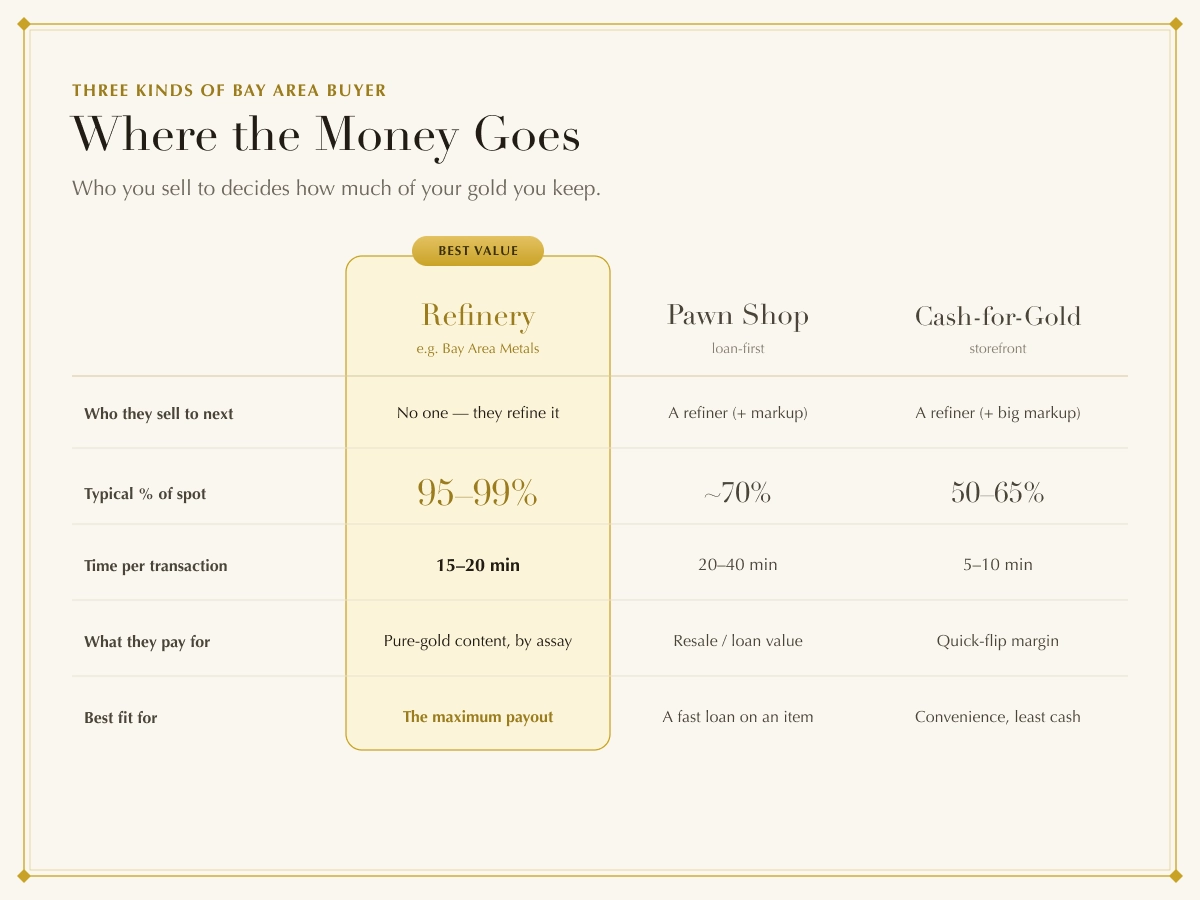
A refinery is the end of the line. We melt the gold, run the assay, and turn the metal into investment-grade bars or casting grain for the next buyer. Because there is no middleman between you and the smelter, refineries can pay the highest percentage of the daily spot price.
A pawn shop is a generalist. It buys the gold from you, holds it, then sells it onward to a refinery (often to one of us). The pawn shop's margin sits between your payout and the refinery's price. Pawn shops have a place in the market, but they are not designed to maximize the seller's payout.
A cash-for-gold storefront or kiosk runs a similar model to the pawn shop, sometimes with even thinner inventory and faster volume. The walk-in is fast, the offer is on the spot, and the price reflects a layered margin.
"I'm a jeweler/goldsmith and have dealt with many refiners. Bay Area Metals are the most upfront and honest with the highest payout. I just moved here from NYC and am really happy I can take my scraps here." — Jennifer N., Brooklyn, NY · customer testimonial, bayareametals.com
A jeweler is the cleanest signal in this market. The people who buy and resell gold for a living choose where to sell their own scrap, and they choose the refinery.
How is the price for your gold calculated?
The number a refinery puts on the counter is not a guess. It is a calculation, and you can do most of it yourself before you walk in.
The four inputs are:
The day's spot price. Spot is the global wholesale benchmark for gold, set twice daily by the London Bullion Market Association (LBMA) at 10:30 and 15:00 GMT through an ICE Benchmark Administration auction overseen by the Bank of England. Every retail tracker (Kitco, APMEX, JM Bullion, etc.) prices off the LBMA benchmark.
Your gold's karat. Karat measures gold purity in parts of 24. 24k is 99.9% gold (the global investment-bullion benchmark, per the World Gold Council). 18k is 75.0%. 14k is 58.3%. 10k is 41.7%. Most Bay Area sellers walking in with jewelry are sitting on 14k or 10k pieces.
The weight in grams. A precise scale, calibrated regularly, gives you the gram weight. Be present when this happens. The industry converts grams to troy ounces using the constant 31.1035 g per troy ounce. (A troy ounce is heavier than the everyday avoirdupois ounce from the grocery store; precious metals exclusively use troy.)
Deductions. A small percentage is held back to cover the assay (the test that proves the karat is what's stamped) and refining loss (a fraction of gold is consumed during the smelt).
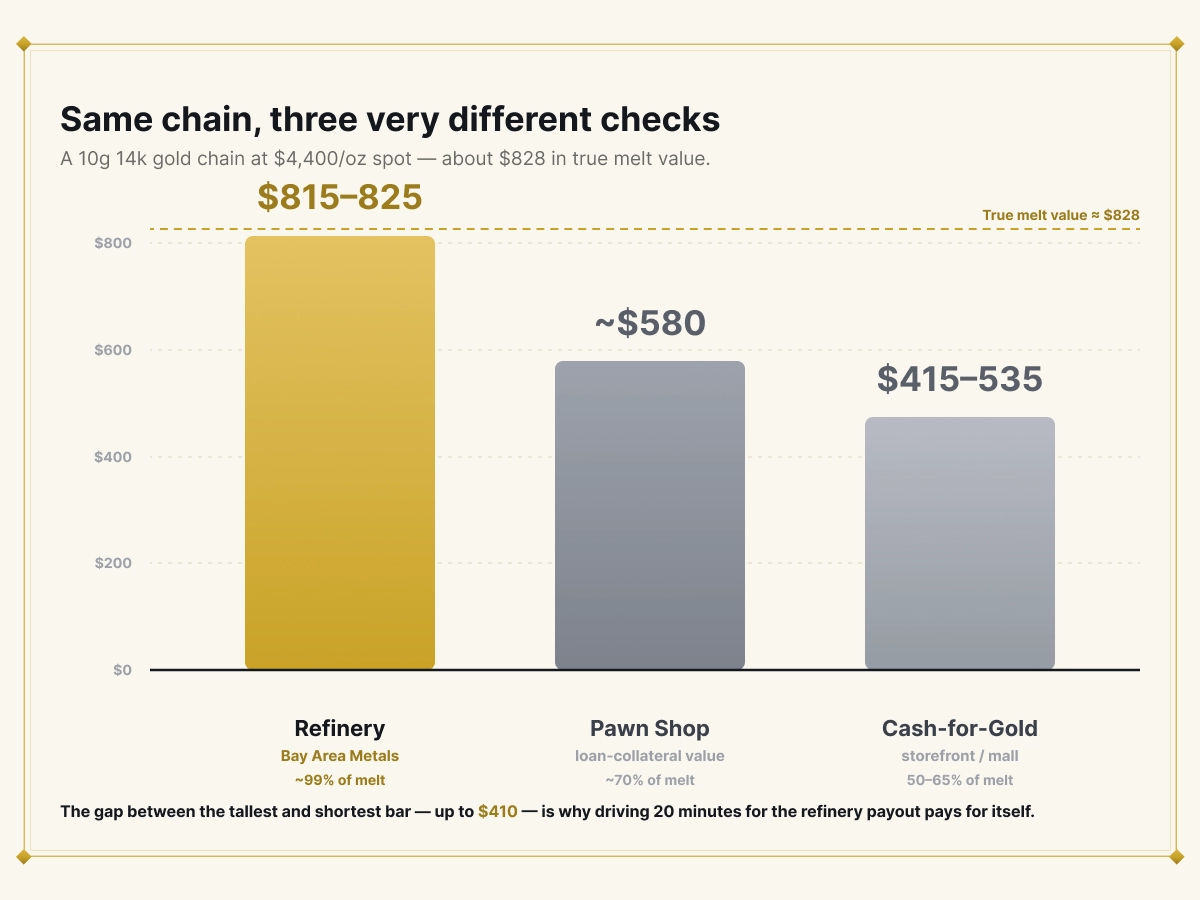
For a worked example, suppose you bring in a 10-gram 14k chain on a day when spot gold is $4,400 per troy ounce (within the May 2026 trading range; verify the live LBMA price before applying this math to your own sale).
Pure gold content: 10 g × 0.583 (14k) = 5.83 g of pure gold.
Convert to troy ounces: 5.83 ÷ 31.1035 = 0.1875 troy ounces.
Gross value at spot: 0.1875 × $4,400 = $825.00.
At a refinery payout in the published range of "up to 99% of spot" on gold, net lands close to $815–$825, minus a small deduction.
A pawn shop offer on the same chain commonly lands in the $580 range (around 70% of spot), because the pawn shop sells your chain to a refinery and keeps a margin.
A cash-for-gold storefront commonly lands lower still, around $415–$535 (50–65% of spot).
That delta — roughly $200 to $400 on a single small chain at current 2026 prices — is the entire argument for driving to a refinery. The math is the whole game. If a buyer cannot show you the math, that is your answer about whether to sell to them.
How much will you actually get for your gold?
Bay Area Metals publishes a payout range of up to 99% of the daily LBMA spot price for gold, and up to 90% for silver, platinum, and palladium.
Gold pays at a higher percentage than the other metals because refining gold loses less metal than refining silver or platinum, and the secondary market for refined gold is the deepest of any precious metal.
A few specific things shape the percentage you actually land in any given week:
The form of the gold. Pure investment-grade bars (Metalor, PAMP, etc.) move at near-spot because no assay is needed. Jewelry requires the assay first, so a small deduction is taken. Scrap with mixed solder or non-gold attachments pays for the gold content only, after the contaminants are accounted for.
The volume. Larger lots pay closer to the top of the range because the per-transaction overhead is spread across more metal.
The market. When spot gold is moving fast — and the May 2026 market has been volatile, with gold off its January 2026 record of $5,602 — refineries quote with a small buffer to protect against intraday swings. Stable markets allow tighter quotes.
"I have been here several times and it's always a quick and fair experience. I have been bringing gold and precious metals to different folks for decades and dealing with the owner here has been a good experience." — Emily T., Berkeley, CA · customer testimonial, bayareametals.com
A seller with decades of refinery experience who keeps coming back is the trip-after-trip math checking out.
What can you sell to a Bay Area refinery?
Most public sellers come in with one of five things:
Gold jewelry. Chains, rings, earrings, broken pieces, single-side earrings whose pair is lost. We assay, weigh, and quote. Solder and clasps are accounted for in the deduction.
Gold coins. American Gold Eagles (22k), Krugerrands, Sovereigns, Maple Leafs. Most modern bullion coins pay close to spot. One important note: rare or numismatic coins sometimes carry collector value that exceeds melt value. If you suspect that, bring it in and we will tell you the truth, then refer you to a coin dealer if the numismatic value is higher than the melt value. We do not melt a coin worth more whole than smelted.
Gold bars. Investment-grade Metalor bars (we sell these too) and other recognized brands move at near-spot.
Dental gold. Crowns, bridges, PFMs (porcelain-fused-to-metal). Dental gold is typically a 10k to 22k alloy mixed with palladium or silver. The alloy mix matters because pure 24k gold is too soft for dental work, which is why dentists historically chose mid-karat alloys. We handle this in volume on the dental page.
Scrap gold. Bench sweeps, polishings, gold-plated pieces with real gold content, broken solder joints. We can refine a wide range of scrap; not all gold-toned items contain real gold, and the assay tells the truth.
What we don't buy: stolen merchandise, items without proof of ownership when one is reasonably expected, costume jewelry with no gold content (gold-plated brass, gold-filled pieces with negligible gold weight), and any item where the legal provenance is unclear.
What California law requires when you sell
Under California Business and Professions Code §21628 — part of the state's secondhand-dealer chapter (BPC §21500 et seq.) — any dealer buying used jewelry, scrap, or other "tangible personal property" from a member of the public must:
Verify the seller's identity using a currently valid (or issued within the last five years) government-issued photo ID with a serial number.
Record a certification of ownership from the seller.
Take a legible fingerprint of the seller.
Report the transaction to the California Department of Justice through CAPSS (the California Pawn & Secondhand Dealer System).
Retain the records for three years.
This is universal across every legitimate buyer in California, including BAM. If a buyer doesn't ask for ID and doesn't appear to be reporting, that's a regulatory red flag and a reason to walk out with your gold.
Exception worth knowing: coins, monetized bullion, and commercial-grade ingots are explicitly excluded from the secondhand-dealer chapter. Selling a US Mint American Gold Eagle or a Metalor 1kg bar is governed by separate coin-dealer rules, not the same ID/fingerprint regime. The practical experience is similar (we still verify ID for our own records), but the legal basis differs.
What to bring with you when you come to sell
Five minutes of prep saves you the trip back. Bring:
The gold itself, separated by type if possible (rings together, chains together, scrap separately). Mixing slows the assay.
A government-issued ID. See the California law section above — this is required, not optional.
Any documentation you have on coins, especially anything that looks rare or older than 1933.
A phone with a calculator if you want to verify the math on the spot.
You don't need to remove cement, enamel, or other non-gold materials from your pieces. Pull the gemstones you want to keep, and we handle the rest.
Appointments are recommended, especially for larger lots or specific assay requests. Walk-ins are accepted during posted hours. Text or call (650) 675-5009 to confirm a slot.
What actually happens during the transaction
In our South San Francisco refinery, a typical public-seller transaction takes 20 to 45 minutes. The process:
You arrive at 154 South Spruce Ave, South San Francisco CA 94080, ideally with an appointment, with walk-ins accepted during posted hours.
We log your ID and the items, with the certification and fingerprint required by §21628. A photo of the items is taken alongside the ID.
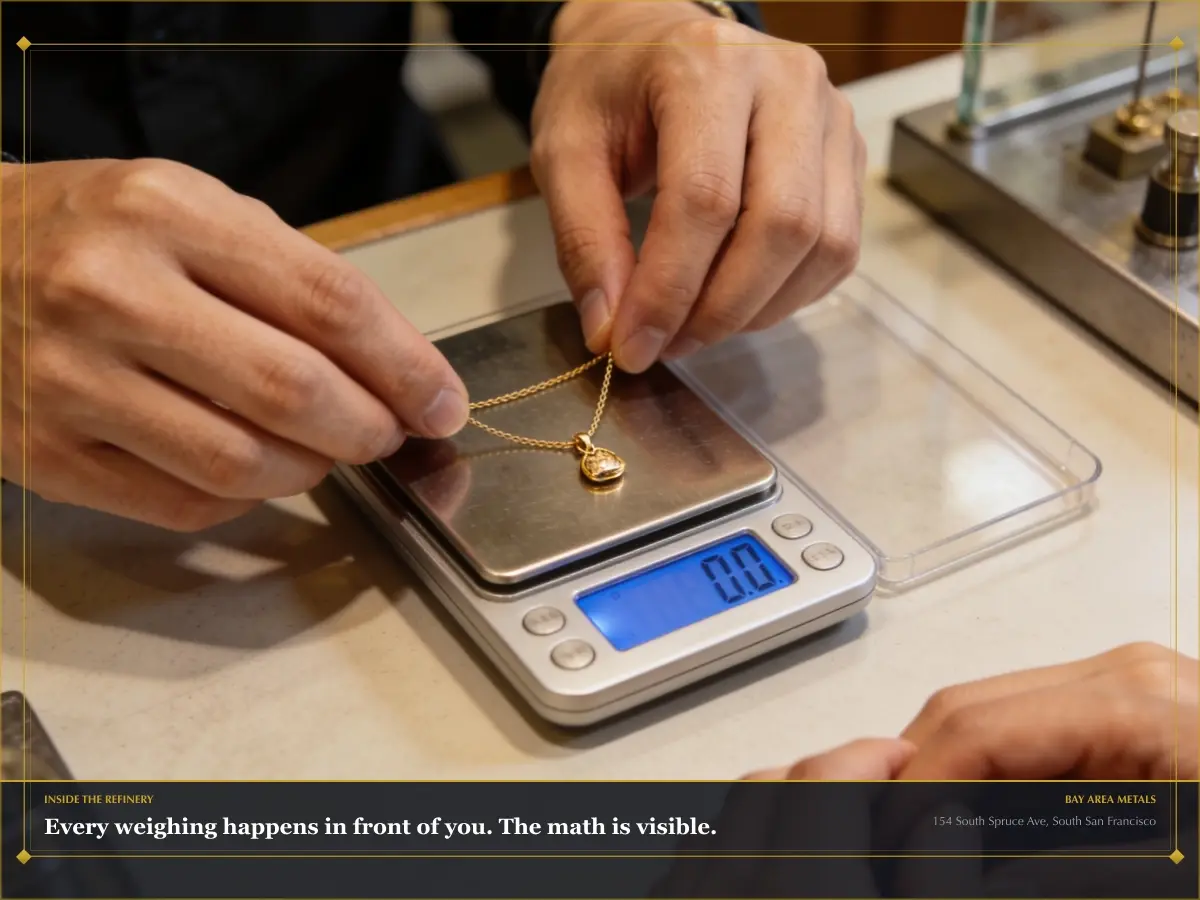
We weigh the items in front of you on a calibrated scale. You see the gram reading.
We test the karat. For jewelry, a quick acid-test or X-ray fluorescence (XRF) gun gives the karat read in a few minutes. For higher-volume or higher-stakes lots, a fire assay is run — the traditional gold-standard test by cupellation, and you are welcome to watch it.
We show you the math. Spot × purity × weight − deduction = payout. The number is on the counter before you decide.
You decide. If you accept, you walk out with cash, casting grain, gold bars, or wire — whichever payment form you prefer. Same-day or next-day, depending on the lot size and method.
"All the jewelers come here to sell their gold for melting purposes. This place offers you the best prices! Issac the owner is friendly and professional. The whole transaction is painless and fast!" — Debbie G., Millbrae, CA · customer testimonial, bayareametals.com
You are not obligated to sell after the quote. If the number is lower than you expected, walk out with the gold and the math, then compare. Most sellers don't bother, because the math itself is the comparison.
Selling in San Francisco, Oakland, or San Jose: city-specific notes
The single Bay Area Metals refinery is in South San Francisco. Sellers come from across the Bay, but the logistics shift slightly by where you start.
From San Francisco proper: 154 South Spruce Ave, South San Francisco CA 94080 is a 15- to 25-minute drive depending on traffic, just off 101 and 380. Parking is on-site. Most SF sellers compare us against a small number of dedicated SF gold buyers and a larger number of pawn shops. The refinery-vs-pawn-shop math is the same anywhere; the difference is whether you would rather drive 20 minutes for the refinery payout or walk three blocks for the pawn-shop offer.
From Oakland: Across the Bay Bridge, the drive is 30 to 45 minutes depending on the hour. For Oakland sellers, the refinery-direct payout has to clear the cost of the trip and the bridge toll. For anything more than a single small piece of jewelry, the math almost always works — the $200+ delta on the worked example above clears a bridge toll several times over.
From San Jose: South Bay sellers face the longest drive, roughly 45 to 60 minutes depending on traffic. We see San Jose sellers mostly on larger lots — estate jewelry, coin collections, dental gold from a parent's estate, jeweler bench sweeps — where the payout difference covers the time many times over.
Common mistakes Bay Area sellers make
Five things we see often enough to call out:
Mistake 1: Selling without knowing the day's spot price. Spot moves daily and sometimes hourly. Look it up before you walk in — pull the live LBMA Gold Price or any major financial site. Then ask the buyer to show you their math against that number.
Mistake 2: Treating all "gold buyers" as the same. They aren't. A refinery, a pawn shop, and a cash-for-gold storefront have different cost structures and different margins. Knowing which one you're walking into is half the deal.
Mistake 3: Melting a coin worth more whole. Numismatic value can be a multiple of melt value. If a coin looks old, looks rare, or carries a story, get a numismatic opinion first. Especially anything pre-1933 (when the US went off the gold standard for circulating coinage).
Mistake 4: Bringing one piece at a time over multiple visits. The per-transaction overhead works against you. Bring everything you plan to sell in one trip.
Mistake 5: Accepting a quote without seeing the math. If the buyer hands you a number with no breakdown, that is a complete answer to whether to sell to that buyer.
What does selling gold actually cost you in taxes?
This is where the answer most public sellers expect is wrong, and the correction is worth knowing before you sell.
The IRS classifies physical gold — bullion, coins, and jewelry — as a collectible under IRC §408(m). Collectibles do not get the favorable long-term capital gains rates that apply to stocks, ETFs, and most other appreciable assets.
Federal treatment:
Held more than one year: long-term gains on collectibles are taxed at your ordinary federal income rate up to a maximum of 28%, not the 0%/15%/20% that applies to standard LTCG.
Held one year or less: short-term gains are taxed at your ordinary federal rate (up to 37%).
Inherited gold: uses a stepped-up basis under IRC §1014 — the basis resets to the fair market value as of the prior owner's date of death. In practice, this often reduces the taxable gain to a small amount or to zero if you sell shortly after inheritance.
California state treatment: California taxes capital gains as ordinary income, with brackets from 1% to 13.3% depending on total taxable income. California does not offer a preferential long-term rate — holding period doesn't change the state rate. See the California Franchise Tax Board for current brackets.
What this looks like for a typical Bay Area seller: A 10-gram 14k chain that pays out around $815 at current spot, and that you originally paid (say) $300 for fifteen years ago, generates roughly $515 of long-term capital gain. The federal tax at the collectibles rate is up to 28% (so up to ~$144 federal), and the California tax at ordinary income rates adds up to 13.3% (so up to ~$68 California), for a worst-case combined ~$212 in taxes on a $515 gain.
The buyer (us or any other) does not withhold tax at the point of sale. The seller keeps their own records and reports the gain on Schedule D of their federal return. For larger bullion lots, the buyer may issue a Form 1099-B; for typical jewelry sales by individual public sellers, no 1099 is issued.
This is general information, not tax advice. Every situation is different. For larger lots, inherited estates, or anything complex, consult a CPA.
Glossary (quick reference)
Spot price — The live wholesale price per troy ounce of gold, set twice daily by the LBMA in London.
Karat — Gold purity measured in parts of 24. 24k = 99.9% gold; 14k = 58.3% gold.
Fineness — Gold purity measured in parts per thousand. 24k = 999 fineness; 14k = 583 fineness. Same standard, different notation.
Troy ounce — The weight unit for precious metals. 1 troy ounce = 31.1035 grams. Heavier than the avoirdupois (grocery-store) ounce.
Fire assay — The traditional gold-content test by cupellation. Most accurate method; takes 45+ minutes.
XRF — X-ray fluorescence. A fast, non-destructive karat read using a handheld unit. Reads the surface only.
Lemel — The fine dust and shavings collected at a jeweler's bench, gathered for refining.
Bench sweeps — The floor sweepings under a jeweler's bench, often containing recoverable gold.
PFM — Porcelain-fused-to-metal. Dental crowns with porcelain bonded over a gold-alloy base.
Casting grain — Small gold pellets used for melting and casting into jewelry or industrial pieces.
CAPSS — California Pawn & Secondhand Dealer System. The state reporting system dealers use under BPC §21628.
FAQ
Ready to sell? Start your refinery sale
Start your refinery sale on the dedicated process page — that is where the sale itself happens, with the form, the address, and the next-step instructions.
If you want to talk first, text (650) 675-5009 or come by 154 South Spruce Ave, South San Francisco CA 94080. Bring your gold, your ID, and any questions. You will see every weighing, every assay, and every number that goes into the payout. If the math looks fair, you sell. If it doesn't, you walk out with the gold and the quote.
About the author
Issac Makdessian is the owner and head refiner at Bay Area Metals, the family-owned precious-metals refinery at 154 South Spruce Ave, South San Francisco CA 94080. The business has operated in the Bay Area since 2012, refining gold, silver, platinum, and palladium for public sellers and B2B clients across the region's jewelry, dental, pawnshop, electronics, and solar industries.
"Our commitment to transparency, speed, and fair payouts has been the foundation of our success, and we look forward to continuing to serve the Bay Area community for many more years to come." — Issac, Owner of Bay Area Metals, in a 2024 press release.
Bay Area Metals carries an A+ rating with the Better Business Bureau and a 5.0 Yelp rating from over 60 published customer reviews.