

Where to Sell Gold in San Francisco: 5 Things to Check First
By Issac Makdessian, Owner and Head Refiner at Bay Area Metals. Operating the family-owned South San Francisco refinery since 2012. Specialist in gold, silver, platinum, and palladium refining for public sellers and B2B industry clients across the Bay Area.
Key Takeaways
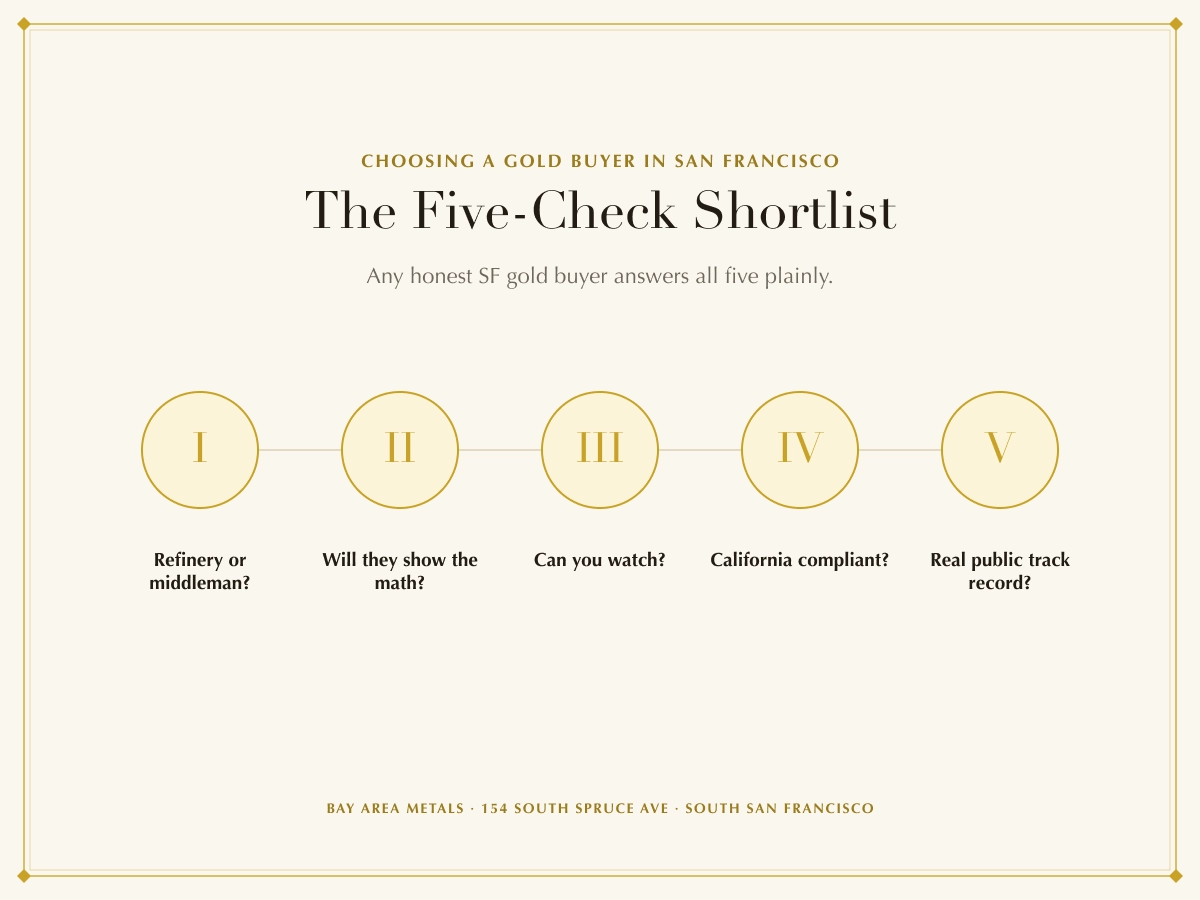
The right place to sell gold in San Francisco is whichever buyer passes five basic checks: clear buyer-type, transparent math, visible weighing and assay, California-compliant paperwork, and a verifiable public track record.
The math is universal. Spot × karat × weight − a small deduction = your payout. Today's gold spot is published by the LBMA; look it up before you walk into any buyer.
The biggest payout gap in San Francisco is refinery vs middleman. A pawn shop or cash-for-gold storefront resells your gold to a refinery and keeps a margin. Going direct to a refinery removes that margin.
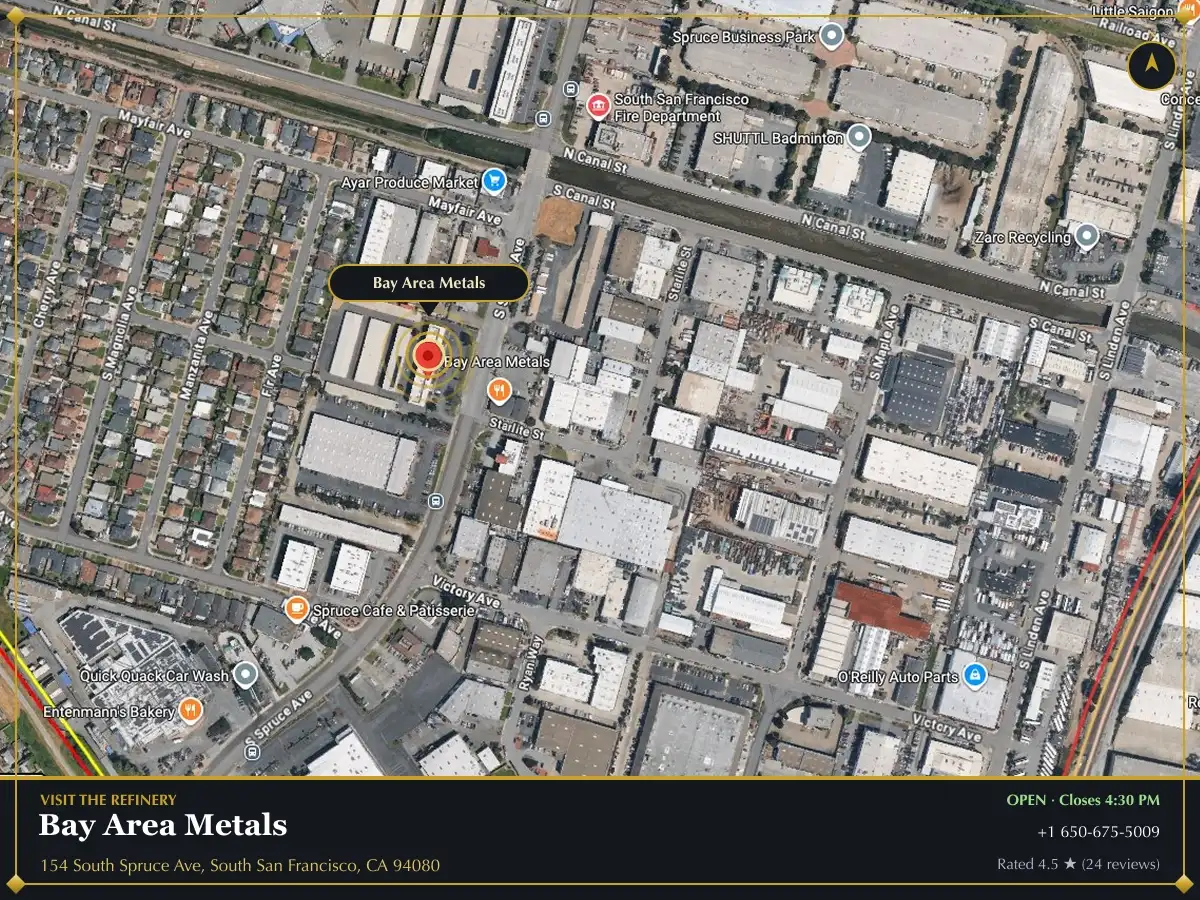
Bay Area Metals is the family-owned refinery at 154 South Spruce Ave, South San Francisco — about 15–25 minutes from downtown SF by car, or roughly 13 minutes' walk from the South San Francisco Caltrain station. Appointments are recommended; walk-ins are welcome.
For the deeper "how is gold actually priced and refined" walkthrough, see our full Bay Area selling guide.
Why this question is harder than it looks
If you live in San Francisco, you can sell gold without driving far. You will find pawn shops in almost every neighborhood, a small number of dedicated SF gold-and-jewelry buyers (places like Polyak Precious Metals on Polk Street or Bay Area Gold & Silver Buyers on Sutter Street), and a handful of refineries within a short drive — including ours in South San Francisco.
What that range hides is a wide spread in payout. On the same 10-gram 14k chain, a refinery commonly pays close to 99% of the day's spot price, a pawn shop pays in the 70% range, and a cash-for-gold storefront often lands between 50% and 65%. At today's gold prices, that gap is $200 to $400 on a single small chain — easily worth a 20-minute drive, especially if you have more than one piece.
So the question is not really "where in SF can I sell gold." It is "which SF-area buyer will pay me the most without surprises." Five simple checks separate the answer.
Check #1: Is the buyer the refinery, or someone reselling to one?
This single question explains most of the payout difference between any two SF buyers.
A refinery melts and assays the gold itself, then sells refined metal to manufacturers. There is no middleman between you and the smelter.
A pawn shop or cash-for-gold storefront buys your gold to resell — often to a refinery. The pawn shop's margin sits between your payout and the refinery's price.
Refineries can pay closer to the LBMA spot price because they cut out the resale layer. Pawn shops have a place in the market — they hold inventory, take on risk, and operate fast — but they are not designed to maximize the seller's payout.
If you ask a buyer "do you melt the gold here, or do you sell it to someone else who does," you will get an immediate read on which type you are walking into.
"I'm a jeweler/goldsmith and have dealt with many refiners. Bay Area Metals are the most upfront and honest with the highest payout. I just moved here from NYC and am really happy I can take my scraps here." — Jennifer N., Brooklyn, NY · customer testimonial, bayareametals.com
When a working jeweler — someone who buys and resells gold for a living — drives to a refinery to sell her own scrap, that tells you which side of the supply chain pays more.
Check #2: Will they show you the math?
The price of your gold is a calculation, not a guess. A buyer who can't show the math is a buyer hoping you won't notice.
Ask any SF gold buyer to walk you through the four inputs before they make an offer:
The day's spot price, set twice daily by the London Bullion Market Association. Pull it up on your phone. (Gold is trading in the $4,400 range as of late May 2026; check the live number before you walk in.)
The karat (purity). 14k = 58.3% gold. 10k = 41.7%. 24k = 99.9%.
The weight in grams, converted to troy ounces at 31.1035 g per troy ounce.
The deduction, which covers assay and refining loss.
For a worked example, a 10-gram 14k chain at $4,400 spot calculates to:
10 g × 0.583 (14k) = 5.83 g pure gold → 5.83 ÷ 31.1035 = 0.1875 troy oz → 0.1875 × $4,400 = $825 gross.
At a refinery payout of "up to 99% of spot," net is $815–$825. A pawn shop offer on the same chain commonly lands near $580. A cash-for-gold storefront often lands between $415 and $535.
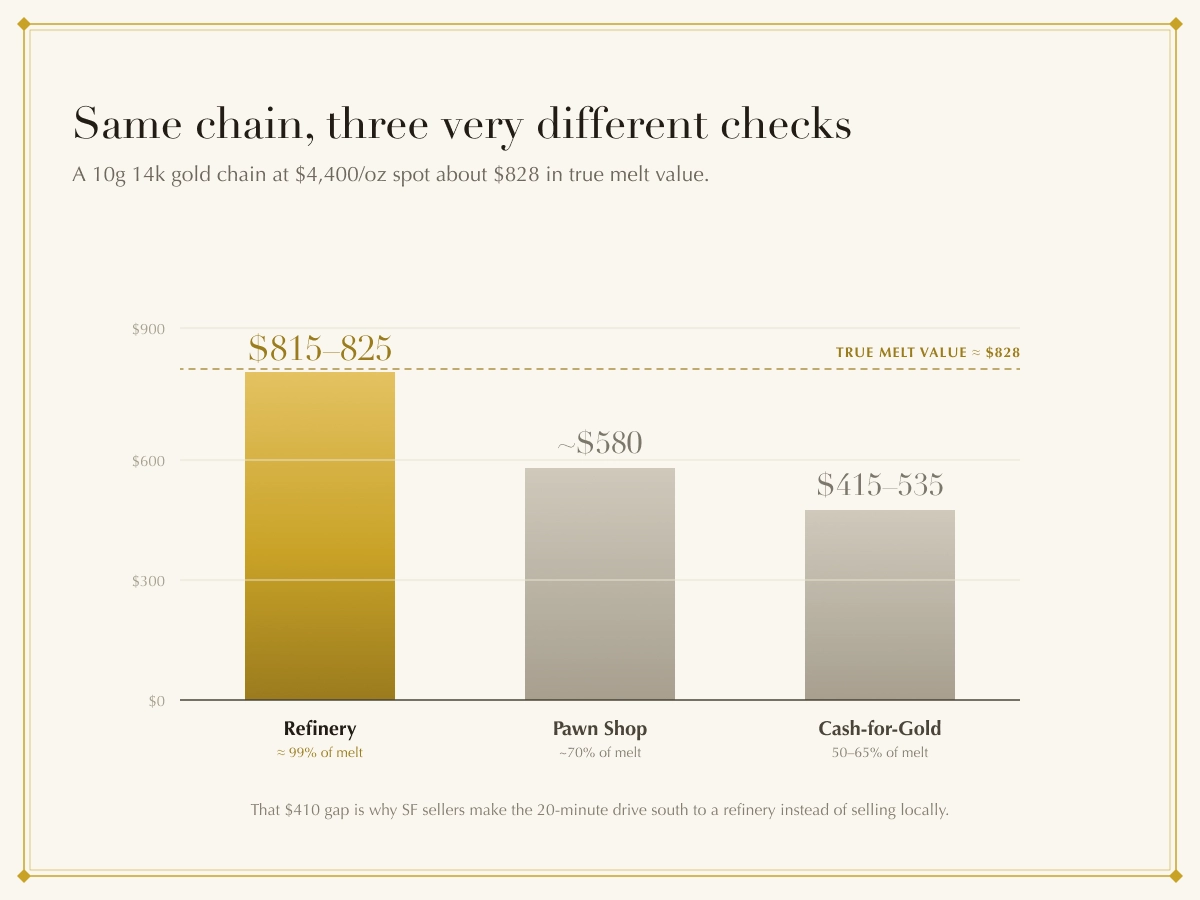
Any SF buyer who refuses to break down the math, or who quotes a single round number without showing how they got there, has answered your question for you. The deeper walkthrough of how this calculation works in practice is in our full Bay Area selling guide.
Check #3: Can you watch the weighing and the assay?
Transparency at the counter is the strongest single signal that a buyer is honest. Three checks to insist on:
Watch the scale. A precise digital scale, calibrated regularly, should be visible to you. You should see the gram reading.
Watch the karat test. For most jewelry, an XRF (X-ray fluorescence) gun gives a karat read in under a minute. For larger lots, a fire assay — the traditional cupellation test that still sets the industry standard for accuracy — takes about 45 minutes. Either way, you can stay and watch.
Watch the math get written. Spot price × purity × weight − deduction = the number on the counter. The breakdown should be visible to you.
If a buyer wants to take your gold "to the back" to weigh or test it, that is the moment to ask why. A refinery has nothing to hide; the whole process is built to be watchable.
"All the jewelers come here to sell their gold for melting purposes. This place offers you the best prices! Issac the owner is friendly and professional. The whole transaction is painless and fast!" — Debbie G., Millbrae, CA · customer testimonial, bayareametals.com
Millbrae is two miles down 101 from us. The Peninsula trade has been routing to BAM for years for exactly this reason.
Check #4: Are they following California law?
In California, buying used jewelry and scrap gold from the public is regulated under Business and Professions Code §21628 — part of the state's secondhand-dealer chapter (BPC §21500 et seq.). Any compliant SF gold buyer is required to:
Verify your government-issued photo ID.
Record a certification of ownership.
Take a fingerprint.
Report the transaction to the state through CAPSS — the California Pawn & Secondhand Dealer System.
Keep records for three years.
This is universal. It is also non-optional. If you walk into an SF gold buyer who does not ask for ID, does not fingerprint, and does not appear to be entering anything into a state system, that is a regulatory red flag — and a reason to take your gold back out the door.
Two notes:
Coins and bullion are explicitly excluded from this chapter. Selling a US Mint American Gold Eagle or a Metalor 1kg bar is governed by separate coin-dealer rules. The ID is still standard practice; the legal basis is just different.
San Francisco doesn't add a separate citywide precious-metals dealer ordinance on top of the state law. The state framework is what governs SF gold buyers.
Check #5: Do they have a verifiable public track record?
The last check is the simplest. Three signals to look up before you visit any SF gold buyer:
Better Business Bureau profile. Look for a rating, the years in business, and any unresolved complaints. (BAM holds an A+ rating with the BBB, with the file going back to 2013.)
Yelp and Google reviews. Read the negative ones, not just the positive ones. Patterns matter more than individual reviews. (BAM carries a 5.0 Yelp rating across 60+ reviews.)
A real address and a real phone number. A buyer with only a P.O. box, only a cell number, or only an online quote form is a buyer you cannot find later if something goes wrong.
For a deeper decision frame on choosing a refiner — including questions to ask before you hand over higher-value lots — see our forthcoming guide on how to choose a Bay Area gold refiner. (Spoke F4; activate this link when F4 publishes.)
Getting to Bay Area Metals from San Francisco
If you've worked the checklist and want to sell directly to a refinery, here are the practical details for our South San Francisco shop:
Address: 154 South Spruce Ave, South San Francisco, CA 94080
By car from downtown SF: 15–25 minutes via US-101 South or I-280 South, depending on traffic. On-site parking.
By transit: South San Francisco Caltrain station is about a 13-minute walk; San Bruno BART is about a 23-minute walk. From SoMa, a Caltrain trip plus the walk runs roughly 45 minutes door-to-door.
Hours: Appointments recommended for the quickest turnaround; walk-ins welcome during posted hours. Text or call (650) 675-5009 to confirm a slot before you leave.
What to bring: Government-issued photo ID with serial number, the gold (separated by type if possible), and any documentation on coins.
What you'll get: A live, in-person weighing and assay; the math on the counter; payment in cash, casting grain, or gold bars, typically same-day or next-day. For larger or specific assay requests, schedule an appointment in advance.
FAQ
Ready to sell? Start your refinery sale
Start your refinery sale on our dedicated process page — that is where the sale itself happens, with the address, ID requirements, and next steps.
If you want to talk first, text (650) 675-5009 or come by 154 South Spruce Ave, South San Francisco. Bring your gold, your ID, and any questions. You will see every weighing, every assay, and every number that goes into the payout.
About the author
Issac Makdessian is the owner and head refiner at Bay Area Metals, the family-owned precious-metals refinery at 154 South Spruce Ave, South San Francisco. The business has operated in the Bay Area since 2012, refining gold, silver, platinum, and palladium for public sellers and B2B clients across the region's jewelry, dental, pawnshop, electronics, and solar industries. Bay Area Metals carries an A+ rating with the Better Business Bureau and a 5.0 Yelp rating from over 60 published customer reviews.