
Buy Gold in San Francisco: Spot Price to Physical Bars
By Issac Makdessian, Owner and Head Refiner, Bay Area Metals. Fourteen years refining gold, silver, platinum and palladium at our South San Francisco facility.
Key Takeaways
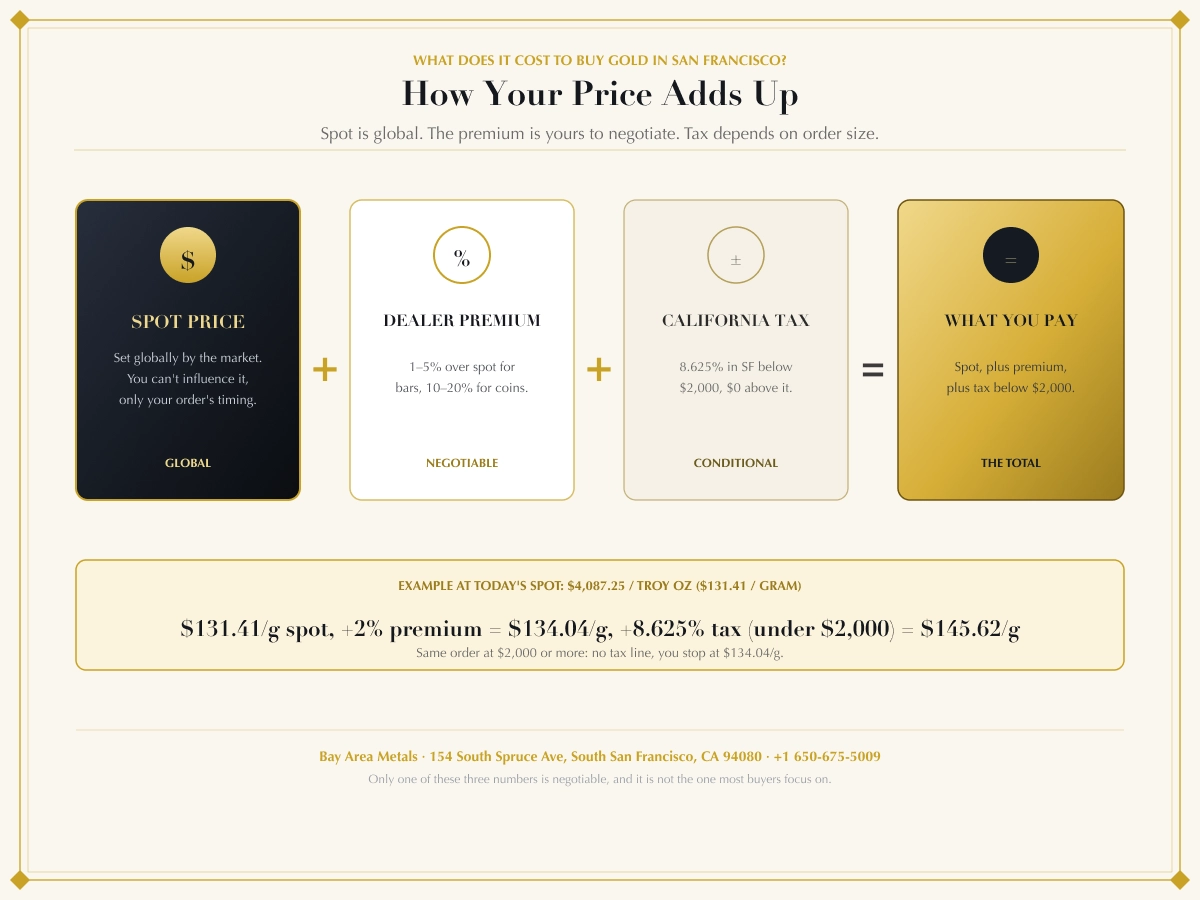
Buying gold in San Francisco involves three numbers, not one: the spot price, the dealer's premium, and California sales tax. Spot was $4,087.25 per troy ounce on July 29, 2026, per JM Bullion, which puts a 1 kilogram bar at $131,408.14 in metal value alone.
Premiums run roughly 1% to 5% over spot for gold bars and 10% to 20% for some coins, according to JM Bullion. Kilo bars sit near the bottom of that range, because one large bar is cheaper to produce than 32 small ones. GoldCore describes typical kilo-bar premiums of 1.4% to 2%, while its own live pricing on the same page runs closer to 2% to 2.5%.
California exempts bullion from sales tax only when a single transaction totals $2,000 or more, under CDTFA Regulation 1599(a)(3)(A). Below that line, San Francisco's 8.625% rate applies. A 10-gram bar can therefore cost about 10.7% more per gram than a half-ounce purchase.
Bay Area Metals sells Metalor 1 kilogram bars and casting grain direct from our South San Francisco refinery, with a minimum order of 1 kilogram and delivery within 7 days of payment. Below one kilo, a local coin shop or bullion dealer is the right call, and this article explains what to ask them.
Most articles about buying gold in San Francisco are written by people selling you the gold. I refine it. Bay Area Metals has operated at 154 South Spruce Avenue since 2012, melting, assaying, and casting precious metals. Many bars in Bay Area dealer cases started on our bench.
That vantage point comes with an obligation to be blunt about two things. The first is that the price you pay for gold is decided almost entirely before you walk into any shop, by numbers you can check yourself in about four minutes. The second is that Bay Area Metals cannot sell to most of the people who read this. Our minimum order is one kilogram.
So here is the whole picture: what gold actually costs here, where the money goes, and how to buy well at any size.
What does it actually cost to buy gold in San Francisco?
Three numbers decide it: the global spot price, the seller's premium over spot, and California sales tax. You cannot influence the first, you can shop the second, and you can often eliminate the third entirely by changing the size of your order.
On July 29, 2026, gold's spot price was $4,087.25 per troy ounce, according to JM Bullion's live gold chart. That works out to $131.41 per gram and $131,408.14 per kilogram. Every quote you receive in San Francisco starts from that figure, whether the seller is a Polk Street coin shop, an online dealer, or a refinery in South San Francisco.
What separates a good purchase from a bad one is what gets added on top. A buyer paying a 2% premium with no sales tax and a buyer paying a 5% premium plus 8.625% tax are holding identical metal at prices roughly 12% apart. Over a $50,000 position, that gap is about $6,000, which is real money for something that comes down to arithmetic.
Why the spot price is never the price you pay
You never pay spot. You pay the ask, plus the cost of turning a wholesale benchmark into a bar you can carry out of the building.
Spot is a reference price for one troy ounce of pure gold, not a retail price for a finished product. It is calculated off the front-month futures contract on the COMEX, per JM Bullion, which treats COMEX as the key exchange for spot, and it moves every few seconds while markets are open.
The bid-ask spread is the first gap between that number and your invoice. Spot is quoted as two prices: the bid, the highest price a buyer will pay, and the ask, the lowest price a seller will accept. When you buy, you pay the ask. When you sell, you receive the bid.
Manufacturing is the second gap. Someone has to refine the metal, cast it into a recognizable form, stamp it, insure it, and hand it to you. That work is what the premium covers.
The LBMA Gold Price is a different benchmark, and worth knowing by name because it turns up in contracts and news coverage. It is administered independently by ICE Benchmark Administration and set by auction. When a seller mentions "the London fix," this is the number they mean. Most dealers quote off live spot instead, so you are unlikely to be charged against the auction price, but you should recognize the term when it appears.
How much premium should you expect over spot?
For gold bars, expect roughly 1% to 5% over spot. For coins, expect 10% to 20% on some pieces, per JM Bullion's guidance on physical gold costs. Kilo bars carry lower premiums than one-ounce and ten-ounce bars. GoldCore describes typical kilo-bar premiums of 1.4% to 2%, though its own live pricing on that same page runs closer to 2% to 2.5% depending on order size. Which is a useful reminder to price the specific bar on the specific day rather than trusting any published range, including this one.
The reason is manufacturing, not marketing. Producing one kilogram bar takes a single melt, a single cast, one set of stamps, one assay and one serial number. Producing the same 32.151 troy ounces as thirty-two separate one-ounce bars means doing all of that thirty-two times. I have run both jobs. The labor difference is not subtle, and it shows up in the premium.
Coins carry more because they add a government mint, a face value, a design, and in some cases collector demand that has nothing to do with metal content. That premium is not a rip-off. It buys divisibility and instant recognizability, which genuinely matter to some buyers. A coin is a different product from a bar, and worth choosing deliberately rather than by default.
Bars, coins, or casting grain?
Form should follow purpose. Bars hold value most efficiently per dollar, coins buy divisibility and easy recognition, and casting grain exists for people who intend to make something out of the metal rather than store it.
Bars are the cheapest route to a given number of ounces, for the manufacturing reasons above. The tradeoff is granularity: a kilo bar is one indivisible unit, so partial liquidation means selling the whole thing and rebuying.
Coins solve that. A stack of one-ounce coins can be sold in pieces as needed, and a common bullion coin is recognized by every dealer in the country without an assay. You pay for that flexibility in the premium. If you already own coins and are weighing whether to sell them, we wrote a separate walkthrough on selling gold coins in San Francisco that covers when melt value beats numismatic value.
Casting grain is the one most retail buyers have never heard of. It is refined gold in small pellets, alloyed to a specified karat, and it is what jewelers and dental labs actually feed into a casting machine. Bay Area Metals sells it alongside kilo bars, and for a jewelry manufacturer it is a working material rather than an investment. If you are buying gold to hold, buy bars. If you are buying gold to melt next week, grain saves you a step.
What "LBMA Good Delivery" means, and why the name on the bar matters
Good Delivery is the London Bullion Market Association's accreditation for refiners whose bars meet the standard required for trading on the global over-the-counter market. It attaches to the roughly 400-ounce bars used to settle London contracts, not to every product an accredited refiner makes, which means your 1 kilogram bar is not itself a Good Delivery bar.
That distinction trips people up constantly, so it is worth being precise about what the accreditation actually buys you: confidence in the refiner whose mark is on the metal. That confidence is the thing the next buyer prices. As of this writing, 66 gold refiners worldwide hold the accreditation, and a bar from any of them sells at a normal spread without anyone questioning what is inside it.
We sell Metalor bars specifically. Metalor is a full LBMA member, and Metalor Technologies SA, the Swiss arm, is one of seven refiners worldwide serving as an LBMA Good Delivery referee, the panel that technically assesses new applicants and runs anonymous monitoring of refiners already on the list. Per Metalor's own Good Delivery page, its refineries produce 400-ounce LBMA Good Delivery gold bars at five locations across Switzerland, the United States, Hong Kong, Singapore and China.
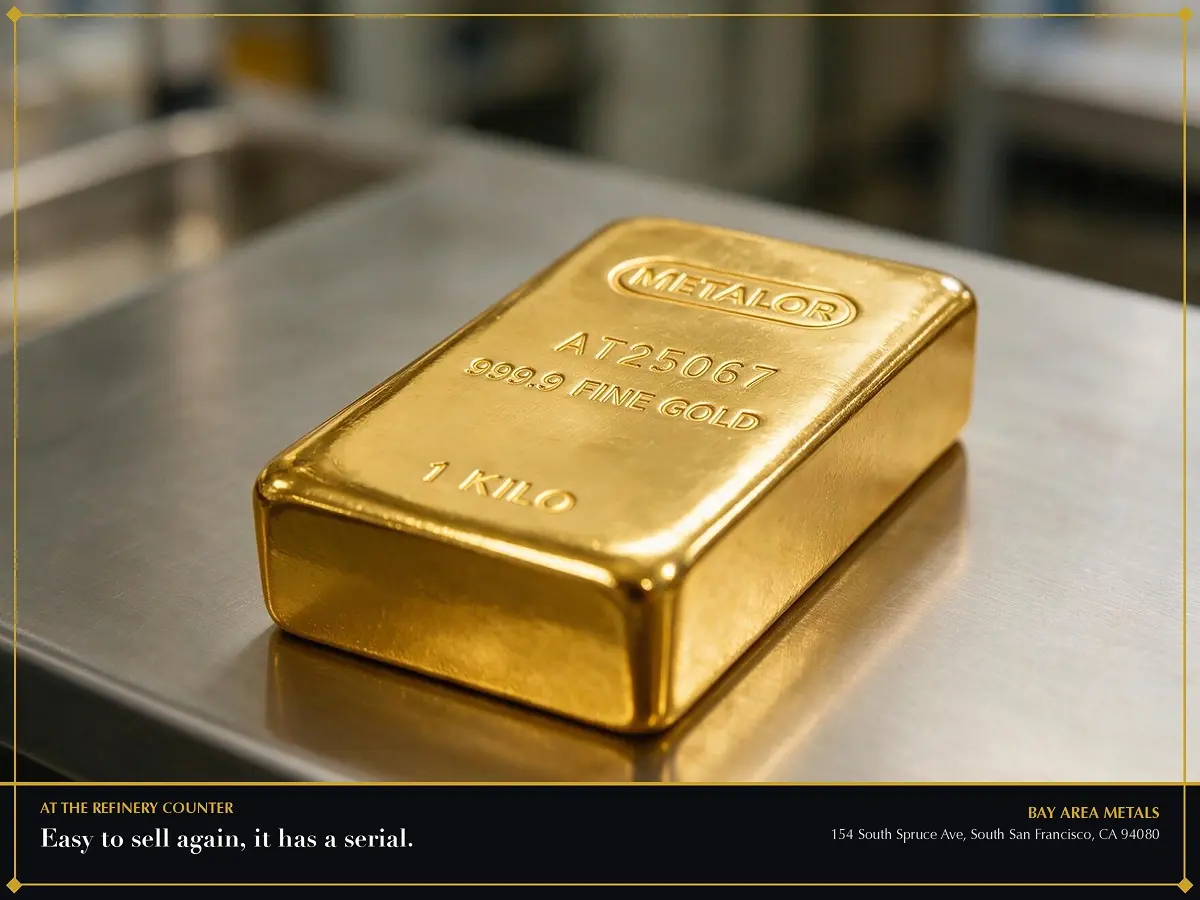
In practice, three marks on the face of the bar do the work:
The refiner's mark, which tells the next buyer who made it.
The stated weight and fineness, which tell them what is in it.
A unique serial number, which ties that one bar to the refiner's own records.
Together they let the next buyer accept your bar on sight instead of sending it out for an assay at your expense. An unbranded or unserialized bar is not necessarily fake. It is simply going to cost you time and money to sell, which is a strange thing to build into an asset you bought for liquidity.
This is also where a refinery differs from a reseller. On the sell side, the melt and the assay happen here, on equipment I operate, and you are welcome to stand in the room while it happens. On the buy side, what you get is a Metalor bar carrying the refiner's own mark and serial number, sold to you by people who handle refined metal every day rather than by a storefront that ordered it in.
"We've been in the gold buying business for over 30 years and have used several refiners in the past. Issac's transparency, honesty, and integrity are beyond compare." — Larry L., gold investor
Who can actually buy from a Bay Area refinery?
Bay Area Metals sells to buyers ordering at least one kilogram, which at the July 29, 2026 spot price is about $131,400 in metal before premium. We deliver within 7 days of payment, and our order form requests a business license number, so our buy-side customers are mostly jewelry stores, jewelry manufacturers and pawn shops, along with private investors operating at that scale.
If you are buying less than a kilo, we are not your seller, and no amount of good writing changes that. What we can do is tell you what to check, because we see the downstream consequences of bad purchases when people bring metal back to us to sell.
Four questions to ask any San Francisco coin shop, local bullion dealer or online dealer before you pay:
What is your premium over spot on this specific item, as a percentage? A seller who will not answer in percentage terms is hoping you will not do the division.
Who refined it, and does the bar carry a serial number and stated fineness? Check the refiner against the LBMA Good Delivery List. This costs you thirty seconds and protects your resale.
Does this invoice total $2,000 or more? If it lands just under, ask what it would cost to cross the line. In San Francisco that question is worth 8.625% of the purchase.
What is your buyback spread on this item today? The gap between what they will sell it to you for and what they will pay to take it back is the truest measure of what the purchase actually costs you.
If you already own gold and are looking to sell rather than buy, our guide to how to sell gold in the Bay Area covers payout math and California's seller reporting rules. Later in this series we go deeper on Metalor kilo bars against online dealers, on casting grain, and on the refinery-versus-dealer decision.
The honest summary
Buying gold well here is not about finding a secret source. Spot is fixed, the premium is the negotiable part, and California's $2,000 threshold can quietly cost or save you 8.625%. Get those three right and you will beat most buyers regardless of who sells to you.
The objection I hear most often about refinery minimums is that they feel like a wall built to keep ordinary people out. They are not. They are the same manufacturing arithmetic that makes kilo bars cheap in the first place.
"A true old-school refining company. A handshake still means something here. The whole process is transparent and fast. I've never been disappointed at Bay Area Metals." Gary O., jewelry manufacturer
Bay Area Metals carries an A+ rating with the Better Business Bureau and has operated from the same South San Francisco address since 2012.
Ready to buy at kilo scale? If you are looking to purchase 1 kilogram or more in Metalor bars or casting grain, request a quote on our Invest in Gold page or call the refinery at (650) 675-5009. Tell us the quantity and the form you need, and we will come back with a price against the live spot. Orders start at 1 kilogram, and we deliver within 7 days of payment.
Frequently Asked Questions
Author
Issac Makdessian is the owner and head refiner at Bay Area Metals, a family-owned precious metals refinery operating at 154 South Spruce Avenue in South San Francisco since 2012. He has spent fourteen years smelting, assaying and casting gold, silver, platinum and palladium for Bay Area jewelers, dental labs, pawnbrokers, solar and semiconductor manufacturers, and members of the public. Customers are welcome to watch their metal being processed.