
How Precious Metal Refining Works (And Your Payout)
By Issac Makdessian, Owner and Head Refiner at Bay Area Metals. Operating the family-owned South San Francisco refinery since 2012. Specialist in gold, silver, platinum, and palladium refining for public sellers and B2B industry clients across the Bay Area.
Key Takeaways
A gold refinery is the end of the supply chain: it melts, assays, and reprocesses metal into investment-grade bars or casting grain. Selling scrap directly to a refinery skips the broker margin that sits between a business and the smelter.
Bay Area Metals is a working refinery at 154 South Spruce Ave, South San Francisco CA 94080, operating since 2012. We publish a payout range of up to 99% of the daily LBMA spot price for gold and up to 90% for silver, platinum, and palladium.
Each trade brings a distinct scrap stream: jewelers (lemel, bench sweeps, polishings, casting scrap), dental labs (10k–22k crown and PFM alloys with palladium), pawnshops (mixed lots), electronics firms (IC chips, gold-plated CPU pins, RAM), and solar companies (silver-bearing panels).
Trade clients can stand at the furnace and watch their own lot smelt and assay on-site. That is the difference between a local refinery and a national mail-in service that processes your metal out of sight.
Payment comes as cash, wire, or exchange for investment-grade bars and casting grain. Recurring trade accounts are available for higher-volume shops, whether you drop off in person or ship insured.
What is a gold refinery, and why does it matter to a Bay Area business?
A gold refinery is the business at the end of the precious-metals chain. It takes raw or scrap metal, melts it down, tests its exact purity, and reprocesses it into refined bars, grain, or bullion that re-enters the market. Everyone else who buys gold, the pawnbroker, the cash-for-gold counter, the estate buyer, eventually sells to a refinery. That is the whole reason working with a gold refinery in the Bay Area pays a business more than selling to an intermediary: there is no one standing between your scrap and the smelter, so there is no extra margin to subtract.
For a shop that generates precious-metal scrap as a byproduct, the difference compounds fast. A jeweler's monthly bench sweep, a dental lab's box of old crowns, a pawnshop's accumulated scrap lot: each one loses value at every hand it passes through before it reaches a smelter. Selling directly removes those hands.
Bay Area Metals is a family-owned refinery that has operated in South San Francisco since 2012. We serve the trades that produce precious-metal scrap every day, and we run the smelt, the assay, and the payout under one roof. This guide walks through how refinery-direct pricing works, what each industry we serve actually brings us, and how a business opens a trade account.

Why choose a local refinery over a national mail-in service?
A local refinery lets you see the process; a mail-in refiner asks you to ship your metal and trust the number that comes back. For a business moving meaningful volume, that difference is the whole decision.
National refiners and mail-in works for some sellers. But it means your metal leaves your possession, travels insured across the country, and gets melted and assayed somewhere you cannot see. You get a settlement statement after the fact. If you disagree with the assay, the metal is already gone.
At a Bay Area refinery you can drive your lot over, watch it weighed on a calibrated scale, watch the assay run, and leave with payment the same day. For a South San Francisco shop, that is a 20-minute round trip instead of a multi-day shipping cycle. It also keeps a business relationship local: you know who is refining your metal, and you can call the person who did it. That accountability is the reason a lot of Bay Area jewelers and labs stopped mailing their scrap out of state.
How does refinery-direct pricing work for the trade?
Refinery-direct pricing is a calculation from four numbers: the day's spot price, the metal's purity, the weight, and a small deduction for the assay and refining loss. It is not a quote pulled from the air, and the inputs are the same for a business lot as for a single ring, which is why a refinery can show its work.
Spot is the global wholesale benchmark, set twice daily by the London Bullion Market Association (LBMA) through an auction overseen by the Bank of England. Every legitimate refiner prices off that same number. Purity is measured in karats for gold (24k is 99.9% pure, 14k is 58.3%) or in fineness for other metals. Weight is taken in grams on a calibrated scale and converted to troy ounces at 31.1035 grams per troy ounce. The deduction covers the fire assay and the fraction of metal consumed in the smelt.
Bay Area Metals publishes a payout range of up to 99% of spot for gold and up to 90% for silver, platinum, and palladium. Two things push a business lot toward the top of that range. The first is volume: larger, regular lots spread the per-transaction overhead across more metal, so the percentage climbs. The second is form: clean, sorted, single-karat scrap assays faster and pays higher than mixed lots with solder, stones, or base-metal attachments.
A worked example makes the margin concrete. Suppose a jeweler brings in a month of accumulated 14k bench scrap weighing 200 grams, on a day when spot gold is $4,400 per troy ounce (within the May 2026 trading range; verify the live LBMA price before applying this to a real lot). The pure gold content is 200 g × 0.583 = 116.6 g, or 3.75 troy ounces. At spot that is about $16,500 of gold. A refinery paying near the top of its published range settles that lot within a few percent of $16,500, minus the assay deduction. A broker who buys the same scrap at 70% of spot and resells it to a refinery pays the jeweler around $11,500 and keeps the rest. On one month's scrap, refinery-direct is worth roughly $4,000 to $5,000 more to that shop.

Refining for Bay Area jewelers: lemel, bench sweeps, and casting scrap
Every jewelry bench loses gold as a cost of doing business, and a refinery is how a shop recovers it. Cutting, filing, sanding, and polishing all shed metal. Over a month that adds up to a measurable weight of recoverable gold sitting in the sweeps and the scrap bin.
We accept the full range of jeweler byproducts: lemel (the fine filings and shavings from the bench), floor and bench sweeps, polishing dust, worn-out casting scrap, sprues, buttons, and old or broken inventory. You do not need to sort or pre-clean it beyond pulling the gemstones you want to keep. The assay determines the exact gold content, including what is recoverable from sweeps that look more like dust than metal.
For working jewelers, the payment options matter as much as the rate. A shop can take cash or a wire, or it can exchange refined scrap for investment-grade casting grain or bullion in the karat it needs, closing the loop between what goes out as scrap and what comes back as usable metal. That exchange is why a lot of Bay Area benches treat us as a supplier and a refiner at once.
"I'm a jeweler/goldsmith and have dealt with many refiners. Bay Area Metals are the most upfront and honest with the highest payout. I just moved here from NYC and am really happy I can take my scraps here." - Jennifer N., Brooklyn, NY · customer testimonial, bayareametals.com
When a working goldsmith who has used refiners on both coasts picks yours, that is the cleanest signal in the trade. The people who handle gold for a living know what a fair assay looks like.
Refining for Bay Area dental labs and dental offices
Dental scrap is more valuable than most offices assume, because dental alloys are engineered to be durable, not pure, and they carry palladium and platinum alongside the gold. That mix is exactly what a refinery is built to separate and pay for.
Dental gold typically runs from 10k to 22k, alloyed with palladium, platinum, silver, and base metals to give crowns and bridges the hardness that pure gold lacks. Under the American Dental Association's alloy classification, a "high-noble" alloy contains at least 60% noble metal by weight, of which at least 40% is gold; "noble" alloys are at least 25% noble metal, and "predominantly base" alloys fall below 25%. The practical takeaway for a lab: a crown that looks like a small amount of metal can assay well because of what is alloyed inside it.
We accept crowns, bridges, inlays, PFMs (porcelain-fused-to-metal), and lab casting scrap. There is no need to remove the porcelain; the assay accounts for it. Dental labs and offices handling recurring volume are served through our dedicated sell dental gold direct to the refinery process, which is built for the compliance and paperwork side that clinical practices need. For offices, the option to exchange scrap for casting grain also applies, which some labs use to stock alloy for new work.
Refining for pawnshops: bulk smelt versus individual assay
For a pawnshop, a refinery is where accumulated precious-metal inventory converts to its true melt value, and the choice is between a bulk smelt and an individual assay. Which one pays better depends on what is in the lot.
A pawnbroker sits one step above the refinery in the chain. You buy jewelry, coins, silverware, and scrap from the public, hold what you must, and eventually move the precious-metal inventory onward. Selling that inventory to us directly means you capture the refinery price instead of handing it to another middleman. As we tell every pawnshop client: pawnshops sell to refineries, so selling to the refinery removes the last markup between you and spot.
The bulk-smelt-versus-assay decision comes down to consistency. A mixed lot of similar-karat scrap can be smelted together and assayed as one bar, which is fast and cost-efficient. A lot with a few high-value or unusual pieces, or with coins that might carry numismatic value above melt, is worth assaying individually so nothing valuable gets averaged into a bulk number. We will look at a lot and tell you honestly which approach nets you more before anything goes in the furnace.
Refining electronics and semiconductor scrap: IC chips, CPU pins, and RAM
Electronic scrap is one of the richest gold sources by concentration, which is why the Bay Area's electronics industry is a core refining vertical. According to the U.S. Environmental Protection Agency, one metric ton of circuit boards can contain 40 to 800 times the gold found in one metric ton of mined ore (U.S. EPA). The gold is concentrated in the parts engineers chose for conductivity.
We buy gold-bearing electronic scrap in bulk: IC chips, gold-plated CPU pins, RAM modules, connectors, and similar high-value components. The exact concentration varies widely by board type and component, but high-grade boards, chips, and connectors hold far more recoverable gold and silver per ton than the same weight of mined ore. The point for a Bay Area electronics or semiconductor firm is that scrap trays and reject components are not waste; they are a recoverable asset with a real assay value.
One distinction matters. We refine valuable precious-metal scrap; we are not a household e-waste recycler. A drop-off of gold-plated pins, chips, and boards from a manufacturer or repair operation is refining. A pile of old monitors and cables is recycled, and that belongs with a certified e-waste handler. If a business is unsure which category its scrap falls into, we will tell you plainly whether there is recoverable metal worth assaying.

Refining for solar companies: recovering silver from panels
Solar panels are a growing silver stream, and defective or end-of-life panels are worth recovering rather than discarding. Photovoltaic cells use silver paste to carry current, and that silver is recoverable through refining.
The scale is significant. The photovoltaic industry consumed a record 193.5 million ounces of silver in 2023, according to the Silver Institute's World Silver Survey. A single crystalline-silicon panel contains an estimated 10 to 20 grams of silver, by industry estimates, though the exact amount varies by cell technology and manufacturing year. For a solar manufacturer or installer sitting on a pallet of cracked, defective, or decommissioned panels, that is a meaningful quantity of recoverable metal.
We handle the extraction and refining of the silver and other precious metals from solar scrap, assay the recovered content, and pay on it like any other lot. For solar companies, the recurring nature of the scrap, from manufacturing rejects to warranty returns to end-of-life removals, is exactly the kind of stream a trade account is built to handle.
What happens to your metal inside the refinery?
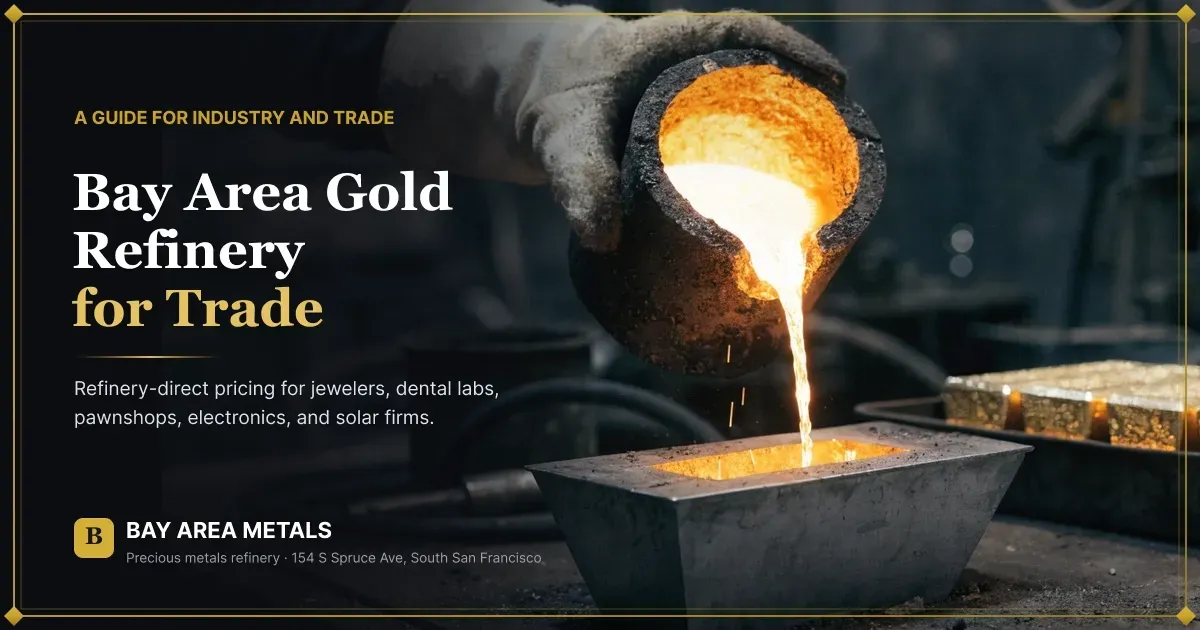
Once a lot is accepted, it moves through weighing, assay, smelting, and payout, and a trade client is welcome to watch every step. Transparency is not a slogan here; it is the layout of the building.
The sequence is straightforward. First, the lot is logged and weighed in front of you on a calibrated scale. Next comes the assay. For a fast read we use X-ray fluorescence (XRF), a non-destructive test that reads purity in minutes; for higher-stakes or higher-volume lots we run a fire assay by cupellation, the traditional and most accurate method for determining exact gold content. Then the metal is smelted in an induction furnace into a homogeneous mass, which is where the true, blended purity is confirmed. Finally, the payout math (spot × purity × weight, minus the deduction) is shown to you before you decide.
This is the process our authority guide, How Precious Metal Refining Actually Works, covers in full detail. For a trade client, the practical value is simple: you see the weight, you see the assay, and you see the number before any metal changes hands.
How do you open a trade account with a Bay Area refinery?
Opening a trade account starts with a conversation about your volume and metal type, followed by the same identity and record-keeping steps California requires of every precious-metal buyer. It is not a lengthy process, and for most shops it is done in a single visit.
California law requires any dealer buying scrap, jewelry, or used precious metals from the public to verify identity and keep records under the state's secondhand-dealer rules (California Business and Professions Code §21628). For a business selling its own trade scrap, the paperwork is straightforward, and we handle the reporting side. What a trade account adds on top is the ongoing relationship: agreed handling for your metal type, in-person drop-off or insured shipping for recurring volume, and your choice of payment as cash, wire, or exchange for bars and casting grain.
"All the jewelers come here to sell their gold for melting purposes. This place offers you the best prices! Issac the owner is friendly and professional. The whole transaction is painless and fast!" - Debbie G., Millbrae, CA · customer testimonial, bayareametals.com
The businesses we serve across the Bay Area's jewelry, dental, pawnshop, electronics, and solar industries came to us for the payout and stayed for the transparency. Bay Area Metals carries an A+ rating with the Better Business Bureau and a 5.0 Yelp rating from over 60 published reviews, and the process is the same for every client: see the assay, see the math, decide.
Glossary (quick reference)
Refinery - The business at the end of the precious-metals chain that melts, assays, and reprocesses metal into refined bars, grain, or bullion.
Lemel - The fine filings and shavings collected at a jeweler's bench for refining.
Bench sweeps - Floor and bench sweepings from a jewelry workshop, often containing recoverable gold dust.
Casting grain - Small precious-metal pellets used for melting and casting into new jewelry or industrial pieces.
Fire assay - The traditional, most accurate gold-content test, performed by cupellation. Takes 45+ minutes.
XRF - X-ray fluorescence, a fast, non-destructive purity read using a handheld unit. Reads the surface.
PFM - Porcelain-fused-to-metal. A dental crown with porcelain bonded over a gold-alloy base.
High-noble alloy - The top grade in the American Dental Association's dental-alloy classification: at least 60% noble metal by weight, of which at least 40% is gold.
Spot price - The live wholesale price per troy ounce, set twice daily by the LBMA in London.
Frequently Asked Questions
Author
Issac Makdessian is the owner and head refiner at Bay Area Metals, the family-owned precious-metals refinery at 154 South Spruce Ave, South San Francisco. The business has operated in the Bay Area since 2012, refining gold, silver, platinum, and palladium for public sellers and B2B clients across the region's jewelry, dental, pawnshop, electronics, and solar industries. Bay Area Metals carries an A+ rating with the Better Business Bureau and a 5.0 Yelp rating from over 60 published customer reviews. Author archive
Ready to refine? Open a trade account
If your business generates precious-metal scrap, the fastest way to see what it is worth is to bring a lot in. Text or call (650) 675-5009, or visit 154 South Spruce Ave, South San Francisco CA 94080, to set up a trade consultation. Bring a representative sample of your scrap and your ID. You will see the weight, the assay, and the payout math, and we will lay out account terms for recurring volume. See how we serve the industries we work with to start.