
How Precious Metal Refining Works (And Your Payout)
By Issac Makdessian, Owner and Head Refiner at Bay Area Metals. Operating the family-owned South San Francisco refinery since 2012. Specialist in gold, silver, platinum, and palladium refining for public sellers and B2B industry clients across the Bay Area.
Key Takeaways
The precious metal refining process is the sequence that turns scrap or raw metal into pure, market-grade bars and grain: intake and weighing, an assay to measure exact purity, smelting to a uniform mass, chemical or electrolytic refining, and casting. Your payout is calculated from the numbers this process produces.
Payout is a calculation from four inputs, not a quote: the day's spot price, the metal's measured purity, the weight in troy ounces, and a deduction for the assay and refining loss. A refinery can show its work to everyone.
Purity is measured two ways. X-ray fluorescence (XRF) reads a surface in minutes; a fire assay by coupling melts the whole sample down for the exact number. The fire assay is the figure a payout on a serious lot rests on.
Refining methods set the ceiling on purity. The Miller chlorination process reaches about 99.5% gold; Wohlwill electrolysis reaches about 99.99%, according to Encyclopaedia Britannica.
At Bay Area Metals, at 154 South Spruce Ave, South San Francisco CA 94080, you can stand at the furnace and watch your own metal weighed, assayed, and smelted, then see the payout math before any metal changes hands. We publish a range of up to 99% of spots for gold and up to 90% for silver, platinum, and palladium.
What is the precious metal refining process?
The precious metal refining process is the series of steps that takes raw or scrap metal, measures exactly how much pure metal it contains, and reprocesses it into market-grade bars, grain, or bullion. In order, those steps are intake and weighing, assay, smelting, chemical or electrolytic refining, and casting. Every number that decides your payout comes out of this sequence, which is why understanding it tells you where your money is won or lost.
Most people who sell gold never see any of it. They hand metal across a counter, take a number, and leave. That number was still produced by a refining process somewhere down the line, whether the seller watched it or not. The difference between selling to a refinery and selling to a middleman is not whether refining happens; it is whether you are standing there when it does, and whether the price you get reflects the refined value or a markdown taken before your metal ever reached the furnace.
Bay Area Metals is a family-owned refinery that has operated in South San Francisco since 2012. We run intake, assay, smelting, and payout under one roof, and customers are welcome to watch. This guide walks through each stage of the process, what it measures, and exactly how it feeds the payout number, so that when you sell gold, silver, platinum, or palladium, you know what the person on the other side of the counter is actually doing.

Why does the refining process affect what you get paid?
Every step of the refining process either measures your metal or changes its form, and the payout is built directly on those measurements. Get an accurate weight and an accurate purity read, and the math is simple and fair. Skip the measurement, or add a hand between you and the refinery, and the number drops.
Think of the precious-metals chain as a line of businesses, each selling to the next. A cash-for-gold counter buys your ring and sells it to a broker; the broker accumulates lots and sells to a refinery. The refinery is the end of the line, the only business that actually melts the metal down and returns it to the market as bullion. Everyone in between prices your metal below its refined value so they can sell it upward at a profit, so selling directly to the refinery removes those hands. That is the whole reason refinery-direct pays more. We cover the business side of that chain in our guide to what a gold refinery does for Bay Area industry and trade.
The second reason the process matters is trust. A number you cannot verify is a number you take on faith, but when you watch the scale, watch the assay, and see the calculation, the payout stops being a quote and becomes arithmetic you can check.
Step one: intake and weighing
Intake is where the lot is logged and weighed on a calibrated scale, and it is the first number that feeds your payout. Weight sets the outer limit of what your metal can be worth, so it has to be exact and it has to be done in front of you.
At Bay Area Metals, a lot is weighed in grams on a calibrated scale while you watch. Gold and other precious metals are priced per troy ounce, and one troy ounce equals 31.1035 grams, so the gram weight is converted before any pricing happens. This is not the same as the avoirdupois ounce a kitchen scale uses, which is one reason a quote taken on the wrong scale can quietly shortchange a seller.
Weighing is also where sorting starts to matter. A clean, single-karat lot can be weighed and assayed as one unit, while a mixed bag with stones, solder, clasps, or base-metal attachments has to be accounted for, because only the precious metal is paid on. You do not need to pre-sort or clean your metal to sell it. Just know that the more mixed the lot, the harder the assay has to work to separate the real content from everything riding along with it.
Step two: the assay, or how purity is actually measured
The assay is the step that measures purity, and it is the single most important number in the whole process after weight. Purity is expressed in karats for gold (24k is 99.9% pure, 14k is 58.3%, 10k is 41.7%) or in fineness for silver, platinum, and palladium. A refinery uses one of two methods to find it, and knowing the difference tells you how much to trust a given number.
The fast method is X-ray fluorescence, or XRF. A handheld or benchtop unit bombards the metal with X-rays and reads the composition off the surface in a few minutes, without destroying the piece. XRF is excellent for a quick, non-destructive check and for sorting. Its limitation is in the word "surface": it reads what is on the outside, so a plated or surface-enriched piece can read higher than the metal actually is all the way through.
The accurate method is the fire assay, the technique a payout on a serious lot ultimately rests on. A fire assay melts the entire sample down, which is why it measures true content rather than surface content, and it is the method governed by an international standard, ISO 11426, "Determination of gold, cupellation method (fire assay)". We break the fire assay down step by step in our companion guide, Fire Assay Explained.
The point of running both methods is speed without giving up accuracy: XRF gives you a fast read at the counter, and the fire assay stands behind it when the value of the lot justifies the extra time. That combination is what customers tend to remember about the experience.
"Always a quick and fair experience." - Emily T., Berkeley, CA · customer testimonial, bayareametals.com

How does a fire assay work?
A fire assay determines exact gold content by melting the sample with lead, then burning the lead and base metals away in a porous cup until only a bead of precious metal remains, which is then weighed. It has been done for thousands of years, and it is still the reference method because it analyzes the whole sample instead of a surface.
The sequence is precise. The sample is weighed on a sensitive balance, then combined with lead and, for gold work, with silver in a step called inquartation. The mixture is fused in a furnace above 1,000 degrees Celsius, and the molten lead collects the precious metals as it melts. That lead-and-metal button is then heated in a porous cup called a cupel at around 1,100 degrees. The lead oxidizes and soaks into the cupel along with the base-metal oxides, a step called cupellation, leaving a small bead of gold and silver behind. Finally the silver is dissolved away with nitric acid in a step called parting, and the remaining gold is rinsed, dried, and reweighed. The weight of that final bead against the starting weight is the purity (ISO 11426:2021).
For a seller, the takeaway is simple: the fire assay is why a refinery can pay on true content. It is slower than XRF, usually the better part of an hour, but it does not guess. When we run a fire assay on a lot, you can watch the bead come out of the cupel, and the number that follows is not an estimate. Reading the report it produces, line by line, is its own subject, which is why we wrote a plain-English walkthrough of how to read your assay results.
Step three: smelting
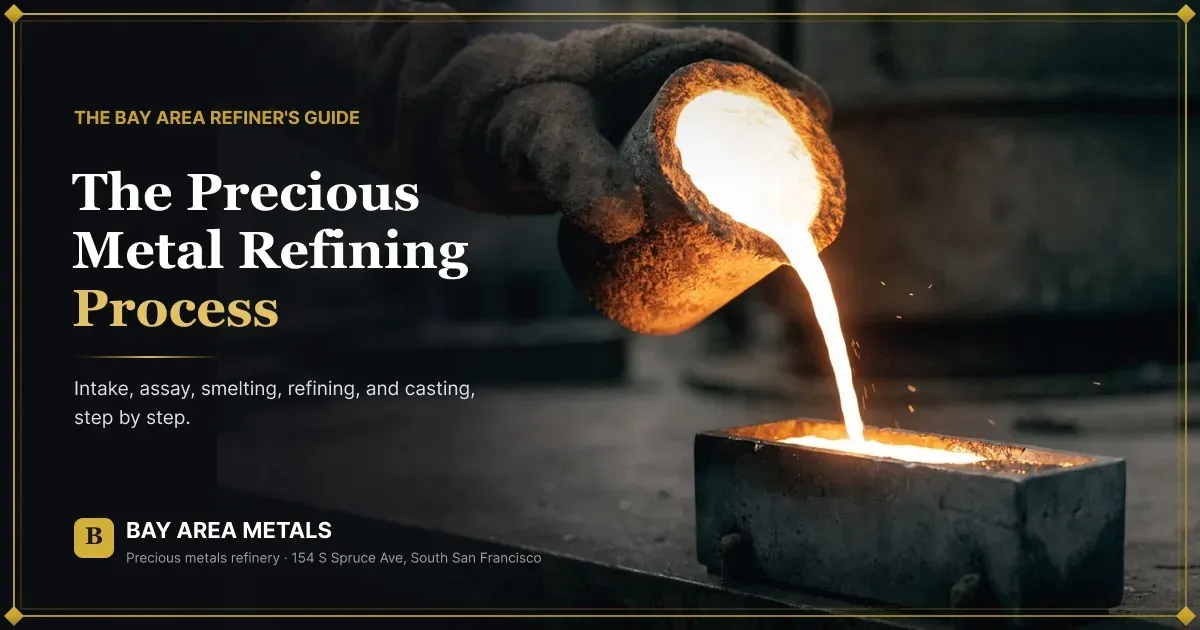
Smelting melts the accepted lot into a single uniform mass so that its true, blended purity can be confirmed and it can be poured into a consistent form. It is the step most people picture when they think of a refinery, and it is where a bag of mixed scrap becomes one homogeneous bar.
At Bay Area Metals we smelt in induction furnaces, which use an electromagnetic field to heat metal quickly and cleanly to its melting point. Gold melts at 1,064 degrees Celsius; silver, platinum, and palladium each have their own melting points. Once a lot is molten and mixed, a sample drawn from it represents the whole, which is what lets the assay on that sample stand for the entire bar. A pile of rings, chains, and crowns cannot be assayed accurately as-is because every piece differs. Melted together and stirred, they become one alloy with one measurable purity.
Smelting is also where a small, real loss occurs. A fraction of the metal is consumed or oxidized in the melt, and that is part of what the refining deduction accounts for. It is not a hidden fee; it is the physical cost of turning mixed scrap into a clean, assayable mass, and a refinery that explains it is describing metallurgy, not padding a margin.

Step four: refining the metal to purity
Refining is the step that removes the remaining impurities and brings the metal up to a defined purity, and the method used sets the ceiling on how pure it can get. This is the stage that gives the whole process its name, and it is where "gold" becomes "999.9 fine gold." Two methods dominate for gold, and a third handles smaller or specialized lots.
The Miller process blows chlorine gas through the molten gold. Because nearly every impurity bonds with chlorine more readily than gold does, those impurities rise to the surface as chlorides and are skimmed off. It is fast and relatively simple, and it produces gold of about 99.5% purity, according to Encyclopaedia Britannica. For a great many purposes, 99.5% is exactly enough.
The Wohlwill process takes purity further using electrolysis. A bar of impure gold is suspended in an electrolyte of hydrochloric acid and gold chloride, and an electric current dissolves the gold off the anode and deposits it, purified, onto a cathode. This reaches about 99.99% purity, again per Encyclopaedia Britannica, the standard for investment-grade bullion and casting stock. For smaller or mixed precious-metal lots, wet chemical refining with acids such as aqua regia dissolves the metal into solution so the target metal can be selectively precipitated back out. Which method fits a given lot depends on its size, its metals, and the purity the end use requires.
Step five: casting into bars and grain
Casting is the final step, where the refined metal is poured into its market-ready form: bars, ingots, or casting grain. This is the point at which the metal re-enters the market and, for a customer who wants a product rather than cash, the point at which your old scrap can come back as something usable.
Refined gold is typically cast into bars and ingots of a stated fineness, stamped and ready to trade, or into casting grain, the small pellets that jewelers and dental labs melt down to make new pieces. At Bay Area Metals the loop can close here: a customer can take payment in cash or a wire, or exchange refined metal for investment-grade Metalor bars or casting grain, taking back product in the karat they need. A jeweler's worn-out bench scrap can leave as fresh casting grain the same week.
Casting is where the process comes full circle. Metal that arrived as a broken necklace, a box of dental crowns, or a tray of electronic scrap leaves as a defined, market-grade product, and everything in between exists to make that transformation measurable and fair.
How is your payout actually calculated?
Your payout is spot price times purity times weight, minus a deduction for the assay and refining loss. That is the entire formula, and every input is a number the refining process either publishes or measures in front of you. Because it is arithmetic, a refinery can show its work, which is the difference between a price and a quote.
Spot is the global wholesale price per troy ounce. For gold it is set twice each business day by the London Bullion Market Association through an auction, and every legitimate refiner prices off that same public benchmark. Purity comes from the assay. Weight comes from the calibrated scale at intake, converted to troy ounces. The deduction covers the fire assay and the metal lost in the smelt. We publish a payout range of up to 99% of spot for gold and up to 90% for silver, platinum, and palladium, and two things move a lot toward the top of that range: volume, because larger lots spread the fixed assay cost across more metal, and form, because clean, sorted, single-karat metal assays faster and higher than mixed lots.
A worked example makes it concrete. Say you bring in 100 grams of 14k gold jewelry on a day when spot gold is about $4,000 per troy ounce (near the range on 21 July 2026; check the live LBMA price before applying this to a real lot). The pure gold content is 100 g × 0.583 = 58.3 g, which is 1.875 troy ounces. At $4,000 that is roughly $7,500 of gold. A refinery paying near the top of its published range settles within a few percent of that, minus the assay deduction. A buyer paying 70% of spot on the same jewelry hands you around $5,250 and keeps the rest when they sell it onward. On 100 grams of 14k, refinery-direct is worth roughly $2,000 more to you. The same math drives what scrap gold is really worth and how payout is calculated, and why you get about 90%, not 100%, when you sell silver.

"I'm a jeweler/goldsmith and have dealt with many refiners. Bay Area Metals are the most upfront and honest with the highest payout." - Jennifer N., Brooklyn, NY · customer testimonial, bayareametals.com
When someone who handles gold for a living, and who has used refiners on both coasts, calls a payout the highest and the most honest, that is the cleanest signal in the trade. The people who know what a fair assay looks like are the ones you want vouching for the math.
Why can you watch the whole process here?
You can watch the entire refining process at Bay Area Metals because transparency is built into how the shop is laid out, not offered as a favor. You see the weight on a calibrated scale, the XRF or fire-assay purity read, the smelt in the induction furnace, and the payout math, in that order, before any metal changes hands.
This is the practical divide between a local refinery and a national mail-in service. A mail-in refiner asks you to ship your metal across the country, where it is melted and assayed somewhere you cannot see, and you get a settlement statement after the fact. If you disagree with the number, the metal is already gone and mixed into someone else's bar. For a Bay Area seller, watching the process is a short drive instead of a multi-day shipping cycle, and the person who refined your metal is someone you can look at and call.
Choosing where to hand over your metal is worth doing deliberately, which is why the last piece in this series lays out the questions to ask before you choose a refiner. For who we are and how long we have done this, see our story.
Glossary (quick reference)
Refining - The overall process of removing impurities from raw or scrap metal to bring it to a defined purity, then casting it into market-grade form.
Assay - The test that measures a metal's exact purity. Done by XRF for a fast read or by fire assay for the reference number.
XRF - X-ray fluorescence. A fast, non-destructive purity read that measures the surface composition in minutes.
Fire assay (cupellation) - The reference method for exact gold content: the sample is melted with lead, the lead and base metals are burned off in a cupel, and the remaining precious-metal bead is weighed. Governed by ISO 11426.
Smelting - Melting a lot into one uniform mass so its blended purity can be assayed and it can be cast.
Miller process - Chlorination refining that reaches about 99.5% gold purity.
Wohlwill process - Electrolytic refining that reaches about 99.99% gold purity.
Casting grain - Small precious-metal pellets used to melt and cast into new jewelry or industrial pieces.
Spot price - The live wholesale price per troy ounce, set twice daily for gold by the LBMA in London.
Troy ounce - The unit precious metals are priced in. One troy ounce equals 31.1035 grams.
Frequently Asked Questions
Author
Issac Makdessian is the owner and head refiner at Bay Area Metals, the family-owned precious-metals refinery at 154 South Spruce Ave, South San Francisco CA 94080. The business has operated in the Bay Area since 2012, refining gold, silver, platinum, and palladium for public sellers and B2B clients across the region's jewelry, dental, pawnshop, electronics, and solar industries. Bay Area Metals carries an A+ rating with the Better Business Bureau and a 5.0 Yelp rating from over 60 published customer reviews. Author archive
Ready to see what your metal is worth? Talk to a Bay Area refiner
If you have gold, silver, platinum, or palladium and want to know its refined value, the fastest way to find out is to bring a lot in and watch the process. Text or call (650) 675-5009, or visit 154 South Spruce Ave, South San Francisco CA 94080, and bring a representative sample plus your ID. You will see the weight, the assay, and the payout math for your specific scrap, with no obligation to sell. See the full range of services we run in-house to start.