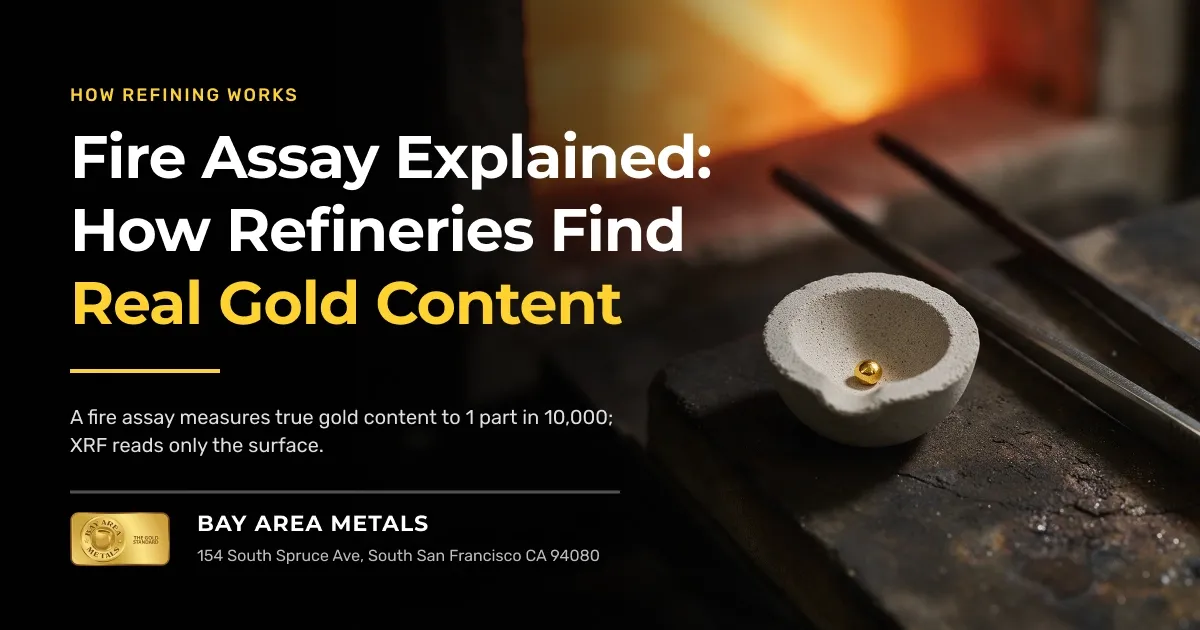
Fire Assay Explained: How Refineries Find Real Gold Content
By Issac Makdessian, Owner & Head Refiner, Bay Area Metals. Refining gold, silver, platinum, and palladium in South San Francisco since 2012.
Key Takeaways
A fire assay measures exact precious-metal content by melting a sample with lead and silver, burning the base metals away in a porous cup, and weighing the bead left behind. It reads the whole sample, not the surface.
Accuracy runs between 1 part per thousand and 1 part per ten thousand. Two published standards govern the method: ASTM E1335-08(2017) for bullion and ISO 11426:2021 for jewelry.
Portable XRF lands within about 1/8 of a karat of a fire assay on clean karat gold, roughly 0.5% of gold content, against fire assay's 0.1% or better.
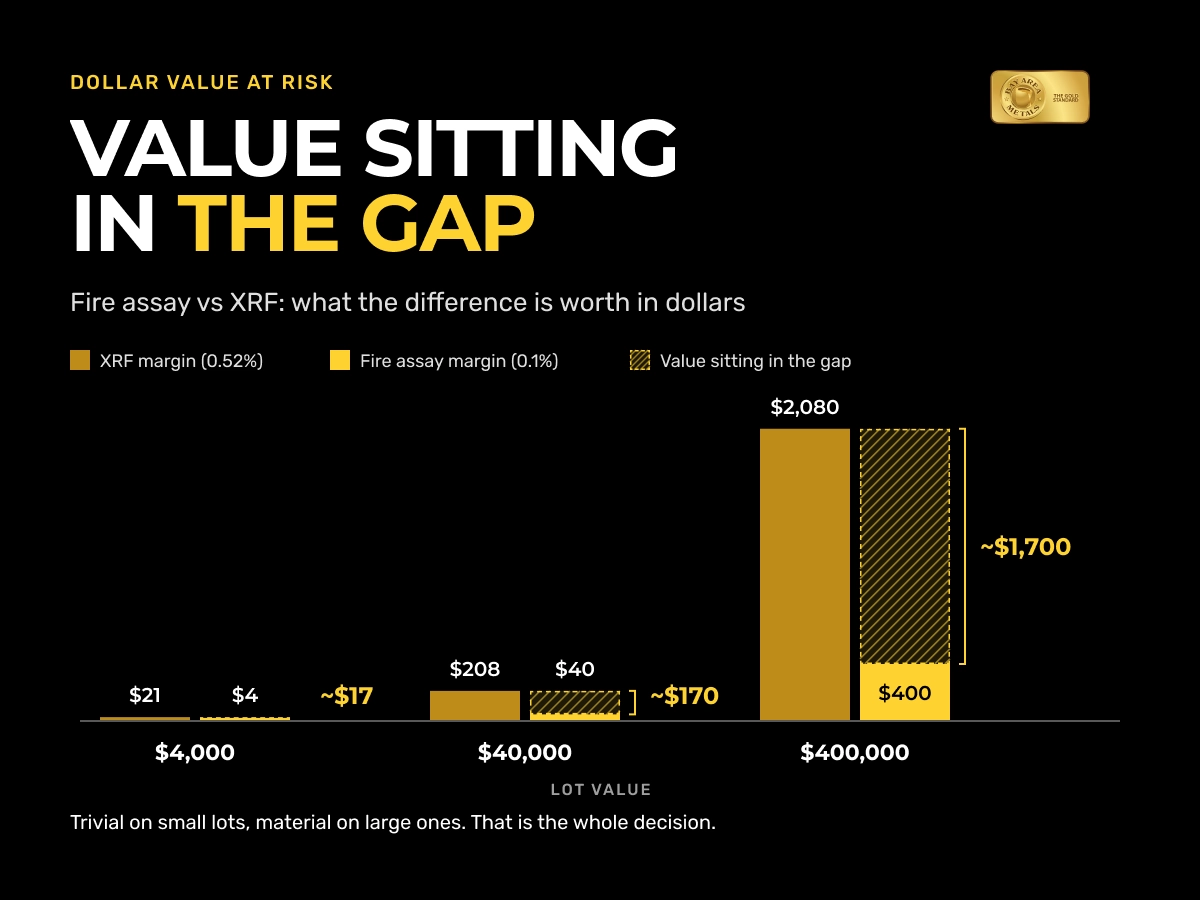
That gap is about 0.4% of a lot's gold value: near $170 on a $40,000 lot, near $1,700 on a $400,000 one.
Rough rule: multiply the assay fee by 240. Below that lot value an XRF read is enough. Above it, the fire assay pays for itself.
What is a fire assay?
A fire assay is the reference method for measuring how much gold, silver, or platinum-group metal a sample contains. The sample is melted with lead, the lead and base metals are driven off in a porous cup called a cupel, and the bead of precious metal that survives is weighed. Content is the bead's weight divided by the starting weight.
The method is thousands of years old and nothing has replaced it, because it does the one thing no instrument does: it destroys the sample in order to measure all of it. Every faster method reads a surface and infers the rest.
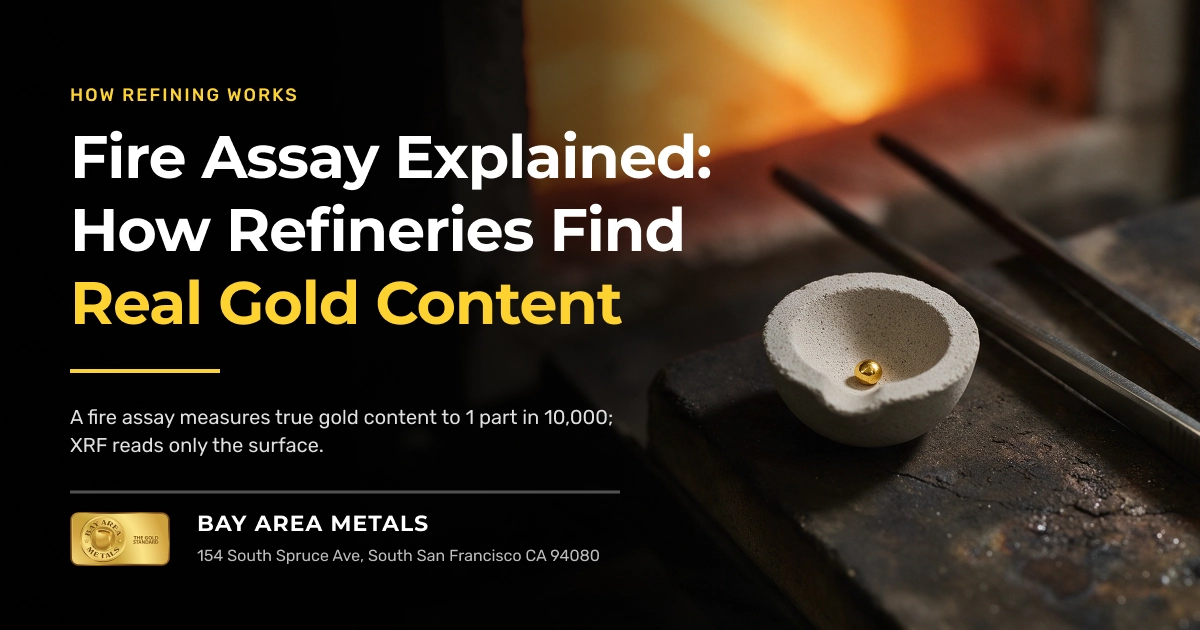
How a fire assay works, step by step
Sampling comes before assaying. A mixed lot of scrap is not one material, it is fifty. Assay an unmelted lot and you have measured whichever piece the technician picked up, not the lot. So the lot goes into the induction furnace first and comes out as one homogeneous bar, and the sample is drilled or pinned from that bar. This is why a refinery melts before it assays, and it is the largest single source of error in the business. Get the sample wrong and a flawless assay gives you a precise answer about the wrong thing.
Weighing. The sample is weighed on a microbalance. Sabin Metal puts bead-weighing precision at 0.001 mg, which is the level the final number rests on.
Inquartation. Silver is added to bring the silver-to-gold ratio to roughly 2.5:1. Without enough silver, the acid stage cannot reach the silver trapped inside the bead.
Cupellation. The sample, the added silver, and lead are fused, then held in a cupel at about 1,100 degrees Celsius. The lead oxidizes and soaks into the porous cup, carrying the copper, zinc, nickel, and other base metals with it. What stays in the depression is a bead of gold and silver.
Parting. Nitric acid dissolves the silver out of the bead, usually in two stages at different concentrations. The gold does not dissolve. It is annealed, cooled, and weighed.
Proof correction. Reference standards of known content are run in the same batch, the same furnace, the same cupels. Whatever they read off their true value becomes the correction applied to your sample. This is what turns a careful measurement into a defensible one, and it is fair to ask any refiner whether they run it.
How accurate is a fire assay?
Fire assay is accurate to between one part per thousand and one part per ten thousand, according to Manhattan Gold & Silver, a refiner that publishes its figures. That is 0.1% down to 0.01% of gold content, depending on the lab and the care taken.
Two standards govern the method. ASTM E1335-08(2017) covers determination of gold in bullion by fire assay cupellation analysis, and ISO 11426:2021 covers the cupellation method for gold in jewelry alloys. If a refiner says their assay follows one of these, that is a checkable claim, and asking which one is a reasonable question.
What the standards do not do is make one refinery equal to another. The result is only as good as the sampling, the furnace control, and whether proof standards were run at all. Two labs following the same standard on the same bar can still differ.
Fire assay vs XRF: what the difference is worth in dollars
Every page ranking for this term explains the method. None of them prices it.
X-ray fluorescence bombards a piece with X-rays and reads composition off the surface in seconds. Thermo Fisher's application note on portable XRF versus fire assay, dated March 2014, reports its analyzers landing typically within 1/8 of a karat of the fire assay result, with an R-squared of 0.999. That is the analyzer maker's own figure, measured on clean karat material, and analyzers have improved since 2014. One eighth of a karat is 0.52% of gold content on the 24-karat scale, against fire assay's 0.1%, so the working gap between the two methods is roughly 0.4% of a lot's gold value.
At gold near $4,000 an ounce, where it has traded through mid-2026 according to the LBMA forecast survey reported by Kitco on 12 August 2026, that gap looks like this:
The last column is money uncertain rather than money lost, and the margin runs in both directions. But uncertainty is never free, because whoever carries it prices for it. A buyer settling a six-figure lot off a surface reading will quote against the bottom of that range to protect themselves, and the seller pays for the caution.
That yields a rule of thumb rather than a formula. Take the assay fee and multiply it by 240. Below that lot value, the precision you are buying costs more than it is worth. Above it, the fire assay pays for itself, and the bigger the lot the less close the call gets. At a $50 fee the crossover sits near $12,000 of metal; at $100, near $24,000.
A refinery recommending the more expensive test has an obvious interest in it, so weigh this accordingly. The fire assay protects us at least as much as it protects you, because it is what stops us overpaying on a plated lot that reads like solid gold. It is a shared standard rather than a favor, and your protection is watching the melt and asking to see the proof standards, not taking our word for it.
On a scrap lot the assay fee is usually not a separate invoice. It sits inside the deduction between spot and your payout, alongside the metal lost in the melt. So "what is your assay fee" and "what percentage of spot do you pay" are the same question, and the second is the one to ask. We publish up to 99% of spot for gold and up to 90% for silver, platinum, and palladium, and larger lots sit higher in that range for the reason the table shows: one fixed cost spread across more metal.
Where a surface reading breaks down: plated and surface-enriched metal
On plated or surface-enriched metal, XRF is not slightly imprecise. It can be entirely wrong, and the 1/8-karat figure does not apply at all.
The reason is in the word surface. Gold plating, gold fill, and the surface enrichment left behind by polishing and pickling all put a thin layer of higher-purity gold over something much poorer. A beam that penetrates a fraction of a millimeter reads that layer and reports it as the whole piece, so a heavily plated base-metal item can read as solid karat gold. No better analyzer fixes this, because the instrument is reporting exactly what it sees.
A fire assay cannot be fooled this way, because there is no surface left to read. The piece is melted into the sample. So the two methods work as a sequence rather than as rivals. XRF screens at the counter in seconds, and the fire assay settles the number when the value justifies it. For scrap of unknown origin, telling solid from filled from plated is the first job, and we cover what that sorting does to a payout in our guide to what scrap gold is worth. Reading the report that comes back is its own subject, and we have a plain-English walkthrough of the line items.
Watch your fire assay run in South San Francisco
At our South San Francisco refinery you can stand at the counter while your lot is weighed, melted in our induction furnace into one bar, sampled from that bar, and assayed, then see the payout math before any money moves. The melt is the part worth watching, because that is where a grab sample becomes a representative one. For the full sequence from intake to casting, start with how precious metal refining works; our assaying and refining services page covers what we run in house, and you can start a lot with the refinery here.
Bring a representative sample of your lot and your ID. Text or call (650) 675-5009, or visit 154 South Spruce Ave, South San Francisco CA 94080, and ask to watch the assay.
Frequently Asked Questions
Author
Issac Makdessian is the owner and head refiner at Bay Area Metals, the family-owned precious-metals refinery at 154 South Spruce Ave, South San Francisco CA 94080. The business has refined gold, silver, platinum, and palladium in the Bay Area since 2012 for public sellers and for B2B clients across the region's jewelry, dental, pawnshop, electronics, and solar industries. Bay Area Metals holds an A+ rating with the Better Business Bureau.