
Scrap Gold in the Bay Area: What It's Really Worth
By Issac Makdessian, Owner and Head Refiner at Bay Area Metals. Operating the family-owned South San Francisco refinery since 2012. Specialist in gold, silver, platinum, and palladium refining for public sellers and B2B clients across the Bay Area.
Key Takeaways
Scrap gold is any item sold for the gold inside it rather than for its shape or collectible value. Karat jewelry, broken chain, dental crowns, and bench sweeps qualify. Bullion bars and rare coins usually do not, because both are worth more intact.
Payout starts from fine gold weight. At the LBMA spot price of $4,074.60 per troy ounce (JM Bullion, August 3, 2026), pure gold runs about $131.00 per gram, so a gram of 14k carries roughly $76.40 of metal.
Gold-filled and gold-plated pieces are the common disappointment. Under the FTC Jewelry Guides, "gold filled" needs a gold layer of at least 1/20 of the article's metal weight and "gold plated" only 1/40. A 6-gram plated watch case holds about $20 to $39 of gold.
Nobody pays 100% of spot, because scrap must be assayed and refined before resale. Refiners credit back an accountability rate, commonly 95% to 99% on clean karat scrap. Bay Area Metals publishes a payout of up to 99% of spot for gold.
Most people searching for what scrap gold is worth in the Bay Area are not holding a clean 14k chain. They are holding a bag. Tangled chain, single earrings, a class ring, a watch case that may or may not be solid, a few pieces from a parent's dresser. Some of what is in that bag is not gold at all, and the rest is worth more than people expect.
I have sorted and assayed thousands of these bags at our South San Francisco refinery since 2012. Below is what the payout calculators skip: which pieces carry real gold, and where every cent goes between gross melt value and your check. For the wider process, including California's ID rules and the tax treatment, see our guide to selling gold in the Bay Area.
What counts as scrap gold?
Scrap gold is any gold item sold for its metal content rather than its form, and that distinction decides which pricing model applies to you. Four categories cover almost everything: karat jewelry, where broken pieces are worth exactly what pristine ones are; dental gold, usually a 10k to 22k alloy carrying palladium or silver, because pure gold is too soft for a molar; trade scrap such as bench sweeps, lemel, filings, and casting sprue; and industrial scrap like gold-plated CPU pins, which is real gold, very thin, and economic only in volume.
Two things people bring in are usually not scrap. Investment bars from a recognized mint trade near spot with no assay required, so selling one as scrap gives up value for nothing. And a coin with numismatic interest can be worth a multiple of its melt value, which is why we send those sellers to a coin dealer instead. Our walkthrough on selling gold coins covers that line.
How do you tell real gold from gold-filled and gold-plated?
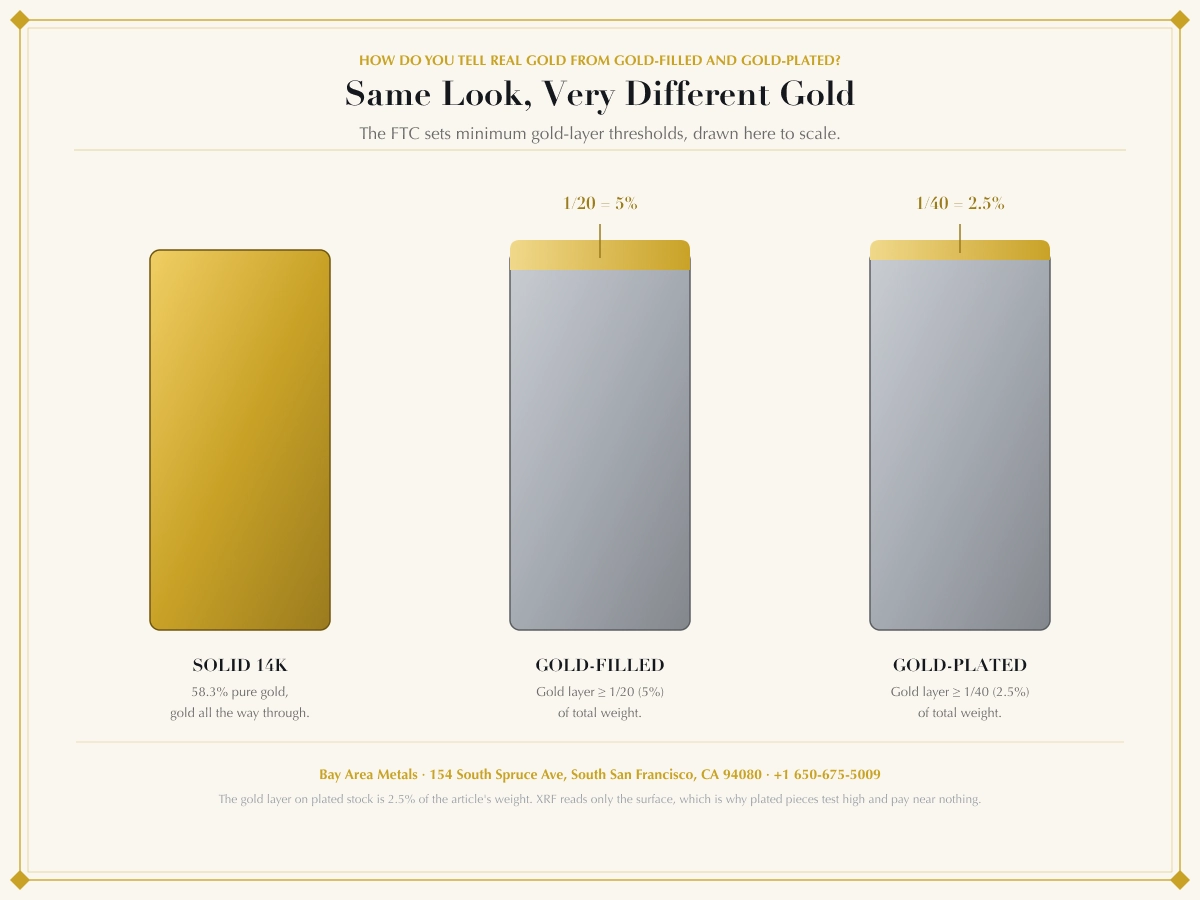
Check the stamp, then be suspicious of anything that reads as a fraction. Under the FTC's Guides for the Jewelry, Precious Metals, and Pewter Industries (16 CFR Part 23), a piece may be called "gold filled" only when the gold layer is at least 1/20 of the article's total metal weight, and "gold plated" or "gold overlay" when it is at least 1/40, at 10 karat fineness or better.
Read those fractions as what they are: 5% and 2.5% of the weight. A stamp like "1/20 12K GF" discloses that 95% of the object is base metal. Solid karat gold is marked 10K, 14K, 18K, 22K, or with the equivalent hallmark fineness numbers 417, 583, 750, and 916. On the purity behind those marks, the World Gold Council puts pure 24k gold at 99.9% gold and 14k at 58.3%.
Here is where sellers get burned, sometimes by buyers using good equipment. An X-ray fluorescence gun reads only the outer 10 to 50 microns of a surface, so a gold-filled piece can return an 18-karat reading at the test point while holding a fraction of that by total weight (VRAY XRF). XRF lands within about 1% of a fire assay on flat, homogeneous karat gold, but it is not a plating detector. Anything unstamped, clad, or suspiciously light gets cut, filed, or fire-assayed before we quote it.
What is a bag of scrap gold worth in the Bay Area today?
Fine gold weight times the day's spot price, minus the deduction. The work is all in the sorting, so here is a realistic 40-gram mixed bag at the August 3, 2026 spot of $4,074.60 per troy ounce, which is $131.00 per gram of pure gold at the standard 31.1035 grams to the troy ounce. Every figure below is that price times the group's karat purity.
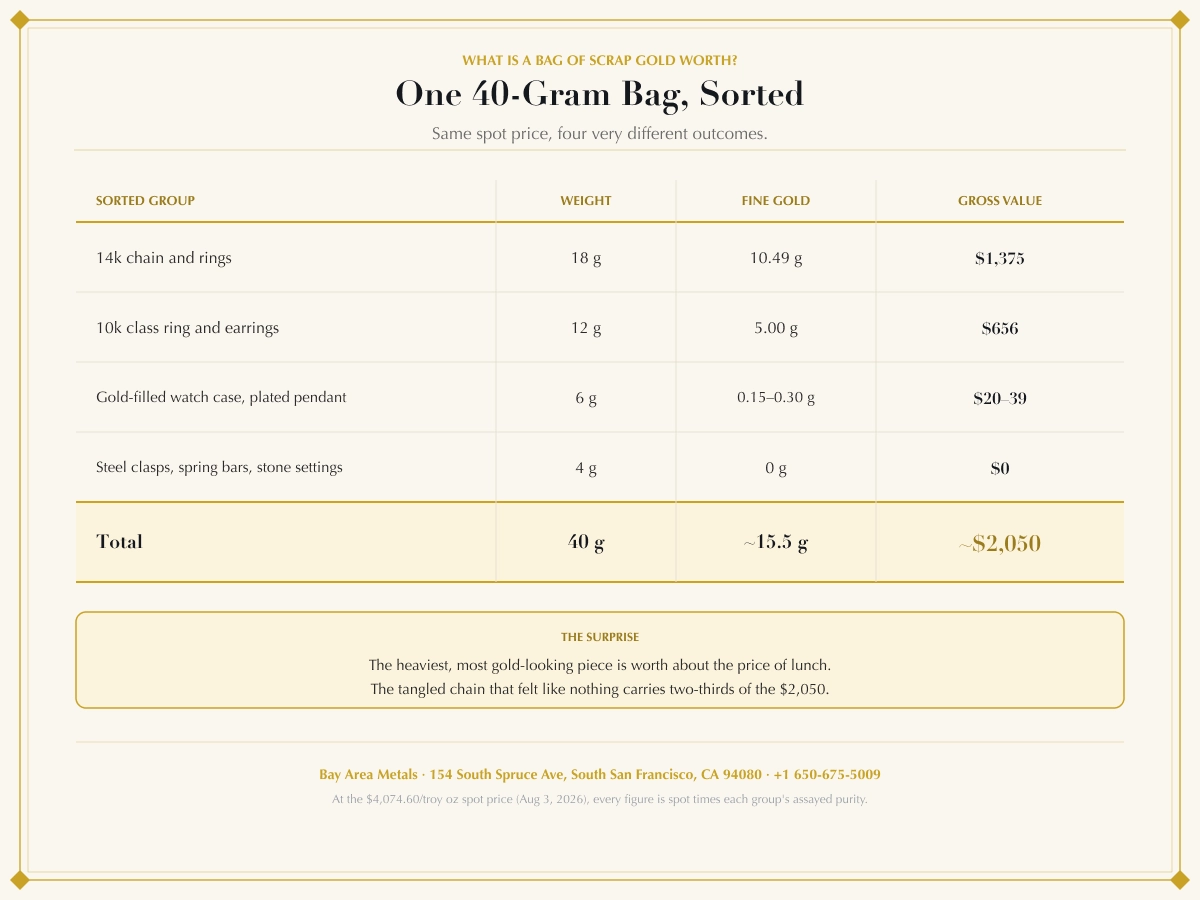
Two things in that table surprise almost everyone. The heaviest, most gold-looking object in the bag is worth about the price of lunch, and the tangle of broken chain that felt like nothing carries two thirds of the $2,050.
Spot moves daily and sometimes hourly, so treat those figures as a method rather than a quote. Check the live LBMA gold price the morning you sell, then ask your buyer to show their math against it.
Why don't you get 100% of spot for scrap gold?
Because spot is the price of refined metal, and scrap is not refined metal yet. The industry term for what comes back to you is the accountability rate: the percentage of assayed fine gold the refiner credits to your account. Refiners handling standard karat jewelry scrap commonly quote accountability in the 95% to 99% range, per Africa Gold Suppliers' 2026 refining charges guide. Across the wider buyer market, including pawn shops and cash-for-gold storefronts, the same guide puts published payouts anywhere from 60% to 95% of spot.
Four things account for the gap. The assay costs money whether it is an XRF read or a fire assay by cupellation, and it protects you, because it is the only thing standing between a stamp and the truth. Refining loss is real, with a fraction of gold consumed in the melt and ending up in residues, flux, and exhaust ducts, near one eighth of one percent by trade estimates (Africa Gold Suppliers, 2026). Non-gold weight covers stones, steel spring bars, enamel, and solder. And lot size matters because per-transaction overhead is the same for 4 grams as for 400.
The number of intermediaries matters more than all four. Bay Area Metals publishes a payout of up to 99% of daily spot for gold, and up to 90% for silver, platinum, and palladium, because we are the refinery at the end of the chain rather than a buyer reselling into one.
"I'm a jeweler/goldsmith and have dealt with many refiners. Bay Area Metals are the most upfront and honest with the highest payout. I just moved here from NYC and am really happy I can take my scraps here." - Jennifer N., Brooklyn, NY, customer testimonial, bayareametals.com
Where the trade takes its own lemel is the most reliable signal a public seller has.
What a fair scrap gold quote shows you
Four things, and you should not have to ask twice for any of them.
Gram weight on a calibrated scale you can watch. At our refinery you read the display yourself, and you are welcome to stay through the assay and the smelt.
Karat per sorted group, not one blended number for the bag. A single average karat across mixed 10k and 14k hides which pieces were discounted.
The spot price used, with a timestamp. Spot at 9am is not spot at 3pm.
The deduction as a number. "Market rate" is not a deduction. A percentage or a dollar figure is.
Any legitimate California buyer will also ask for photo ID, a certification of ownership, and a fingerprint, and will report the sale to the state under Business and Professions Code §21628. A buyer who skips all of that is not doing you a favor.
The objection I hear most is that sorting and assaying sounds like a process built to find reasons to pay less. It is the opposite. A blended eyeball estimate always rounds against the seller, because the buyer prices in risk he cannot see. Sorting removes the guesswork, and the seller keeps what it would have cost.
So bring the bag as it is. Do not clean it, do not cut the steel off, and do not throw out the pieces you assume are worthless. Pull the gemstones you want to keep and leave the rest to us.
Get your scrap weighed, assayed, and quoted at 154 South Spruce Ave, South San Francisco, or text (650) 225-9100 first. You will see the scale, the sort, the spot price, and the deduction, and you can walk out with the gold and the math if the number does not suit you.
Frequently Asked Questions
Author
Issac Makdessian is the owner and head refiner at Bay Area Metals, the family-owned precious-metals refinery at 154 South Spruce Ave, South San Francisco, operating since 2012. He refines gold, silver, platinum, and palladium for public sellers and for the region's jewelry, dental, pawnshop, electronics, and solar trades. Bay Area Metals holds an A+ rating with the Better Business Bureau and has 66 published Yelp reviews as of June 2026.