
Where to Sell Dental Gold Near Me: A Bay Area Guide
By Issac Makdessian, Owner and Head Refiner at Bay Area Metals. Operating the family-owned South San Francisco refinery since 2012. Gold, silver, platinum and palladium refining for public sellers and for the Bay Area's jewelry, dental, pawnshop, electronics and solar trades.
Key Takeaways
Where to sell dental gold near me, in one line: a refinery that melts and assays the alloy itself. Pawn shops, cash-for-gold storefronts and most mail-in buyers resell dental scrap to a refinery and keep the spread. Going direct removes that layer.
Dental gold is almost never pure gold. Under the American Dental Association's alloy classification, a "high noble" restoration is at least 60% gold and platinum-group metal with gold at 40% or more. A "noble" restoration needs only 25% noble content. A "predominantly base" restoration is under 25%, and can hold almost no gold at all.
Gross gold value = (grams × gold fraction) ÷ 31.1035 × spot price. Gold spot moves by the second, so confirm the day's LBMA Gold Price benchmark, before you accept any offer.
Silver-colored fillings are a different material entirely. Dental amalgam is roughly 50% elemental mercury by weight, according to the FDA. It is regulated waste, not precious-metal scrap, and it carries no meaningful payout.
Your dentist can give the old crown back. OSHA's 1993 standard interpretation and the CDC's guidance on extracted teeth both allow returning an extracted tooth to the patient. Ask before the appointment, not after.
Bay Area Metals is the family-owned refinery at 154 South Spruce Ave, South San Francisco, refining since 2012. Walk in or ship insured; appointments are recommended.
Someone hands you a small envelope from a parent's estate. Inside are three gold-colored crowns and half a bridge. You search where to sell dental gold near me, and what comes back is a wall of national mail-in buyers quoting "$40 to $100 per gram" without saying which gram they mean.
Dental gold has a problem that jewelry doesn't. With a ring, a 14k stamp tells you the purity. With a crown, there is no stamp, no paperwork, and no way to know from looking whether you are holding 70% gold or 3% gold. Two crowns that look identical on a kitchen table can differ in value by a factor of twenty.
This guide is written to fix that. Below is how dental alloys are truly classified, how to calculate the payout yourself, the two materials that most first‑time sellers get wrong, and how the transaction works in California.
Two readers, two paths. If you are a family member holding a handful of crowns from an estate or a dental visit, read straight through; the sections on alloy classes, the math and California paperwork are the ones that matter to you. If you run a dental practice or a lab and you have a scrap jar, a bench sweep, or a bin of failed castings, skip to what a lab refining relationship looks like. The metal is the same. The volumes, the deductions and the compliance questions are not.
Where to sell dental gold near me: the four buyer types, ranked
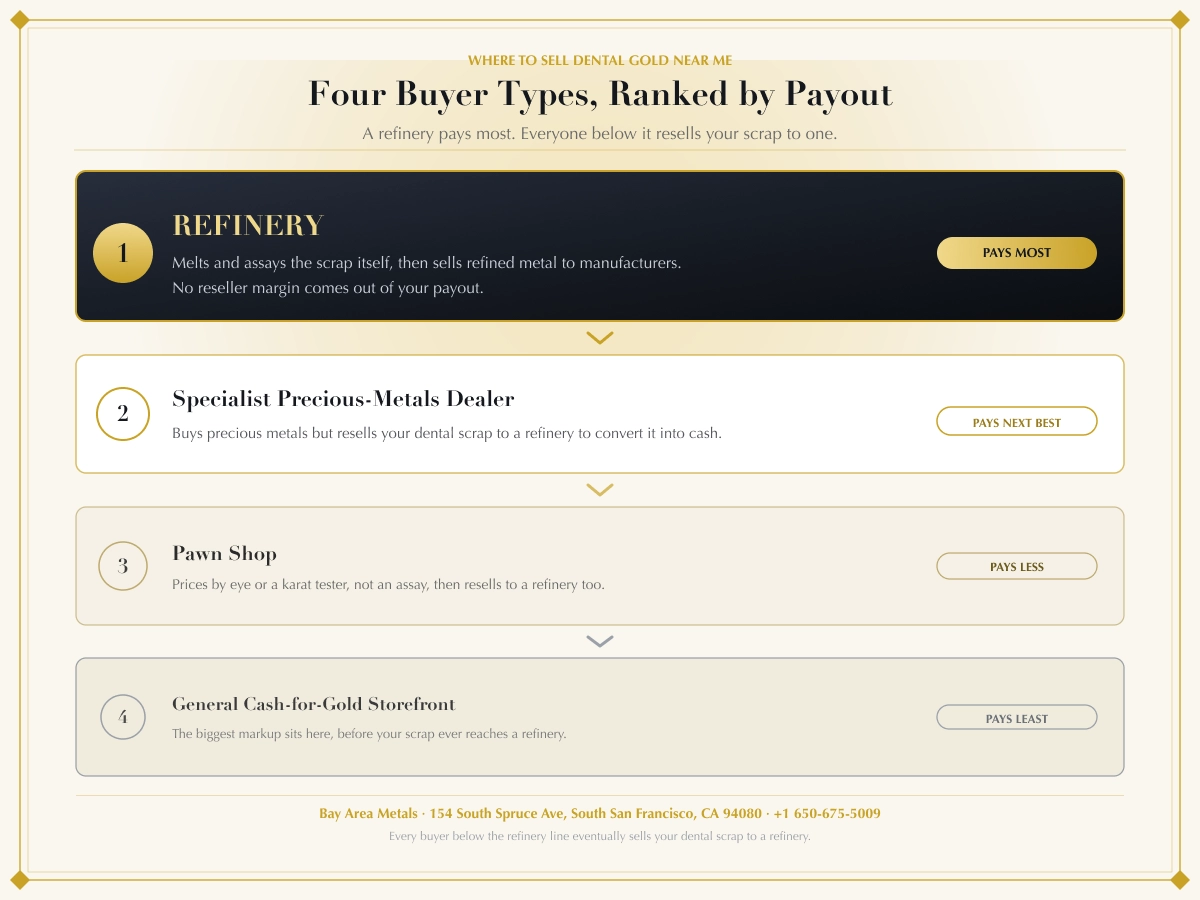
Four kinds of buyers will take dental gold, and they sit in a clear order by payout: a refinery pays most, a specialist precious-metals dealer next, a pawn shop below that, and a general cash-for-gold storefront least.
The reason is structural, not moral. A refinery melts and assays the material itself, recovers the gold, palladium, platinum and silver, and sells refined metal onward to manufacturers. Everyone else in that list eventually sells your crowns to a refinery. Their margin comes out of your payout.
Dental gold makes this gap wider than it is for jewelry. A 14k chain can be karat-tested with an XRF gun in under a minute, so even a pawn shop can price it roughly right. A crown is a small mass of mixed alloy fused to porcelain and old cement, and pricing it properly needs a melt and an assay. A buyer who cannot assay has to protect itself by assuming the alloy is poor. That assumption is priced into the offer you get.
Mail-in buyers are the fourth option, and some are legitimate refiners. The trade-off is that you ship the material, then find out what it was worth. If you are within driving distance of a refinery, watching the assay is worth the trip.
"I have been here several times and it's always a quick and fair experience. I have been bringing gold and precious metals to different folks for decades and dealing with the owner here has been a good experience." — Emily T., Berkeley, CA · customer testimonial, bayareametals.com
What is dental gold actually made of?
Dental restorations fall into three alloy classes, and the class decides most of the value. The ADA Council on Scientific Affairs classification sorts casting alloys by their content of gold and platinum-group metals:
Three things follow from that table, and they explain most of the confusion around dental gold value.
"Noble" does not mean gold. The ADA counts gold, platinum, palladium, iridium, rhodium, osmium and ruthenium as noble metals. A noble alloy can hit its 25% threshold almost entirely on palladium, with very little gold in it. Palladium is genuinely valuable, trading at $1,297.51 per ounce on July 28, 2026 (JM Bullion live spot), so the piece is not worthless. It just isn't a gold piece.
Porcelain-fused-to-metal restorations span the whole range. A PFM (Porcelain-fused-to-metal) is a metal substructure with porcelain baked over it, and per the ADA that substructure can be high noble, noble, titanium, or base metal. The white tooth on top tells you nothing about the metal underneath. Gold-platinum-palladium was the original PFM alloy; gold-palladium-silver combinations followed.
The decade matters. The ADA notes that by 1980 the rising price of gold pushed the profession toward base metals. As a rough rule, the older the restoration, the better the odds it is high noble. A crown placed in 1972 and a crown placed in 2012 are not the same bet.
None of this can be settled by eye, which is the honest answer to "how much is my crown worth." It gets settled by an assay. For the full walkthrough of how karat, alloy mix and refining loss combine into a number, see our forthcoming guide on how dental gold is valued.
How much is a gold crown worth?
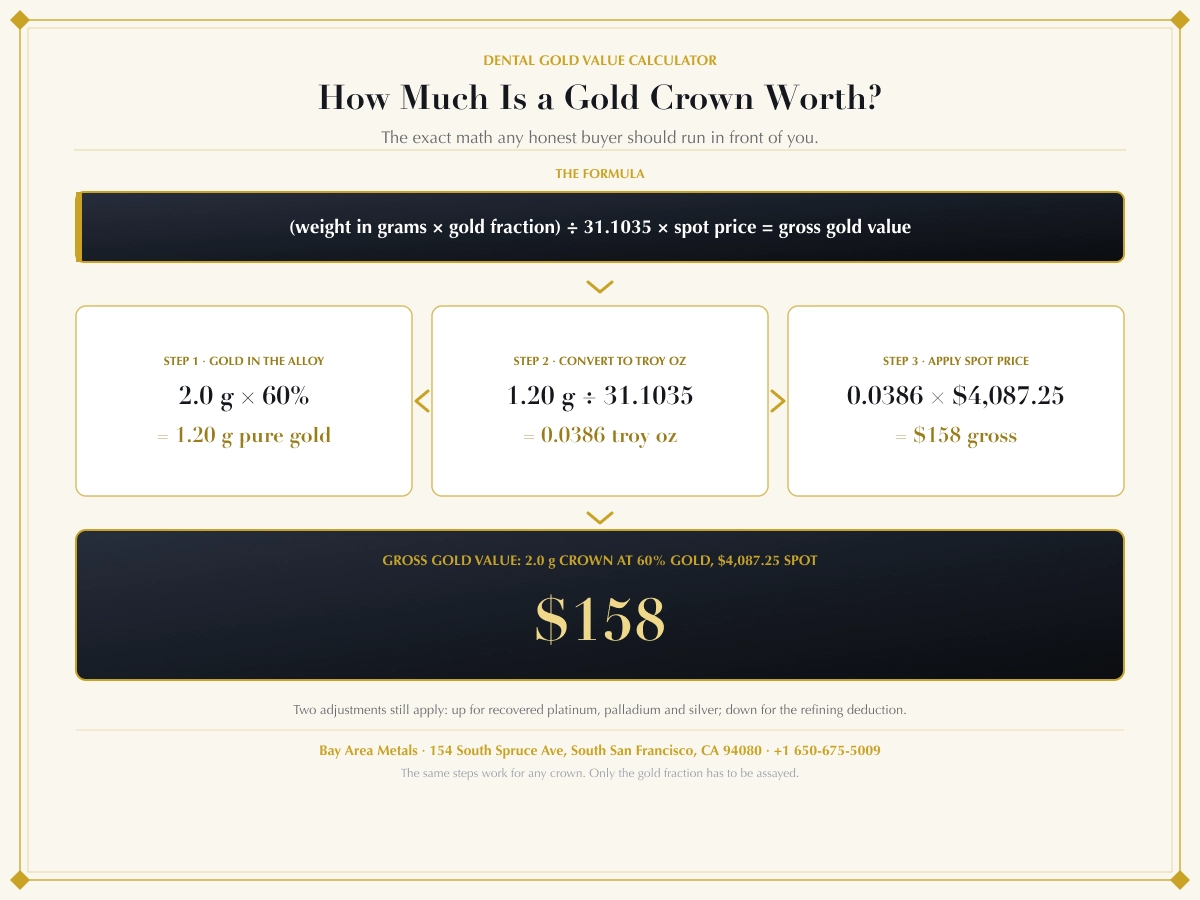
Here is the calculation any honest dental gold buyer should be willing to run in front of you:
(weight in grams × gold fraction) ÷ 31.1035 × spot price = gross gold value
Worked as an example, take a 2.0-gram full-cast crown that assays at 60% gold, with gold at $4,087.25 per troy ounce:
2.0 g × 0.60 = 1.20 g of pure gold
1.20 ÷ 31.1035 = 0.0386 troy ounces
0.0386 × $4,087.25 = $158 gross gold value
Then two adjustments. Upward, for the palladium, platinum and silver in the same alloy, which a refinery recovers and pays on but a storefront usually ignores. Downward, for the refining deduction, which covers the assay and the metal lost in processing.
That $158 is also why the "$40 to $100 per gram" figures you see online are close to meaningless. Per gram of what? A gram of high-noble alloy and a gram of base-metal alloy are the same weight and wildly different money.
Two warnings about the inputs. Porcelain, cement and tooth structure still on the crown add weight but no metal, so any offer quoted on gross weight before cleaning is quoted on the wrong number. And you do not need to remove that material yourself; we handle it. Just pull out any gemstones you want to keep.
The two traps: amalgam and base-metal crowns
The two most common disappointments in dental scrap are both avoidable if you know what you are looking at.
Silver-colored fillings are not silver in any useful sense. Dental amalgam is about 50% elemental mercury by weight, bound to a powdered alloy of silver, tin and copper, per the FDA. The mercury makes it hazardous material rather than scrap. A refinery cannot pay you for it, and handling it is governed by the EPA's dental effluent guidelines, which require practices to run amalgam separators. If your envelope holds dark silver-gray fillings, those go to an amalgam recycler through your dentist, not to a gold buyer.
Base-metal crowns look exactly like the valuable ones. A nickel-chromium or cobalt-chromium crown can be bright and shiny and hold no gold worth recovering. This is the single most common reason a first-time seller feels cheated: the offer was low because the metal was low, and nobody explained the difference beforehand.
Neither trap is a reason to throw anything away. Bring the whole lot. Sorting it is our job, and a real assay is the only way anyone finds out what is in there. What you should refuse is a single lump-sum offer on a mixed bag with no breakdown behind it.
How to get your old crown back from the dentist
If the crown is still in your mouth or about to come out, ask for it before the appointment. Returning an extracted tooth or an old restoration to the patient is permitted: OSHA's 1993 standard interpretation says extracted teeth may be given back on request, and the CDC's dental infection control guidance confirms that once a tooth is returned it falls outside the Bloodborne Pathogens standard.
In practice the office will clean and disinfect the piece first. That is normal and expected. Say so at scheduling rather than at checkout, because many offices default to routing old restorations into their own scrap bin.
What paperwork and taxes should you expect in California?
Selling dental scrap to a California buyer is a regulated transaction, and a compliant buyer will ask you for things a careless one won't.
Buying secondhand tangible personal property from the public falls under California Business and Professions Code §21628, part of the state's secondhand-dealer chapter. Subsection (e) requires the buyer to verify a valid government-issued photo ID, and subsection (a) requires the transaction to be reported to the state through CAPSS, which the statute calls the California Pawn and Secondhand Dealer System and the Attorney General's office also refers to as the California Automated Pawn and Secondhand Dealer System. Bring your ID. A buyer that does not ask for it is telling you something about the rest of their process.
On taxes, two points, and neither is tax advice. Long-term gains on collectibles are taxed at a maximum federal rate of 28% rather than the usual long-term capital gains rates (IRS Topic No. 409), and the tax code's definition of a collectible reaches "any metal or gem" (26 U.S.C. §408(m)(2)). If the crowns came from an estate, your cost basis is generally the fair market value on the date of death rather than what the original owner paid, per the inherited-property rules in IRS Publication 551. For most estate dental lots the gain after that step-up is small. Keep the settlement paperwork either way, and talk to your own tax preparer.
For dental offices and labs: what a refining relationship looks like
If you run a practice or a lab, dental scrap is a recurring revenue line, and most offices leave it on the table. The material worth accumulating is broader than crowns: failed castings, bridges, PFM copings, grills, clasps, bench sweeps and carpet sweeps all carry recoverable metal.
What a refining relationship changes is the unit of sale. A single crown gets valued as a single crown. A quarter's accumulation gets melted into one homogeneous bar, sampled, and assayed once, which is both more accurate and more efficient than pricing pieces one at a time. Payment can come as cash, casting grain, or gold bars, which matters if your lab buys casting alloy anyway.
Two operational notes. Keep amalgam separate from noble scrap; it belongs with your amalgam recycler under the EPA's dental effluent rules, and mixing it into a precious-metal lot creates a handling problem for everyone. And patient-identifiable material should not travel with the scrap. Restorations themselves carry no patient data, so this is usually just a matter of not sending paperwork along with the jar.
For the compliance and workflow detail specific to Bay Area labs, see our forthcoming guide to refining for dental labs. You can also read what we accept from each trade on our industries we serve page.
Selling dental gold in the Bay Area
If you want to watch the assay rather than mail the material away, here are the practical details for our South San Francisco refinery:
Address: 154 South Spruce Ave, South San Francisco, CA 94080. On-site parking.
From San Francisco: 15 to 25 minutes via US-101 South or I-280 South. South San Francisco Caltrain is about a 13-minute walk.
From the East Bay or South Bay: Oakland runs roughly 30 to 40 minutes over the Bay Bridge; San Jose is about 40 minutes up 101.
What to bring: government-issued photo ID, the dental scrap as-is, and any gemstones removed if you want to keep them.
What happens: we weigh, melt and assay the lot, show you the numbers, and pay the same day or the next. You are welcome to stay and watch the whole process.
Shipping instead: ship insured. Call first so we know it is coming.
The same refinery-versus-middleman logic that governs dental scrap governs everything else you might be sorting through from an estate. Our guide to selling gold in the Bay Area covers jewelry and coins, and where to sell gold in San Francisco has the five checks to run on any buyer before you hand anything over.
Get your dental gold assayed
Bring your dental scrap to the refinery, or ship it insured, and we will assay it and quote it. Start on our sell dental gold direct to the refinery page, or text (650) 225-9100 to book a slot at 154 South Spruce Ave. Appointments are recommended; walk-ins are welcome during posted hours.
Frequently Asked Questions
Author
Issac Makdessian is the owner and head refiner at Bay Area Metals, the family-owned precious-metals refinery at 154 South Spruce Ave, South San Francisco. The business has operated in the Bay Area since 2012, refining gold, silver, platinum and palladium for public sellers and for the region's jewelry, dental, pawnshop, electronics and solar trades. Bay Area Metals carries an A+ rating with the Better Business Bureau and a 5.0 Yelp rating from over 60 published customer reviews.