Dental Gold Value: Karat, Alloy Mix, and Real Payout
By Issac Makdessian, Owner & Head Refiner, Bay Area Metals. Refining gold, silver, platinum, and palladium in South San Francisco since 2012.
Key Takeaways
Dental gold value rests on three things: how much metal is there, what percentage of it is precious, and whether your buyer pays on all of those metals or only on the gold.
Dental alloys carry no karat stamp. One dental lab's all-metal crown menu runs from 58% gold down to 2% gold, and both look like gold.
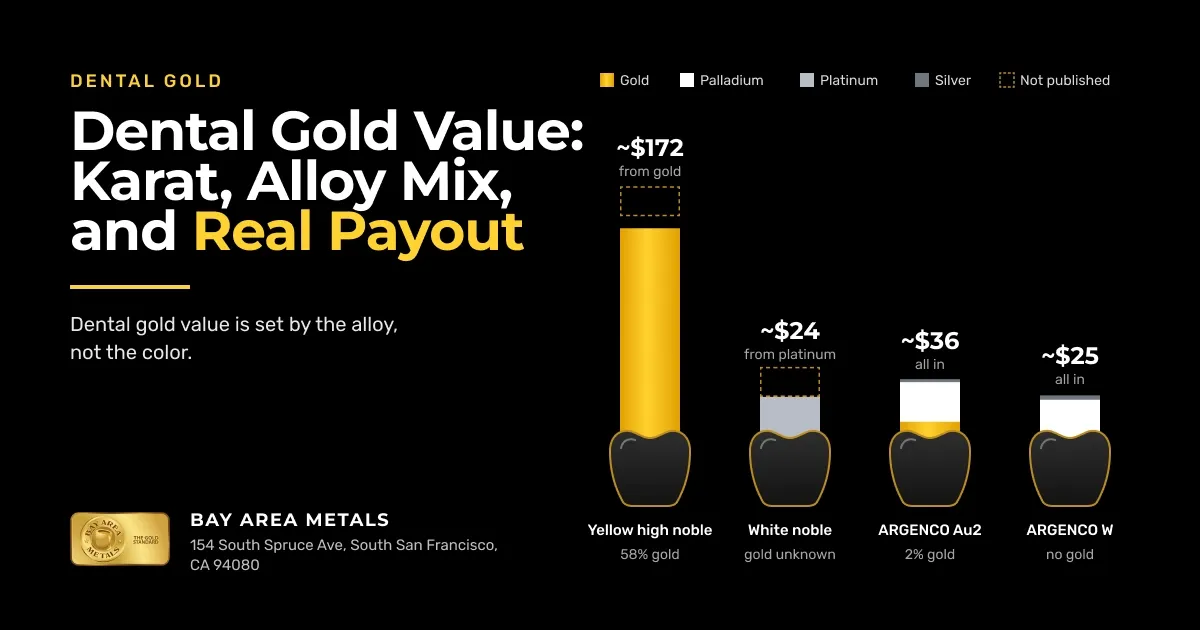
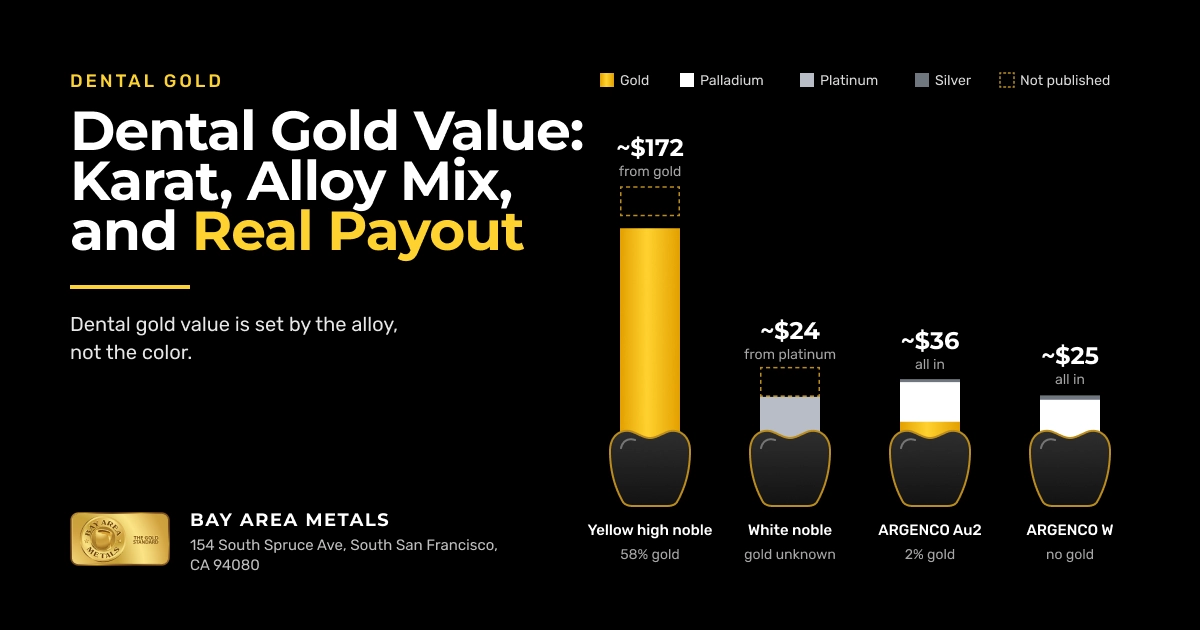
At $4,624.73 an ounce, a 2-gram crown at 58% gold holds about $172 of gold. The same crown in a 2% gold alloy holds about $6 of gold, plus about $28.50 of palladium that only a refinery will pay you for.
The Type number on a lab invoice describes hardness, not gold. ISO 22674 sorts dental metals by yield strength and elongation, so a Type IV alloy can be 58% gold or 2% gold.
You may not have to guess. Labs supply an IdentAlloy certificate naming the exact alloy, and dentists are asked to file it in the patient record.
Two gold-colored crowns sit on the counter. Same size, same weight, same warm yellow. One holds about $172 of gold at today's price. The other holds about $6.
Nothing about them tells you which is which. Dental restorations are not hallmarked: no 14k stamp, no paperwork in the envelope, no way to sort them by eye. That is why dental gold value is so widely misunderstood, and why the figures you find online, somewhere between "$10 a crown" and "$40 to $100 a gram," cannot be answered in that form. A gram of what?
What decides dental gold value
Three inputs: the weight of metal left after everything that is not metal comes off, the percentage of each precious metal in it, and the share of spot price your buyer pays. The math is the easy part.
(grams of metal x the fraction that is gold) ÷ 31.1035 x gold spot price = gross gold value
Do the same for palladium, platinum, and silver, then add the four results. Gold traded at $4,624.73 per troy ounce on 27 August 2026, palladium at $1,355.00, platinum at $1,851.00, and silver at $69.17, per JM Bullion's live spot charts, and spot moves all day, so every figure below shows the method rather than quotes a price.
The middle input is the hard one. Weight you can measure and spot you can look up, but the alloy fraction has to be assayed. Until it is, nobody at any counter knows what your crown is worth.
Karat is the wrong unit for a crown
Karat describes 24ths of pure gold, and jewelry carries it as a stamp. Dental alloys are not sold that way. Manufacturers publish composition by weight percent, and labs order by product name.
The American Dental Association's classification sorts casting alloys into three classes instead. High noble means at least 60% gold plus platinum-group metals, with gold at 40% or more. Noble means at least 25% noble content and sets no gold minimum at all. Predominantly base is anything under 25%.
"Noble" is not a synonym for gold. The ADA counts gold, platinum, palladium, iridium, rhodium, osmium, and ruthenium as noble metals, so an alloy can clear the 25% bar on palladium alone and contain no gold whatsoever.
The Type number is about hardness. Lab menus list Type III and Type IV alloys, and sellers read those as a quality grade. They are not. ISO 22674 sorts dental metals into six types by 0.2% proof stress, elongation, and modulus of elasticity, as Yu and colleagues set out in Materials in 2021. Type IV means hard. It can be 58% gold or 2% gold.
One lab's menu, four alloys, four different answers
Distinctive Dental Studio, a US dental lab, publishes the composition of the all-metal crown alloys it works in, all supplied by The Argen Corporation. Here is the gross metal in a 2-gram restoration of each, before any refining deduction:
Every one is a real crown a dentist could have cemented in your parent's mouth. The first and the third are both yellow, and they differ by a factor of five in total metal and twenty-nine in gold. Read those as nominal compositions, not a reading of your crown. The rest of the 2% gold alloy is indium and zinc, which pay nothing, and neither does the cobalt-chromium option most labs also sell. Base metal pays nothing at all, which is a different thing from paying badly.
When the gold runs out, the palladium does not
The 2% gold row is where the seller and buyer most often part ways.
Two grams of that alloy holds about $6 of gold. It also holds 32.7% palladium and 34.5% silver, worth about $28.50 and $1.50 at today's prices. So a buyer pricing your envelope on gold alone looks at a $36 piece and offers against $6 of it. Nothing dishonest has to happen for that. A counter that cannot assay has to assume the worst, and a buyer who does not refine palladium cannot turn it into money.
That is the practical case for dealing with a refinery rather than a shop that resells to one, which we rank buyer by buyer in where to sell dental gold near me. We recover gold, silver, platinum, and palladium from the same melt, because all four arrive in the same lot, and we publish up to 99% of daily spot for gold and up to 90% for silver, platinum, and palladium.
Weigh that against the obvious: a refinery telling you to use a refinery has an interest in the advice. So take the checkable part instead. Ask any buyer which metals they pay on and what percentage of spot they pay.
What comes off before anyone pays
Gross weight is not payable weight, and the gap is wider in dental scrap than in anything else we take in.
Porcelain, cement, and tooth structure all weigh something, and none of it is worth anything. A porcelain-fused-to-metal crown is a thin metal coping under a ceramic shell, so the piece on your kitchen scale is mostly the part with no metal value in it, and any offer quoted on uncleaned gross weight is quoted against the wrong number. Do not clean anything yourself, though. We take the porcelain and cement off here. Pull out gemstones you want to keep and bring the rest as it is.
Then the lot has to be melted before it can be assayed. Sample an unmelted envelope and you have measured whichever piece the technician picked up, so the pieces go into the furnace, come out as one bar, and the sample is drilled from that bar. Solder joints, base-metal posts, and the occasional stainless screw all land in that average, which is why the answer comes at lot level rather than per crown. We walk through the full sequence in how precious metal refining works, and the assay that settles the number has its own guide.
None of that arrives as a separate invoice. The melt and the assay cost about the same at 8 grams as at 800, and that cost sits inside the spread between spot and your payout.
How to find out before you sell
There are two options:
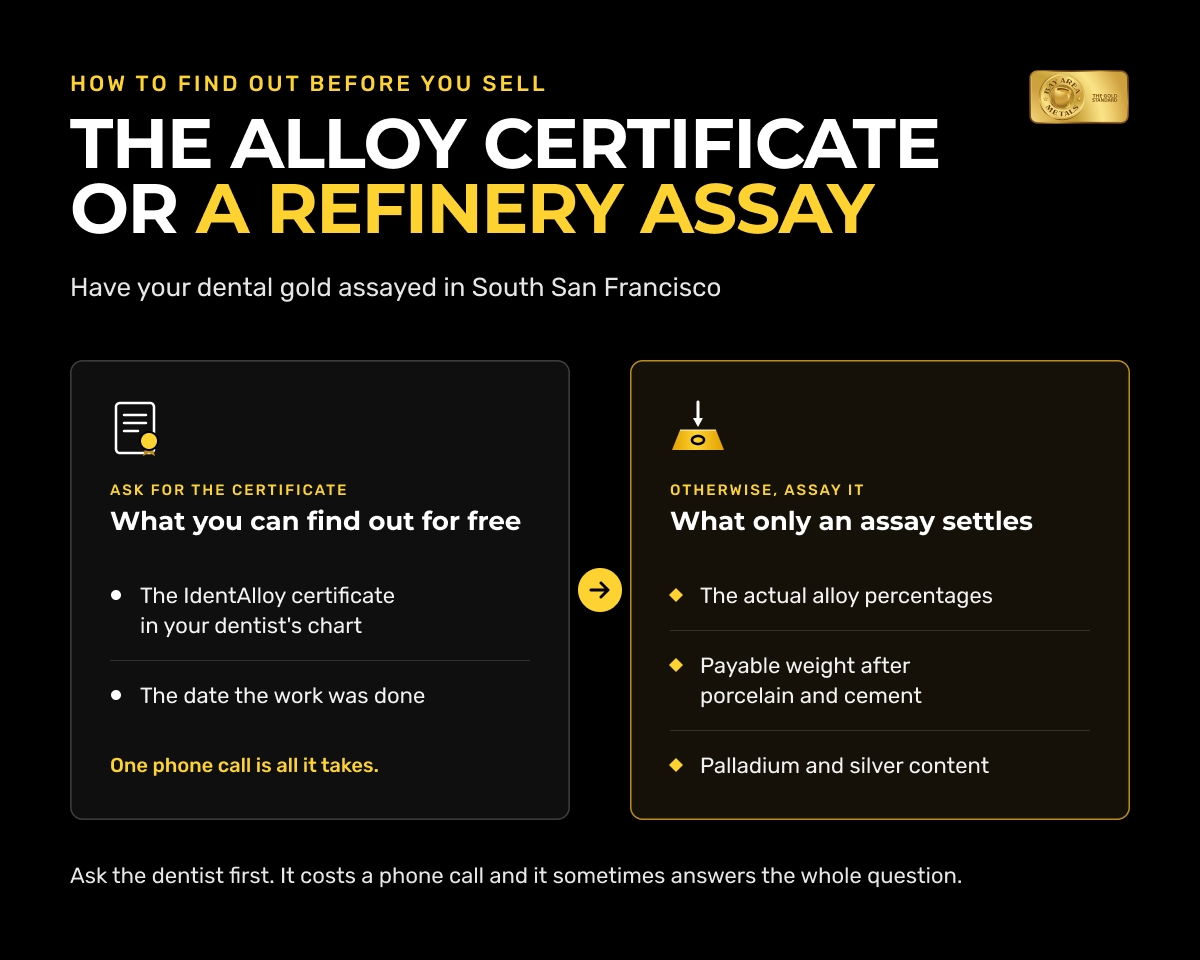
Ask for the certificate. Since 1986 the IdentAlloy Council has run a program in which manufacturers supply a certificate naming the exact alloy and its composition with every restoration. The council asks patients to remind their dentist to file that certificate in their record for every crown or bridge, and estimates that around 90% of the precious metal alloy products now used in the US are registered with it. If the work is recent and the office kept the chart, what your crown is made of may already be written down. One phone call is all it takes.
Otherwise, assay it. For estate material, older work, or anything unlabeled, no certificate exists and the metal has to speak for itself. Set your expectations first. The ADA notes that by 1980 the rising price of gold pushed dentistry toward base metals, so a crown from 1974 and one from 2014 are not the same wager. The $172 row is the good outcome, not the average one.
Have your dental gold assayed in South San Francisco
Bring what you have, including the pieces you assume are worthless. At our South San Francisco refinery your lot is weighed, cleaned, melted into one bar, assayed, and priced in front of you against the day's spot on all four metals before any money moves. We are the refinery rather than a middleman reselling to one, and we run dental scrap every week for families and labs.
Call or text +1 650-675-5009, or come to 154 South Spruce Ave, South San Francisco, CA 94080, and ask to see the assay.
Frequently Asked Questions
Author
Issac Makdessian is the owner and head refiner at Bay Area Metals, the family-owned precious-metals refinery at 154 South Spruce Ave, South San Francisco, CA 94080. The business has refined gold, silver, platinum, and palladium in the Bay Area since 2012 for public sellers and for B2B clients across the region's jewelry, dental, pawnshop, electronics, and solar industries. Bay Area Metals holds an A+ rating with the Better Business Bureau.