
Dental Lab Refining: Crowns, PFMs, and California Rules
By Issac Makdessian, Owner and Head Refiner at Bay Area Metals. Operating the family-owned South San Francisco refinery since 2012. Gold, silver, platinum and palladium refining for the Bay Area's jewelry, dental, pawnshop, electronics and solar trades.
Key Takeaways
Dental lab refining, in one line: a refinery melts and assays your scrap itself, so the alloy mix gets measured instead of estimated. Every other buyer eventually sells that scrap to a refinery.
It cannot take amalgam. Amalgam is nearly 50% mercury, and per California's DTSC (July 2009 fact sheet) it is hazardous waste, manageable as universal waste but never as trash. Same for teeth with amalgam, chair and sink traps, and vacuum filters.
Weight is not a value. Alloy mix is. Gold traded at $4,087.25 per troy ounce on July 29, 2026 and palladium at $1,297.51 on July 28, 2026 (JM Bullion). Ten grams of fine gold holds $1,314; ten grams of palladium, $417.
Most dental labs run two scrap streams without ever deciding to: the jar of crowns and bridges that came back from the office, and whatever accumulates under the bench. Buttons, sprues, grindings, the carpet by the polishing lathe. Both hold recoverable metal. Usually only one gets sold.
Search for a dental refiner and you find a dozen national companies saying the same sentence: send us your crowns, we pay top dollar. None of them tells a California lab which parts of that stream are legally yours to ship, which parts are regulated waste, and what has to happen to a lot before the settlement number is one you can check.
What can a refinery take from a dental lab?
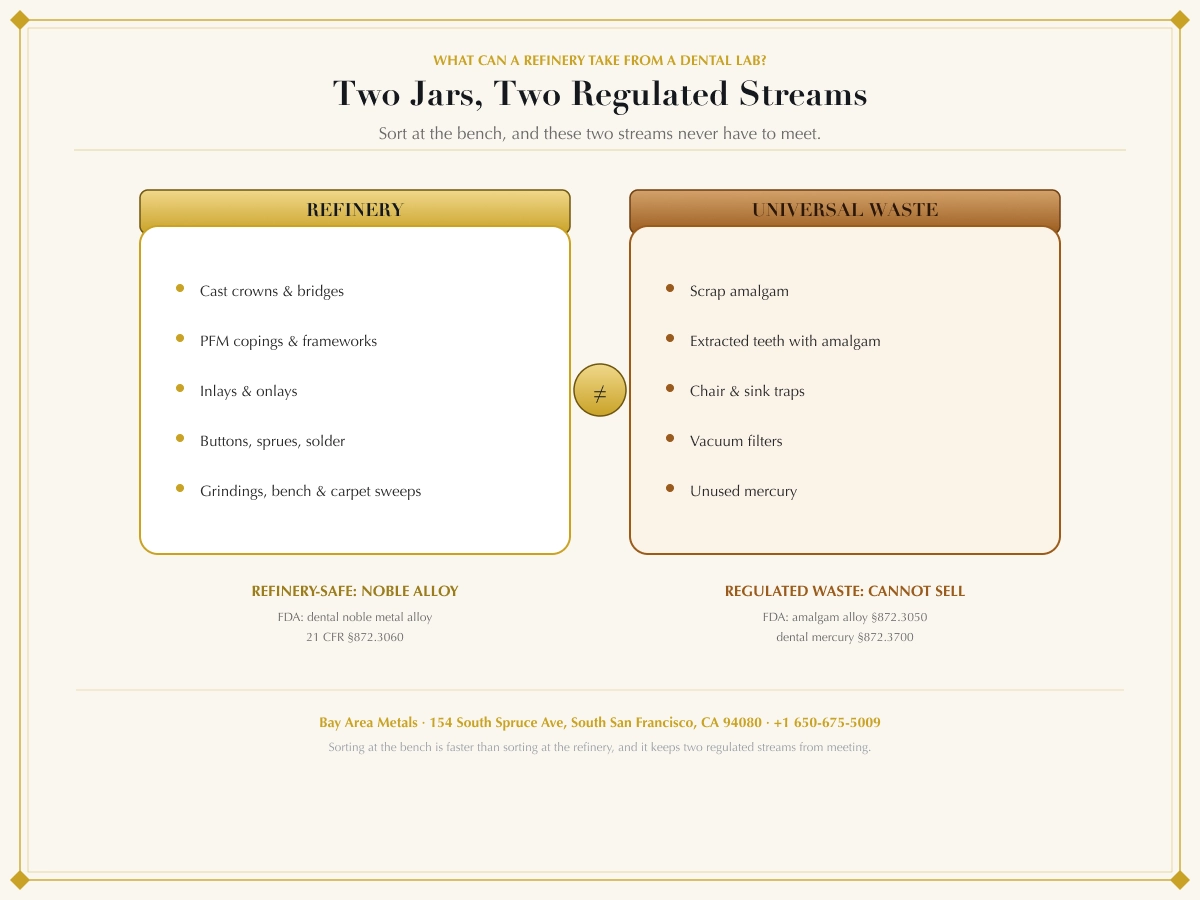
Anything whose metal is a noble alloy. Full-cast crowns and bridges, PFM copings and frameworks, inlays and onlays, partials with noble clasps, and the production scrap most labs forget to count: buttons, sprues, spent solder, grindings, and bench and carpet sweeps.
The FDA draws this line in its own device classification. Under 21 CFR §872.3060, a dental noble metal alloy is a device "composed primarily of noble metals, such as gold, palladium, platinum, or silver," intended for cast or porcelain-fused-to-metal crown and bridge work.
What you cannot send: amalgam and amalgam-bearing waste
Amalgam never goes to a precious metal refinery. In California it is hazardous waste, and it cannot be put in the trash.
DTSC's July 2009 fact sheet for dental, medical and veterinary offices is specific about why. Amalgam is nearly 50% mercury, and because it also contains copper and zinc it cannot be treated as an exempt silver-only waste. Unused mercury, scrap amalgam, teeth with amalgam, chair and sink traps and amalgam-bearing filters may all be managed under California's universal waste standards instead of the full hazardous waste standards. Lighter paperwork, still not the trash.
The California Dental Association's amalgam waste best management practices (2010 revision) put numbers on the housekeeping, and mark several items mandatory under California Code of Regulations Title 22:
Do not place amalgam, elemental mercury, broken capsules, teeth with amalgam, or amalgam-bearing traps and filters in red-bag or regular solid waste.
Store dry scrap amalgam in a designated airtight container labelled "Scrap Dental Amalgam" with your office name, address, phone number and the date you started filling it, and log what went in and when it left. Inspectors may ask to see the log.
Extracted teeth get their own rule. CDC's guidelines say to dispose of them as regulated medical waste unless returned to the patient, under OSHA's Bloodborne Pathogens standard, and not to put teeth containing amalgam into medical waste bound for incineration, since burning them puts the mercury into the air.
Your Certified Unified Program Agency is the authority for your county, and none of the above is compliance advice. One takeaway is immediately actionable, though: if a refiner offers to take your amalgam along with your crowns, that tells you something about the rest of their process.
How should a lab prepare a lot so the assay is worth trusting?
Clean and disinfect before anything leaves the operatory or the lab, keep unlike material in separate containers, and otherwise send the pieces exactly as they are.
The disinfection step is not ours to do for you. Under the Dental Laboratory recommendations in CDC's Guidelines for Infection Control in Dental Health-Care Settings, prostheses and prosthodontic materials should be cleaned, disinfected and rinsed with an EPA-registered hospital disinfectant carrying at least intermediate-level, tuberculocidal activity before they are handled in the laboratory, with PPE worn on anything received until it has been decontaminated. DTSC makes the same point from the waste side: recyclers accept teeth with amalgam only where the sender certifies the material is not infectious.
Document the disinfection method and its duration. The same CDC guidelines ask for that record whenever laboratory cases travel off-site, and a scrap lot leaving for a refinery is a case travelling off-site.
Keep solid metal apart from sweeps. Ganoksin's guidance for the trade, from David H. Fell & Co., splits meltable byproduct such as sprues, buttons and filings from burnable byproduct such as polishing dust and floor sweeps, and puts solid gold settlement at immediate to ten days against two to four weeks for sweeps. Mixed together, you lose visibility into both.
Do not strip porcelain, cement or investment off a casting; the assay accounts for it, and lots arrive here full of plaster and grit anyway. And do not send paperwork in the jar.
What actually moves your payout?
Alloy mix, not weight. Gold traded at $4,087.25 per troy ounce on July 29, 2026, and palladium at $1,297.51 on July 28, 2026, both per JM Bullion. Ten grams of fine gold holds $1,314 at those prices and ten grams of palladium $417, so a high-noble lot and a palladium-silver lot of identical mass settle multiples apart. A per-gram quote offered before an assay is a guess wearing a number's clothing. The per-gram arithmetic is worked through here.
How you lot the material decides whether that mix gets measured properly. For routine accumulation, one bulk melt assayed once beats pricing pieces individually, and the reason is sampling rather than fees: a jar of mixed castings is not uniform, so a sample off the top means nothing. Melt it into one homogeneous bar and the sample you draw represents the whole lot, at the cost of one assay instead of many. Our walkthrough of the refining process covers assay, smelt and payout in full.
Separate assays earn their cost in narrow cases: a heavy high-noble bridge among base-metal copings, or a stream you suspect is palladium-rich. Make that call before the metal goes in the furnace, and the returns stop surprising you.
"Fast, honest, and consistent. Never have any issues and all our expected returns are always in line." - Roy P., jewelry store owner · customer testimonial, bayareametals.com
Then the deduction, covering the assay and the metal lost in processing. Ask for it as a formula rather than a net figure. A refiner who will show you the calculation is a refiner whose calculation survives being shown.
The settlement form is the part labs undervalue. Payment can come as cash, gold bars, or casting grain in the karat you work in. For a lab that buys alloy anyway, grain closes the loop: scrap out, usable metal back, and a supplier margin gone from your cost of goods.
Three questions to ask any dental refiner
Do you melt and assay on site, or broker it onward? Brokered means you are paying a margin to reach the refinery anyway.
Can I be present for the melt and the assay? A no is a request that you accept a number you cannot check.
Will you report the assay element by element, with weights? One net figure is not a report.
If you already ship to a national refiner, the honest comparison is not price, it is verification. Prepaid mailers are convenient and some mail-in houses run real assays, but the material is gone before you learn what it was, and a disputed settlement cannot be re-run on metal already poured into someone else's bar. If South San Francisco is not practical, mail it and insist on the element-by-element assay anyway.
Our guide for Bay Area businesses covers how trade accounts work across the trades we serve.
Open a dental lab refining account
Bring a lot in and watch it run, or ship it insured and call so we know it is coming. Start on our sell dental gold direct to the refinery page, or text (650) 225-9100 to open an account at 154 South Spruce Ave, South San Francisco. Payment is the same day or next day on most lots.
Frequently Asked Questions
Author
Issac Makdessian is the owner and head refiner at Bay Area Metals, the family-owned precious-metals refinery at 154 South Spruce Ave, South San Francisco. The business has operated in the Bay Area since 2012, refining gold, silver, platinum and palladium for public sellers and for the region's jewelry, dental, pawnshop, electronics and solar trades. Bay Area Metals carries an A+ rating with the Better Business Bureau.