
How to Sell Gold Jewelry for Cash in the Bay Area: A Step-by-Step Walkthrough
By Issac Makdessian, Owner and Head Refiner at Bay Area Metals. Operating the family-owned South San Francisco refinery since 2012. Specialist in gold, silver, platinum, and palladium refining for public sellers and B2B industry clients across the Bay Area.
Key Takeaways
Selling gold jewelry for cash in the Bay Area is a six-step process: sort what you have, check the day's LBMA spot price, run the payout math, choose a buyer type, bring the right ID, and complete the transaction at the counter.
Your payout is determined by spot price × karat purity × weight in grams, minus a small deduction for assay and refining loss. As of late May 2026, gold spot is moving in the $4,400 to $4,500 per troy ounce range.
A refinery payout (up to 99% of spot at Bay Area Metals) is the highest available option for jewelry in the region. A pawn shop typically pays around 70% of spot; a cash-for-gold storefront commonly pays 50% to 65%.
California Business and Professions Code §21628 requires any licensed buyer to verify your ID, fingerprint you, and report the transaction. Bring a current government-issued photo ID with you.
Most jewelry transactions at our South San Francisco refinery take 20 to 45 minutes and pay out the same day. Walk-ins welcomed during posted hours; appointments recommended. Call (650) 675-5009 to book a slot.
Where can you sell gold jewelry for cash near me in the Bay Area?
The Bay Area has three kinds of gold-jewelry buyer, and the buyer type controls the payout more than any other variable.
A refinery is the end of the supply chain. We melt, assay, and convert the gold into investment-grade bars or casting grain that go to the next buyer. Because nobody is reselling your jewelry to us at a markup, the refinery payout is closer to the wholesale spot price than any other option. The single Bay Area refinery serving the public is Bay Area Metals at 154 South Spruce Ave, South San Francisco.
A pawn shop buys your jewelry and resells it upstream, often to a refinery like ours. The pawn shop's margin is the difference between what they pay you and what we pay them. Pawn shops are local, fast, and useful for small lots; they are not designed to maximize the seller's payout.
A cash-for-gold storefront or kiosk runs a similar model with even thinner overhead and faster turnover. Walk-ins are quick; payouts reflect the layered margin.
For most public sellers carrying anything beyond a single small piece, the refinery delivers the highest dollar outcome. The six steps below walk through the actual process, in order.
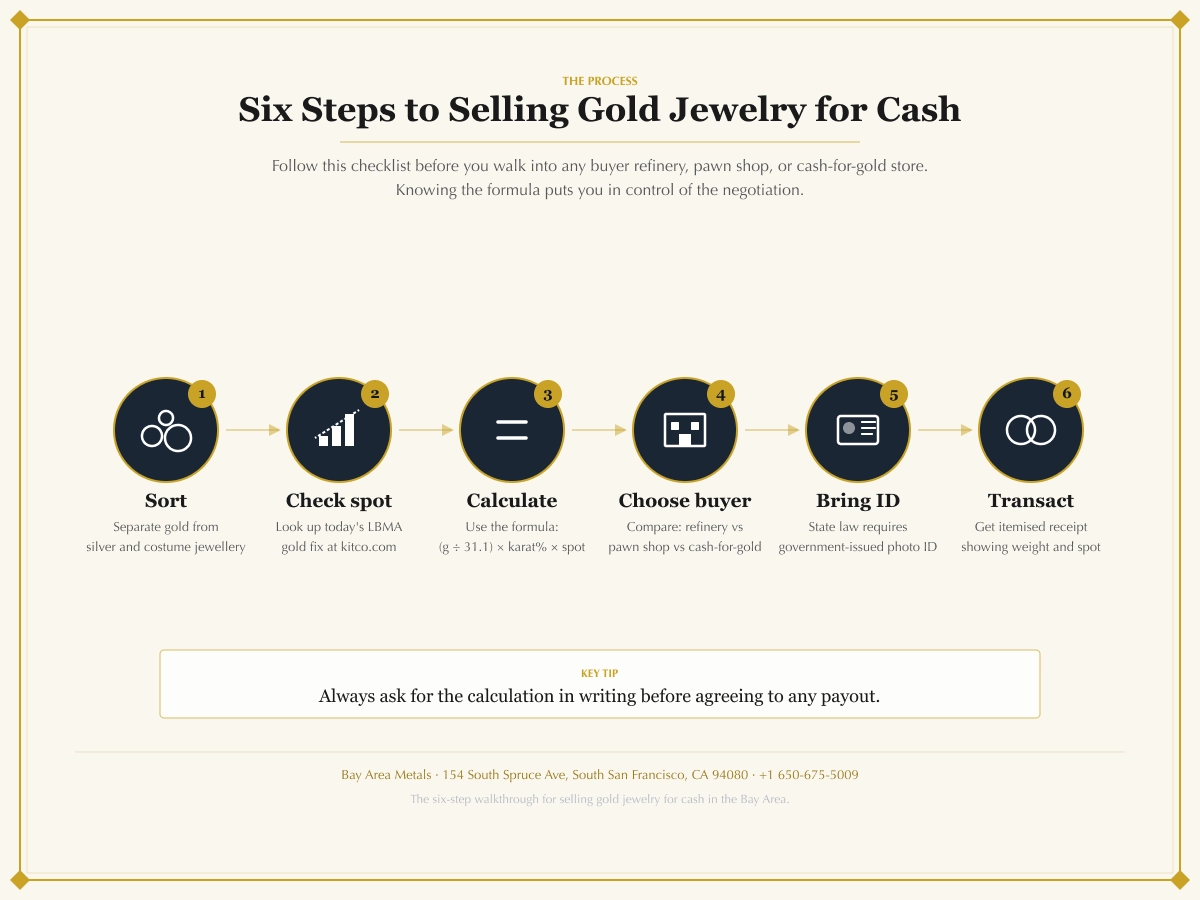
Step 1: Sort your jewelry by karat and condition
Before you go anywhere, take 10 minutes to sort what you have. This step alone speeds the eventual transaction by a third and gives you a credible payout estimate before you walk into any buyer.
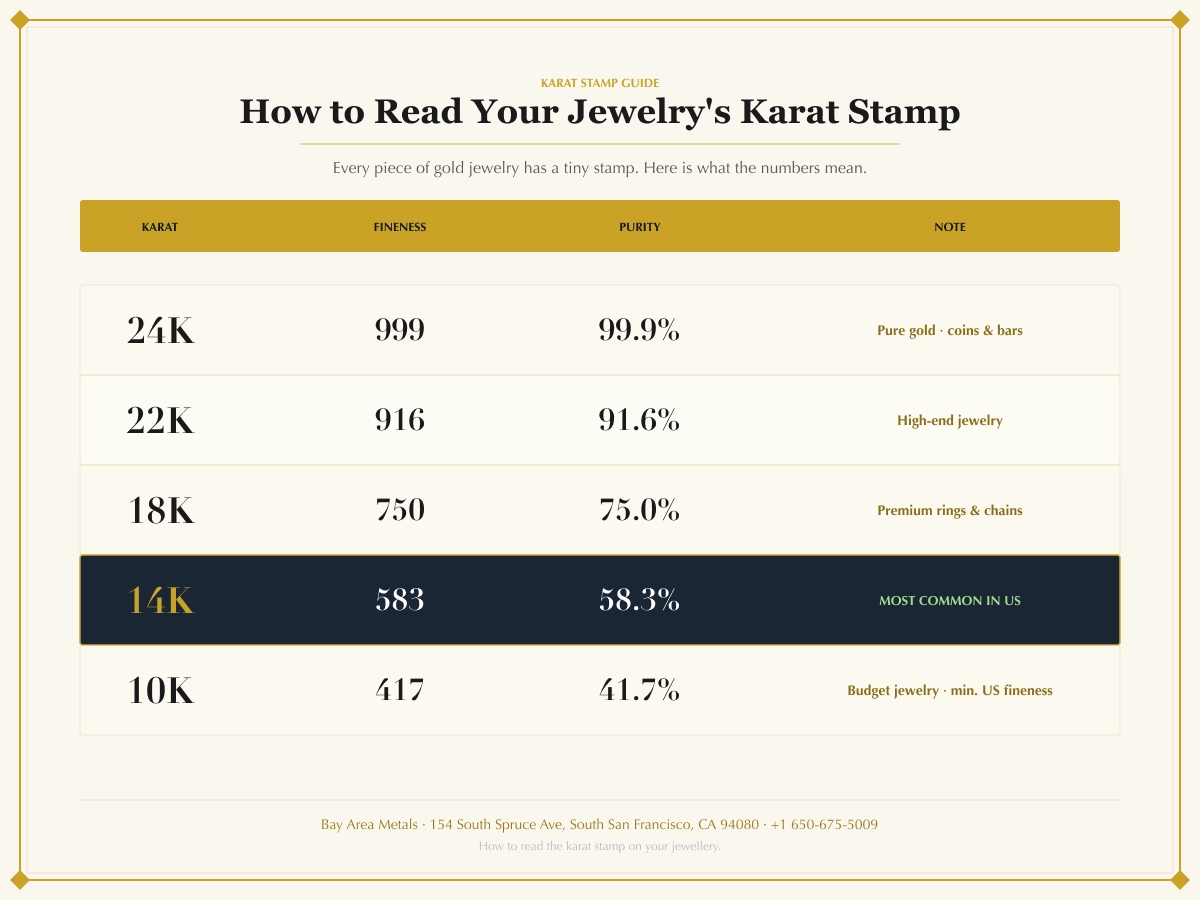
Look at each piece and find the karat stamp, usually on the inside of a ring, the clasp of a chain, or the post of an earring. Common stamps:
24K or 999 (99.9% pure gold; rare in jewelry)
22K or 916 (91.6% pure)
18K or 750 (75% pure)
14K or 583 (58.3% pure; the most common US jewelry karat)
10K or 417 (41.7% pure)
If a piece has no stamp, it may still contain gold but the karat will need to be confirmed by the buyer with an acid test or XRF gun. Set unstamped items in a separate pile.
Separate by condition into three buckets:
Wearable (intact pieces that could be resold as jewelry, not just melted). If the resale value as wearable jewelry is higher than melt, you may want to consult a jeweler before selling to a refinery.
Broken or partial (single earring, broken chain, missing stones). These pay the same as wearable on a per-gram basis, because the refinery values metal content not jewelry condition.
Plated or fashion (gold-plated brass, gold-filled costume jewelry). These usually have negligible gold weight and may not be worth selling.
Setting aside the wearable-resale and plated buckets, the remaining piles are your sellable lot.
For inherited dental gold (crowns, bridges, PFMs), the process differs slightly. See our dental gold guide for the dental-specific walkthrough.
Step 2: Check today's LBMA gold spot price
Spot gold is the live wholesale price per troy ounce, set twice daily by the London Bullion Market Association (LBMA) at 10:30 and 15:00 GMT through an ICE Benchmark Administration auction overseen by the Bank of England. Every retail tracker (Kitco, APMEX, JM Bullion, etc.) prices off the LBMA benchmark.
Pull the live LBMA price on your phone before you do anything else. As of late May 2026, spot has been moving in the $4,400 to $4,500 per troy ounce range, off January 2026's all-time high of $5,602. By the time you publish, that range may have shifted; the LBMA site is always current.
Note the spot price and the date. You will use this number in Step 3.
Step 3: Calculate your estimated payout
Here is the math, in plain order. The four inputs are spot price, karat, weight, and deduction.
Formula:
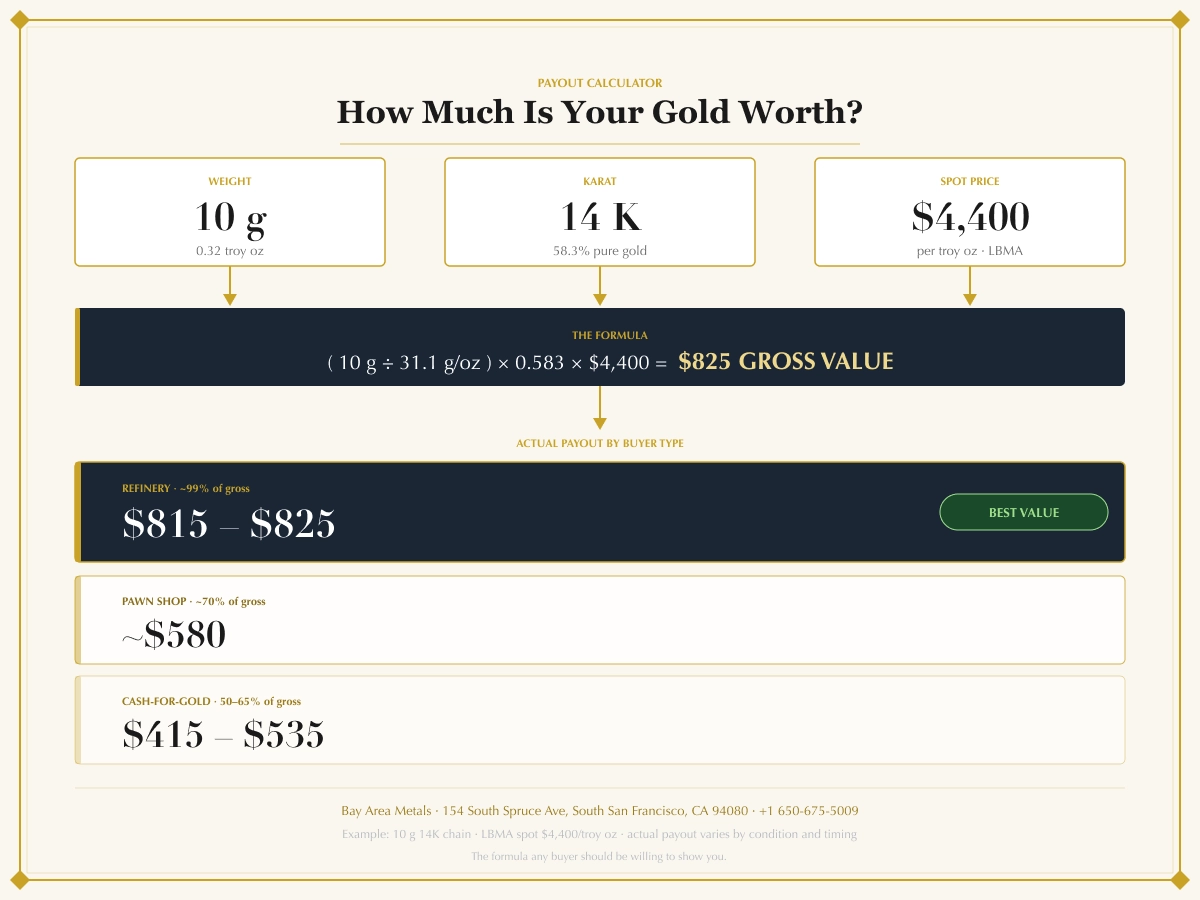
Pure gold content (grams) = total weight (g) × karat purity ratio Pure gold (troy ounces) = pure gold grams ÷ 31.1035 Gross value = pure gold troy ounces × LBMA spot per ounce Net payout = gross value × buyer payout percentage
Worked example:
Say you have a 14k chain that weighs 10 grams, and the LBMA spot price is $4,400 per troy ounce (typical for late May 2026; check the live number).
Pure gold content: 10 g × 0.583 (14k purity) = 5.83 g pure gold
Convert to troy oz: 5.83 ÷ 31.1035 = 0.1875 troy oz
Gross value at spot: 0.1875 × $4,400 = $825
Now apply the buyer payout percentage:
The gap between a refinery payout and a pawn-shop offer on this single chain is roughly $200 to $250. On a larger lot (three chains, a ring or two, and some scrap totaling 40 grams of 14k), the gap commonly runs $1,000 or more.
For the deeper walkthrough of how this calculation works in practice, including why the deductions exist, see our full Bay Area selling guide (A1) and our scrap gold guide (A7) when A7 publishes.
Step 4: Choose a buyer type
You now have an estimated gross value and three buyer-type payout ranges. The question is which one fits your situation.
Choose a refinery if:
Your sellable lot weighs more than a few grams of pure gold content.
You want the highest dollar outcome and you can spare 30 to 60 minutes for the trip from your part of the Bay Area.
You want to watch the weighing and assay yourself, on a calibrated scale, with the math on the counter.
Choose a pawn shop if:
You have a single small piece and the time cost of a refinery trip outweighs the dollar difference.
You are local to the pawn shop and prefer a 10-minute walk to a 45-minute drive.
Choose a cash-for-gold storefront if:
The lot is genuinely small (a single earring, a broken chain with low gold weight).
Speed matters more than dollars.
Most Bay Area public sellers carrying anything beyond a single small piece make the trip to a refinery, because the dollar gap on a meaningful lot covers the trip many times over.
"All the jewelers come here to sell their gold for melting purposes. This place offers you the best prices! Issac the owner is friendly and professional. The whole transaction is painless and fast!" — Debbie G., Millbrae, CA · customer testimonial, bayareametals.com
If the working jewelers of the Bay Area are driving to the refinery to sell their own scrap, that is signal about which buyer type to choose for your own.
Step 5: Bring the right ID and paperwork
California Business and Professions Code §21628 requires any licensed precious-metal buyer to:
Verify the seller's identity using a currently valid (or issued within the last five years) government-issued photo ID with a serial number.
Record a certification of ownership from the seller.
Take a legible fingerprint.
Report the transaction to the state through CAPSS (the California Pawn & Secondhand Dealer System).
Retain records for three years.
This applies in San Francisco, Oakland, San Jose, South San Francisco, and anywhere else in California. If a buyer does not ask for ID and does not appear to be reporting the transaction, that is a regulatory red flag. Walk back out with your jewelry.
Bring to the appointment:
A government-issued photo ID (driver's license, state ID, or passport).
The jewelry, in your three sorted piles (Step 1).
Any documentation you have on coins or older pieces, especially anything stamped before 1933.
A phone with a calculator, to verify the math at the counter.
You do not need an appraisal certificate, a receipt of original purchase, or any other paperwork.
Step 6: At the counter, what to expect and what to watch
Here is what a typical jewelry transaction looks like at our South San Francisco refinery. It takes 20 to 45 minutes from walk-in to payout.
Logging. We photograph your ID and the jewelry together, take the certification of ownership, and the legible fingerprint required by §21628.
Weighing. We weigh each piece, or each karat group, on a calibrated digital scale that is visible to you. You see the gram reading.
Karat testing. For most jewelry, an acid test or an XRF (X-ray fluorescence) gun gives the karat read in a minute or two per piece. For larger or higher-stakes lots, we run a fire assay by cupellation, which takes about 45 minutes and is the most accurate method available. You are welcome to watch any of these tests.
Math. Spot × purity × weight, minus a small deduction, equals your payout. The breakdown is written down or shown on a screen before you decide.
Decision. If you accept, the payment goes out same-day or next-day in your preferred form (cash, casting grain, gold bars, or wire).
If a buyer wants to take your jewelry to a back room to weigh or test, ask why. A refinery has nothing to hide; every step is built to be watchable.
"I'm a jeweler/goldsmith and have dealt with many refiners. Bay Area Metals are the most upfront and honest with the highest payout. I just moved here from NYC and am really happy I can take my scraps here." — Jennifer N., Brooklyn, NY · customer testimonial, bayareametals.com
If a working jeweler drives across the country and chooses the refinery, the transparency at the counter is doing the work.
How long does the whole process take, end to end?
For most public sellers:
At-home sorting and math (Steps 1 to 3): 15 to 30 minutes.
Drive time: varies. From downtown SF, 15 to 25 minutes. From Oakland, 30 to 45 minutes plus an $8.50 westbound Bay Bridge toll. From San Jose, 40 to 45 minutes via US-101 North with no tolls. From Berkeley or Marin, somewhere in between.
The transaction itself: 20 to 45 minutes.
Payment: same day or next day, depending on lot size and payment form.
A complete first-time sale of a typical lot from start to finish, including the trip, lands around two hours. Repeat sellers cut the at-home prep down to a few minutes and the transaction proceeds faster because they know what to bring.
FAQ
Ready to sell your gold jewelry? Two ways to start
Start your refinery sale on our dedicated process page, with the address, ID requirements, and next steps.
If you want a payout estimate before you drive, text or call (650) 675-5009 with a description of what you have (karat stamps you can read, approximate weight, number of pieces). We will give you a same-day range based on the live LBMA spot. If the math doesn't justify the trip, we will tell you.
About the author
Issac Makdessian is the owner and head refiner at Bay Area Metals, the family-owned precious-metals refinery at 154 South Spruce Ave, South San Francisco. The business has operated in the Bay Area since 2012, refining gold, silver, platinum, and palladium for public sellers and B2B clients across the region's jewelry, dental, pawnshop, electronics, and solar industries. Bay Area Metals carries an A+ rating with the Better Business Bureau and a 5.0 Yelp rating from over 60 published customer reviews.