
How to Sell Silver, Platinum & Palladium in the Bay Area
By Issac Makdessian, Owner and Head Refiner at Bay Area Metals. Operating the family-owned South San Francisco refinery since 2012. Specialist in gold, silver, platinum, and palladium refining for public sellers and trade clients across the Bay Area.
Key Takeaways
The highest-paying place to sell silver, platinum, or palladium in the Bay Area is a working refinery, because it sits at the end of the supply chain and pays you directly instead of buying to resell. Bay Area Metals publishes a payout of up to 90% of the daily London spot price for all three white metals.
Payout is a calculation, not a guess: the day's spot price, the metal's purity (sterling silver is 92.5% pure; platinum jewelry is usually 90–95%), the weight in troy ounces, and a small assay deduction.
Silver comes to us as sterling flatware, coins, jewelry, and industrial scrap; platinum as jewelry and lab material; palladium as jewelry, dental alloy, and electronic components. Each is assayed for its exact content, not eyeballed.
At our South San Francisco refinery you can stand at the counter and watch your own metal weighed, assayed, and paid, the same day for most lots. A national mail-in service sends your metal away and mails back a number.
California law requires any precious-metal buyer to verify your ID and keep a record of the transaction, so bring a government-issued photo ID with any lot you sell.
Where can you sell silver, platinum, and palladium in the Bay Area?
The best place to sell silver, platinum, or palladium in the Bay Area is directly to a refinery, because a refinery is the buyer everyone else eventually sells to. A pawn shop, a jewelry store, or a cash-for-gold counter buys your metal to resell it up the chain, and the last stop in that chain is a smelter. Selling to the refinery yourself removes every markup in between.
Bay Area Metals is a family-owned refinery at 154 South Spruce Avenue in South San Francisco, operating since 2012. We buy and refine all four precious metals, and we publish a payout range of up to 99% of spot for gold and up to 90% of spot for silver, platinum, and palladium. This guide covers the three white metals: what your scrap is actually worth, how the number is calculated, and what selling directly to a refinery looks like from the counter.
Why sell white metals to a refinery instead of a pawn shop or jeweler?
A refinery pays more than a pawn shop or jeweler because there is no middleman between you and the smelter taking a cut. A pawn shop that offers you cash for a set of sterling flatware is not keeping it: it plans to resell that silver, often to a refinery, and the price it offers you has to leave room for its own profit. When you sell to the refinery, that margin stays in your pocket.
The second reason is the assay. A jewelry counter typically quotes from a scale reading and a guess at purity. A refinery measures the exact metal content, which matters most for the white metals, where an item's real value is easy to misjudge. A heavy-looking platinum ring and a nickel-white gold ring can look identical, and only a purity test tells them apart.
The trade-off people worry about is trust: how do you know the assay is honest? Our answer is to remove the question entirely. You watch it happen.
"I have been here several times and it's always a quick and fair experience. I have been bringing gold and precious metals to different folks for decades and dealing with the owner here has been a good experience." - Emily T., Berkeley, CA · customer testimonial, bayareametals.com
When someone who has sold metal for decades calls the experience quick and fair, that is the part a mail-in refiner cannot offer. Your metal never leaves your sight.
How is your payout calculated?
Your payout is four numbers: the day's spot price, the purity of your metal, the weight in troy ounces, and a small deduction for the assay and refining loss. Every legitimate refiner works from the same formula, which is exactly why a refinery can show you its math instead of naming a figure.
Spot is the global wholesale price, benchmarked twice a day in London. The London Bullion Market Association administers the daily silver price and the platinum and palladium reference prices through auction, and every honest buyer prices off those same numbers. Purity is measured as fineness: fine silver is 99.9% pure, sterling is 92.5% (stamped 925), and most platinum jewelry runs 90 to 95% (stamped 950 or 900). Weight is taken in grams on a calibrated scale and converted at 31.1035 grams per troy ounce. The deduction covers the fire assay and the fraction of metal lost in the melt.
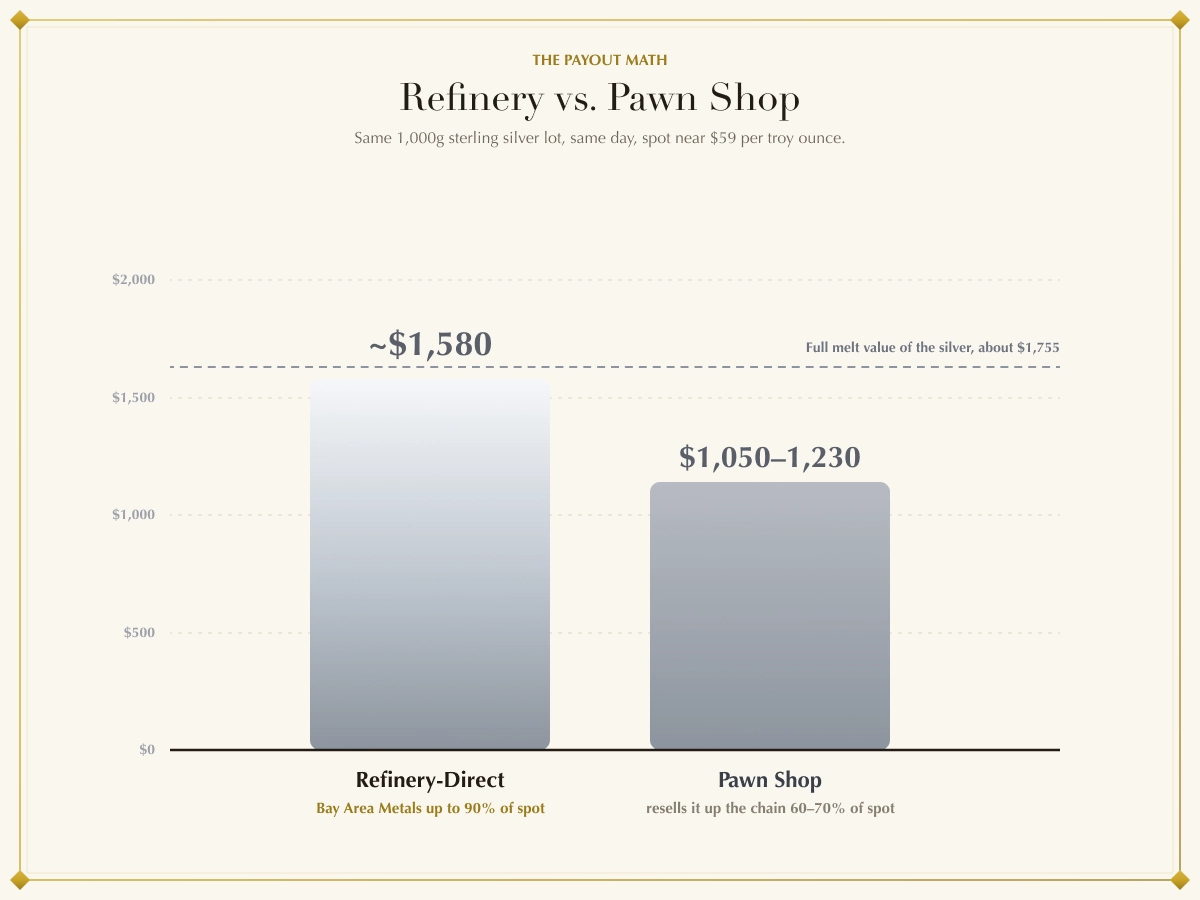
A worked example makes it concrete. Say you bring in a box of sterling silver flatware and jewelry weighing 1,000 grams of actual sterling, on a day when silver spot is about $59 per troy ounce (the level in late July 2026; verify the live price before applying this to a real lot). The pure silver content is 1,000 g × 0.925 = 925 g, or 29.7 troy ounces. At spot that is roughly $1,755 of silver. A refinery paying near the top of its published range settles that lot within a few percent of $1,755, minus the assay deduction. A pawn shop buying at 60 to 70% of spot to resell it would hand you somewhere around $1,050 to $1,230 for the same box. On one modest lot, selling direct is worth several hundred dollars.
How to sell silver in the Bay Area: sterling, coins, flatware, and industrial scrap
We buy silver in almost every form, from a single sterling tray to a manufacturer's box of industrial scrap, and each is assayed for its actual content. The most common lots from the public are sterling flatware and hollowware, silver coins and rounds, scrap and broken jewelry, and sterling giftware. You do not need to polish or sort it beyond pulling out the pieces you want to keep.
A few practical notes save you money. Sterling flatware often has stainless steel knife blades and weighted candlestick bases, which hold no silver, so we separate and weigh only the sterling. Coins can carry collector value above their melt value, so if you have older or unusual coins, say so before anything is melted and we will look at them individually rather than averaging them into a bulk figure. Sterling is stamped "925" or "sterling"; silver-plated items carry almost no recoverable silver, and we will tell you honestly which is which.
There is a real industrial side to Bay Area silver, too. Silver is the most conductive metal there is, which is why it turns up in electronics and solar manufacturing. The photovoltaic industry alone consumed a record 193.5 million ounces of silver in 2023, according to the Silver Institute's World Silver Survey. For a lab or manufacturer sitting on silver-bearing scrap, that material is a recoverable asset, not waste.
If your lot is mostly coins, flatware, or sterling scrap from around one city, our companion guide on selling silver in Oakland walks through those specific item types. To start a silver sale now, see our sell your silver page.
How to sell platinum in the Bay Area: jewelry, bench scrap, and lab material
Platinum is worth more per ounce than silver and often more than you expect, so it pays to have it properly assayed rather than sold as generic "white metal." At a platinum spot price around $1,638 per troy ounce in late July 2026, even a small ring holds real value, and the mistake we see most is people selling platinum to a buyer who prices it like silver or white gold.
The platinum we buy from the public is mostly jewelry: rings, settings, and bands, usually stamped 950 or 900 for 95% or 90% purity. From the trade, we take bench scrap, casting scrap, and old settings from jewelers who work in platinum, along with lab and industrial platinum such as thermocouple wire, crucibles, and laboratory ware. Because platinum and palladium can look alike and sit side by side on a bench, we keep them separate through the assay so each is paid at its own rate.
Selling platinum directly to the refinery works exactly like silver: we weigh it, assay it, and pay up to 90% of the London platinum price, in cash, by wire, or as an exchange for investment-grade bars or casting grain. For a deeper walk-through of platinum jewelry specifically, see our guide on selling platinum jewelry in the Bay Area, or start now on the sell your platinum page.
How to sell palladium in the Bay Area: jewelry, dental, and electronics
Palladium is the least familiar of the three white metals to most sellers, but it is valuable and fully refinable, and it shows up in more places than people realize. It trades close to platinum, around $1,279 per troy ounce in late July 2026, and most of our palladium comes from jewelry, dentistry, and electronics rather than from investment bars.
In jewelry, palladium appears on its own and as the whitening metal in white gold. In dentistry, it is alloyed into crowns, bridges, and PFMs alongside gold and platinum, which is part of why dental scrap assays are higher than a dental office expects. In electronics, palladium is used in components such as multilayer ceramic capacitors, so manufacturers and repair operations accumulate it in reject and scrap trays. We assay each stream for its actual palladium content and pay up to 90% of the London palladium price.
One category needs a direct conversation before you bring it in. Palladium and platinum are also recovered from automotive catalytic converters, and that market carries specific legal and provenance requirements. If you have converter material, call us first and we will tell you plainly what we can and cannot process. For everything else, the sell your palladium page is the place to start, and the selling palladium in the Bay Area guide goes deeper on industrial and lab sources.
What happens to your metal inside the refinery?
Once you accept an offer, your lot moves through weighing, assay, melting, and payout, and you are welcome to watch every step. Transparency here is not a slogan, it is the layout of the building, and it is the reason people who have sold metal for years keep coming back.
The sequence is straightforward. First we log and weigh your lot in front of you on a calibrated scale. Then comes the assay: for a fast, non-destructive read we use X-ray fluorescence (XRF), which reports purity in minutes, and for higher-value or higher-volume lots we run a fire assay by cupellation, the reference method for determining exact precious-metal content. The metal is then melted in an induction furnace into a uniform mass, which confirms the true blended purity of a mixed lot. Finally we show you the payout math, spot times purity times weight, minus the deduction, before any money changes hands.
That process is the same whether you bring one silver tray or a manufacturer's crate of scrap, and it is covered in full in our guide to how precious metal refining actually works. The practical point for a seller is simple: you see the weight, you see the purity, and you see the number, all before you decide.
How do you sell and get paid? What to bring and how payment works
To sell, bring your metal and a government-issued photo ID to the refinery, and expect payment the same day or the next for most lots. California law requires any dealer buying used or scrap precious metals to record the transaction and verify the seller's identity under the state's secondhand-dealer rules (California Business and Professions Code §21628), so the ID is not optional, for us or for any legitimate buyer.
Beyond that, selling is quick. You choose how you are paid: cash, a wire, or an exchange for investment-grade gold bars or casting grain if you would rather convert your scrap into a form you can hold or use. If you cannot come in person, we accept insured shipments, hold the metal securely, and process it as soon as it arrives. Recurring sellers such as jewelers, dental labs, and pawn shops can set up an ongoing account for regular lots.
"All the jewelers come here to sell their gold for melting purposes. This place offers you the best prices! Issac the owner is friendly and professional. The whole transaction is painless and fast!" - Debbie G., Millbrae, CA · customer testimonial, bayareametals.com
When the people who sell precious metals for a living, the jewelers themselves, choose one refinery, that is the clearest signal a member of the public can follow. Bay Area Metals carries an A+ rating with the Better Business Bureau and a 5.0 Yelp rating from more than 60 published reviews, and the process is the same for everyone: see the assay, see the math, decide.
Frequently Asked Questions
Author
Issac Makdessian is the owner and head refiner at Bay Area Metals, the family-owned precious-metals refinery at 154 South Spruce Ave, South San Francisco. The business has operated in the Bay Area since 2012, refining gold, silver, platinum, and palladium for public sellers and trade clients across the region's jewelry, dental, pawnshop, electronics, and solar industries. Bay Area Metals carries an A+ rating with the Better Business Bureau and a 5.0 Yelp rating from more than 60 published customer reviews. Author archive
Ready to sell? Bring your metal in
If you have silver, platinum, or palladium to sell, the fastest way to learn what it is worth is to bring it in. Text or call (650) 675-5009, or visit 154 South Spruce Ave, South San Francisco, with your metal and a photo ID. You will watch it weighed and assayed, see the payout math, and choose to be paid in cash, by wire, or in bars and casting grain. Start on the sell your silver, platinum, or palladium page.