
Where to Sell Silver: Refinery vs Coin Shop vs Pawn
By Issac Makdessian, Owner and Head Refiner at Bay Area Metals. Operating the family-owned South San Francisco refinery since 2012. Specialist in gold, silver, platinum, and palladium refining for public sellers and B2B clients across the Bay Area.
Key Takeaways
Four kinds of buyer will take your silver: a refinery, a coin shop, a pawn shop, or an online mail-in buyer. The right one depends on whether your silver is worth more intact or melted.
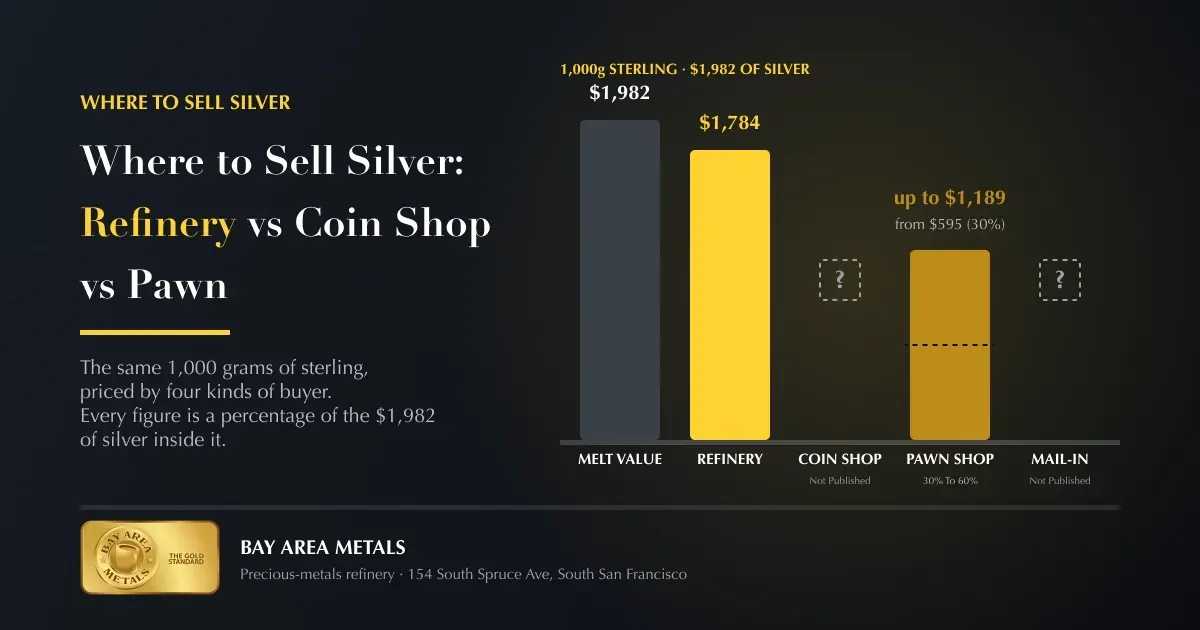
Melt value is the baseline every offer is a percentage of. At the August 17, 2026 spot of $66.64 per troy ounce (APMEX), sterling carries $1.98 per gram, so 1,000 grams of mixed sterling holds about $1,982 of silver.
Bay Area Metals publishes a payout of up to 90% of spot for silver, about $1,784 on that pile, because a refinery is the last stop in the chain rather than a buyer reselling into it.
Pawn shops pay 30% to 60% of market value (US Pawn), roughly $595 to $1,189 on the same silver.
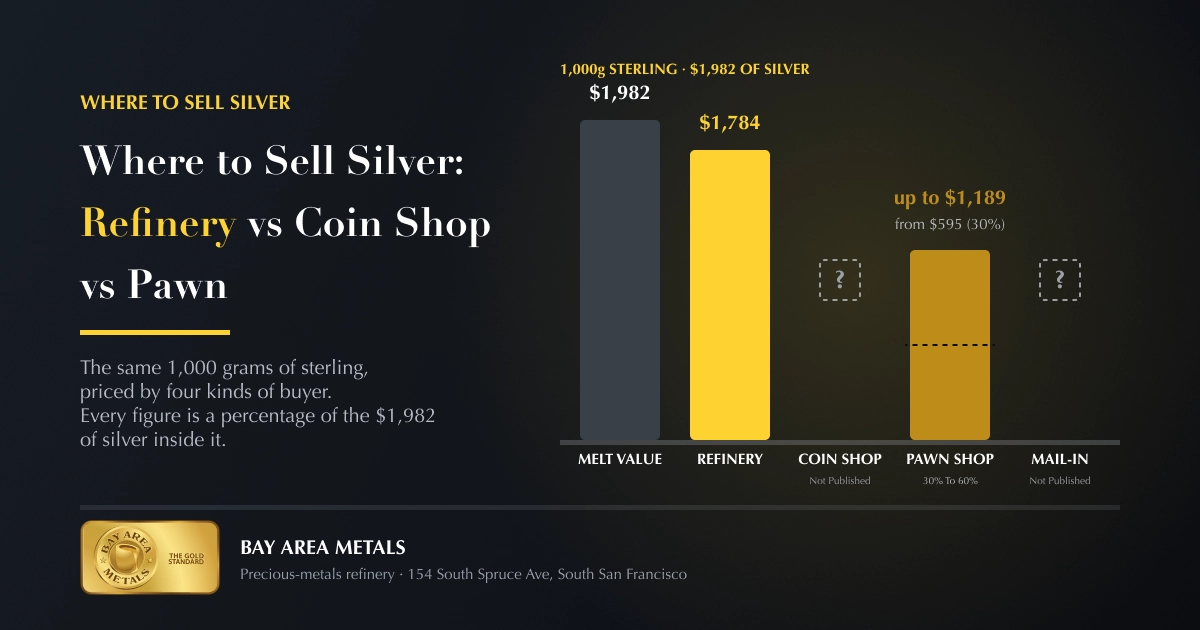
The same thousand grams of broken sterling is worth about $1,784 or about $595 depending on which door you carry it through. Which is why ten minutes spent reading this article is worth the ~$1200 you could lose out on by searching "where to sell silver near me".
We run a refinery, one of the four types of silver buyers. What I can offer, that a price calculator cannot, is the math behind each buyer's offer.
The Silver Institute reported on February 10, 2026 that silver breached $100 an ounce for the first time in January, then fell back below $80, and projects global recycling to pass 200 million ounces this year.
What is your silver worth before anyone makes you an offer?
Weight times purity times the day's spot price. That figure is the melt value, and it is the only baseline that matters, because every offer you receive is a percentage of it.
Silver was $66.64 per troy ounce on August 17, 2026 (APMEX). At 31.1035 grams to the troy ounce that is $2.14 per gram of pure silver. Sterling is 92.5% silver, so a gram of sterling carries $1.98, and pre-1965 US coins at 90% fineness carry $1.93.
A thousand grams of mixed sterling, roughly 2.2 pounds, holds 925 grams of fine silver and therefore about $1,982 of metal. Any number below that is just a percentage.
One piece of vocabulary saves confusion. On scrap, "percent of spot" and "percent of melt" mean the same thing, because melt value is the fine silver inside your item priced at spot. On bullion they come apart, because a recognized coin carries a premium a scrap buyer cannot pay you for.
Silver rose 2.95% during the single day I wrote this (JM Bullion, August 17, 2026), so treat $66.64 as a method rather than a quote.
Why does no buyer pay 100% of melt?
Because spot is the price of refined metal, and what you are holding is not refined metal yet. Somebody has to assay it, melt it, and separate the silver from the copper it is alloyed with.
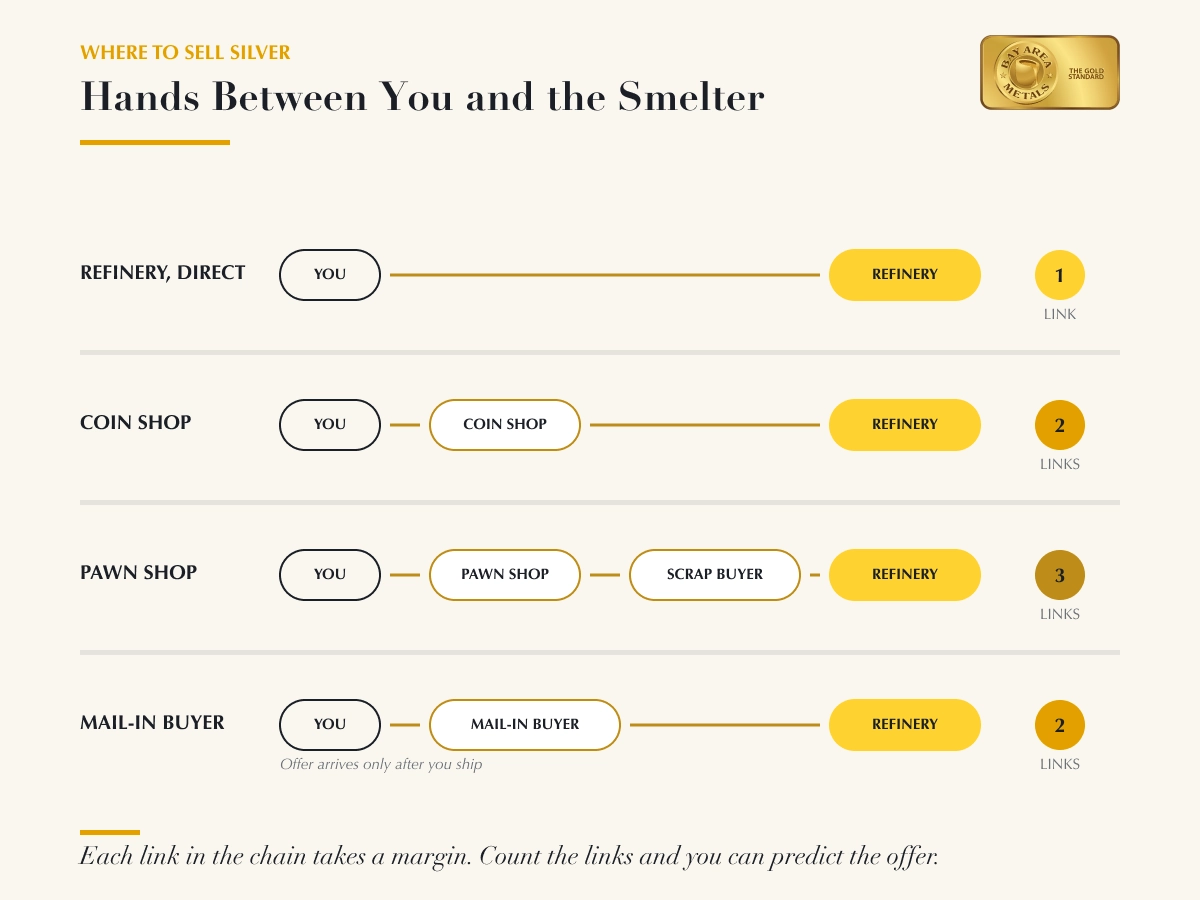
So the useful question is not who is generous. It is how many hands sit between you and the smelter, because each takes a margin and prices in the risk that the metal is not what it looks like. A pawn shop sells to a scrap buyer, who sells to a refinery. Count the hands and you can predict the offer within a few points.
What does a refinery pay for silver?
Up to 90% of spot, in our case, for a structural reason rather than a generous one. Bay Area Metals publishes up to 90% of spot for silver, platinum, and palladium, and up to 99% for gold. On the $1,982 pile, that is roughly $1,784.
The remaining ten points are not a fee we invented. They cover the assay, the loss in the melt, the copper we separate out and cannot sell as silver, and overhead that is the same on 40 grams as on 4,000. What they do not cover is a resale margin, because there is nobody after us to sell to. That is why the trade sells to refineries rather than to shops.
"I'm a jeweler/goldsmith and have dealt with many refiners. Bay Area Metals are the most upfront and honest with the highest payout. I just moved here from NYC and am really happy I can take my scraps here." - Jennifer N., Brooklyn, NY, customer testimonial, bayareametals.com
Where working jewelers take their own scrap is the most reliable signal a public seller has, because they do it monthly and they compare.
The trade-off is real. A refinery is a plant, not a storefront, so expect a drive, a scale, an assay, and a wait measured in hours. Our guide to selling silver in the Bay Area covers the visit and our walkthrough of the refining process covers the rest.
What does a coin shop pay for silver?
Close to melt on coins, and materially less on everything else. That distinction decides whether you should be reading this article at all.
On pre-1965 US silver coins, coin shops pay 88% to 98% of melt value, scaling with lot size: 88% to 92% on loose handfuls, 90% to 95% on a $100 face-value lot, and 95% to 98% on a $1,000 bag, according to Summit Metals (July 16, 2026). Bullion dealers sit around 95% of spot on recognized coins and bars, per GoldSilver.
Those numbers beat ours, and they should. A coin shop buying a tube of Silver Eagles is not buying metal to be destroyed. It is buying inventory to resell intact at a premium over spot, so a thin margin is all it needs.
Hand the same shop a bag of broken sterling and the transaction inverts. Now it is buying material it cannot resell in that form, so it is passing it on to a refinery, and its offer has to sit below what the refinery pays it. We could not find one coin shop publishing a percentage for sterling scrap.
What does a pawn shop pay for silver?
Between 30% and 60% of market value, according to US Pawn. US Pawn states that against market value rather than assayed melt, so treat the conversion as an estimate: on the $1,982 of silver in our pile it works out to $595 to $1,189.
A pawn shop is not being unreasonable within its own business. It lends against collateral, so its buy price has to survive silver falling before the item moves, and it has no assay equipment to tell it what the item is. What you buy with the difference is speed and proximity. Our comparison of gold buyers in San Jose runs the same math on the gold side.
What do online mail-in buyers pay for silver?
No published percentage, which is the finding rather than an oversight. Cash for Gold USA advertises free insured overnight shipping, an offer within 24 hours of receipt, and 14 days to reject it and have the metal returned, but quotes no payout figure. Garfield Refining published a guide titled "The Best Place to Sell Silver," updated the day I wrote this, and quotes none either. Searching on August 17, 2026, we found no mail-in buyer that publishes one.
The mechanics are convenient, and Cash for Gold USA at least commits in writing to insuring the parcel and returning the metal. Look at the sequence, though. Your silver leaves your hands, and then the offer arrives, which is a different negotiation from standing at a scale. So photograph and weigh everything first, keep the tracking, and get the return window in writing. That window is the protection, not the shipping insurance.
Where to sell silver, based on what you are holding
One question decides it, and it is not which buyer advertises the best price. It is whether your silver is worth more intact than melted.
If it can be resold as it is, take it to a coin shop or a bullion dealer. American Silver Eagles, recognized bars and rounds, pre-1965 dimes and quarters, anything with a date and a mintmark a collector might want. Those trade near melt because nobody needs to refine them, and a refinery cannot pay for a premium it has no way to resell. We send those sellers down the road rather than buy a Morgan dollar for its metal.
If it is only worth its metal, a refinery is where the chain ends and where the money is. Broken chain, single earrings, mixed 925 findings, dented holloware, bench sweeps, anything unmarked, anything a jeweler would call scrap.
The objection we hear most is that assaying and sorting sounds like a process built to find reasons to pay less. It runs the other way. An eyeball estimate always rounds against the seller, because a buyer who cannot see what the metal is prices in the risk that it is worse than it looks. Measuring removes the guess, and the seller keeps what it cost.
Bring your silver in for a weight, an assay, and a quote at 154 South Spruce Ave, South San Francisco. You will watch the scale and see the spot price we are working from, and you can walk out with the silver and the math if the number does not suit.
Frequently Asked Questions
Author
Issac Makdessian is the owner and head refiner at Bay Area Metals, the family-owned precious-metals refinery at 154 South Spruce Ave, South San Francisco, operating since 2012. He refines gold, silver, platinum, and palladium for public sellers and for the region's jewelry, dental, pawnshop, electronics, and solar trades. Bay Area Metals holds an A+ rating with the Better Business Bureau and has 66 published Yelp reviews as of June 2026.