
Pawnshop Refining: Bulk Smelt or Individual Assay?
By Issac Makdessian, Owner and Head Refiner, Bay Area Metals. Operating the family-owned South San Francisco refinery since 2012.
Key Takeaways
In pawnshop refining, bulk smelting is the right default for mixed karat scrap when your refiner settles on a fire assay of the melt, because the assay measures total fine gold regardless of which pieces it came from.
That default holds on three conditions: the melt is homogenized and properly sampled, platinum group and white metal pieces are pulled first, and your payout percentage does not quietly slide with lot quality.
Pull a piece for individual handling when it is worth more than melt value, when it holds stones, when it may carry platinum or palladium, or when you need a per-item record.
If your refiner pays off a pre-melt XRF read rather than a fire assay of the melt, bulk smelting does cost you, because you are being paid on a surface reading of a mixed pile.
California Financial Code § 21201 sets a four-month minimum loan period plus a 10-day redemption window after notice, so forfeited metal reaches your scrap drawer on a schedule you can plan lots around.
You set your buy-side margin the day you write the ticket. You set your sell-side margin the you decide what goes in the furnace together. Most shops treat that second decision as no decision at all. Everything goes in one bag, the bag goes to the refiner, and a number comes back.
One bag is usually the right call. But a few pieces in every lot are worth more whole than melted, and you only get one shot at that choice. Here is how to find them.
What is pawnshop refining, and what are you actually paid for?
Pawnshop refining converts a shop's accumulated forfeited and purchased metal into settled value, paid on true fine content rather than on appearance. The refinery weighs the lot, melts it, measures what is actually in it, and pays against that measurement.
So the number that matters is not the price per gram you were quoted. Weigh the lot, then multiply by the purity the assay finds. That gives you a fine weight of the real gold in the pile. Multiply fine weight by spot and you have the gross. Subtract what the refinery charges to assay and melt it, and what is left is your check. At Bay Area Metals that lands at up to 99% of spot for gold and up to 90% for silver, platinum, and palladium, and we walk trade clients through how the refining process and payout actually work before they commit a lot.
Your shop buys from the public at somewhere near 70% of spot, the going rate we see across Bay Area pawn shops. The gap between what you pay in and what you settle at is your whole margin on the metal, and every point you leave on the refining side comes out of it.
What a bulk smelt actually does to your lot
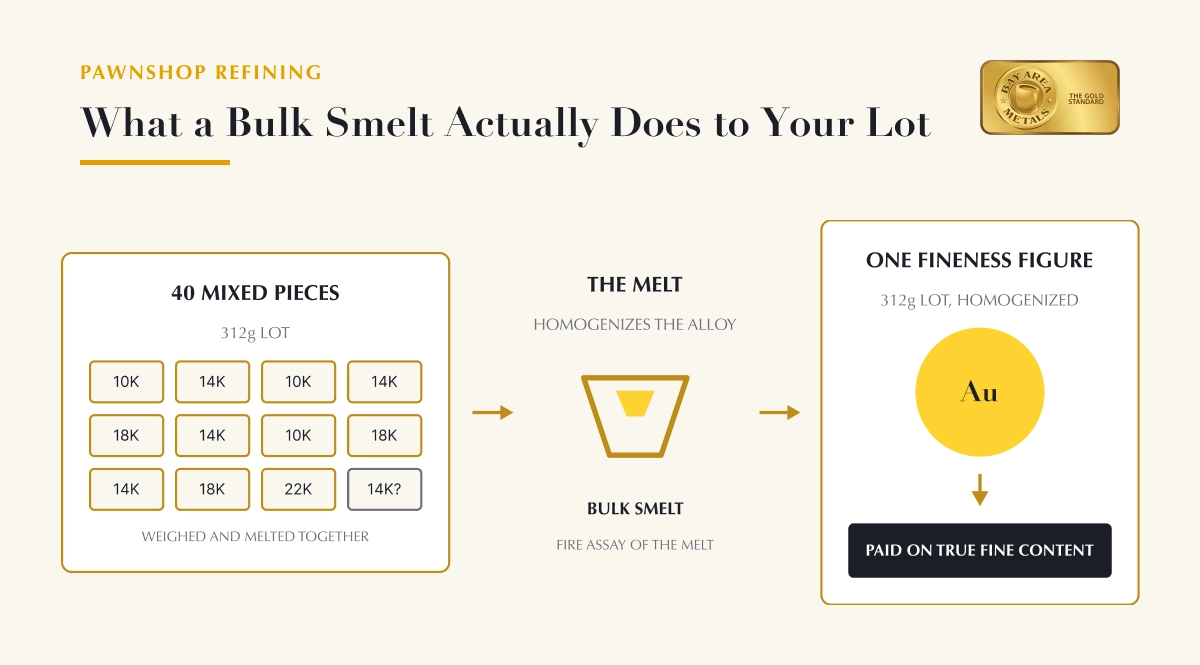
A bulk smelt melts your entire lot into one homogeneous mass, and then a sample of that mass is fire assayed to determine its exact fine content. The lot stops being forty pieces of unknown karat and becomes one bar of known composition.
This is where most pawnbrokers' intuition goes wrong. It feels like the 22k bangle gets dragged down by the 10k chain around it. On the gold itself, it is not. A fire assay measures total fine gold in the sampled mass, and that total does not care which pieces contributed it. The method collects the precious metal into a lead button, oxidizes the lead away in a cupel, then parts the surviving gold and silver bead in acid to leave the gold, standardized for jewellery work under ISO 11426. It measures true content, not surface content.
Two conditions have to hold before you trust that. The melt has to actually be homogeneous, which is not automatic in a bag holding steel clasps, lead solder, and the occasional piece of platinum that will not dissolve at gold-melt temperature. And the sample has to represent the melt, which depends on whether the refiner pins the stirred stream or drills the cooled bar, and how many samples they pull.
Get those right and the averaging you were worried about is happening to the alloy, not to your payment.
When should you pull a piece for individual assay?
Pull a piece out of the lot when melting it destroys value that the metal alone does not carry, or when you need that piece measured on its own record. Five situations account for nearly all of it.
The piece is worth more than the melt. A signed maker's mark, a collectible coin, or an intact period setting could all prove to be more valuable than the melted metal. This is the single most expensive mistake in the whole process, and it's not a metallurgy problem. It's an identification problem at intake.
The piece holds stones. Stones need to come out before the melt, and shops differ on whether they want that labor done in house or at the refinery.
You suspect platinum group metal. This one does double damage. Dental alloys and some older settings carry palladium or platinum with its own payout rate, so unrecognized PGM goes unpaid. It also corrupts the gold figure around it, because ISO 11426 flags platinum, palladium, and heavy base metal as cases where standard cupellation needs modification. One unnoticed platinum ring can put a whole lot's number in question.
The piece is disputed, consigned, or under a hold. Anything that might need to be produced again as itself has no business in a communal melt.
Your refiner does not fire assay the melt. If they price your lot from an XRF read taken before melting, you are being paid on a surface reading of a mixed pile, and the 22k bangle really does get averaged in with the plated junk. Pull every high-karat piece and settle it separately.
Why the karat stamp and the XRF gun cannot settle the question
Neither a stamp nor a handheld reading is a settlement instrument. Both are sorting instruments, and they are good at that job.
A stamp is a manufacturer's claim, and even an honest one is allowed to run light: under 15 U.S.C. § 295, actual fineness may sit up to 3/1000ths below the mark, or 7/1000ths on jewelry once solder is counted, as summarized by Stuller. That tolerance is small. The real problem is what no tolerance covers, which is the underkarated, the counterfeit, and the confidently mismarked, all of which cross a pawn counter every week.
XRF has a different limit. It reads the surface, penetrating only the top tens of microns of a gold alloy, which is why a plated or filled piece can read convincingly on the gun and disappoint in the crucible. Even XRF manufacturers say so: one notes that XRF cannot replace fire assay for final refinery settlement.
Which brings the whole article to one question you should ask your refiner before anything else. Do you pay on a fire assay of the melted lot, or on an estimate taken before the melt? If the answer is a fire assay of the melt, bulk smelting is the efficient default and you only pull the exceptions above. If the answer is a pre-melt XRF read on a mixed pile, then averaging is genuinely working against you, and pulling your high-karat pieces is no longer optional. It is defense.
A worked example: one forfeited lot, two ways of handling it
Take a 312-gram lot, roughly forty pieces. Thirty-four are broken mixed 10k and 14k chain, unmarked fragments, and single earrings. Four are marked 18k. One is a 22k import bangle. One is a heavy ring stamped 14k that feels wrong in the hand.
Sent as one bulk melt to a refiner settling on fire assay, all 312 grams are homogenized and assayed together, and the bangle contributes its full fine gold to the total. Note what you do not get back: one lot certificate reports one fineness for the whole melt, so if the suspicious ring is mostly base metal, its shortfall is absorbed quietly into the lot number and you never see which piece cost you. That is an argument for screening it at the counter, not for skipping the bulk melt.
The realistic alternative is not forty separate assays, because nobody fire assays broken chain one piece at a time. It is sorting into two or three karat buckets and running them as separate melts, which is worth doing when your low bucket is heavy with solder and base metal, since a cleaner melt loses less and settles better. So ask whether your payout percentage moves with lot quality. If it does, sorting pays.
The objection to sorting at all is time, and it is fair on a Saturday afternoon. But the sorting that matters is not forty decisions, it is one: does this piece have a buyer who wants it as a piece? You ask that at intake anyway, when you write the ticket.
How California's redemption clock sets your lot cadence
California Financial Code § 21201 requires a pawn loan contract to run a minimum of four months, and the pledgor then gets a further 10 days to redeem from the date the termination notice is sent, per the statute. Title does not pass to your shop before that clock runs out.
So tickets written in one month become scrap-eligible about four months later, in a wave you can see coming. Shops that time lots to that wave send fewer and larger ones, which is also the direction that moves your payout percentage up.
What to ask before you hand over a first lot
Six questions, and the answers should be immediate.
Do you settle on a fire assay of the melted lot, and will I get the assay certificate?
How do you sample the melt, and how many samples do you pull?
What is your payout percentage on gold, and on silver, platinum, and palladium separately, and does it move with lot size or lot quality?
Is silver content in a karat gold lot credited, and is there a minimum?
Can I watch the intake, the weighing, and the melt?
What happens to stones, and to any platinum group metal you find?
That third question is not sentimental. A number you cannot watch being produced is a number you take on faith, and faith is an expensive input for a business whose margin lives in the second decimal place.
Bring your next lot to 154 South Spruce Ave, South San Francisco, and stay while we weigh it, melt it, and assay it. Call or text (650) 675-5009 to book a first-lot walkthrough, and see what we handle for pawn shops and other trade clients before you come.
Frequently Asked Questions
Author
Issac Makdessian is the owner and head refiner at Bay Area Metals, a family-owned refinery in South San Francisco operating since 2012. He refines gold, silver, platinum, and palladium for public sellers and for trade clients including pawn shops, jewelers, and dental labs across the Bay Area. Bay Area Metals holds an A+ BBB rating and a 5-star Yelp rating across 60+ reviews.