
Gold Smelting and Melting: What a Smelter Does and Costs
By Issac Makdessian, Owner and Head Refiner at Bay Area Metals. Operating the family-owned South San Francisco refinery since 2012.
Key Takeaways
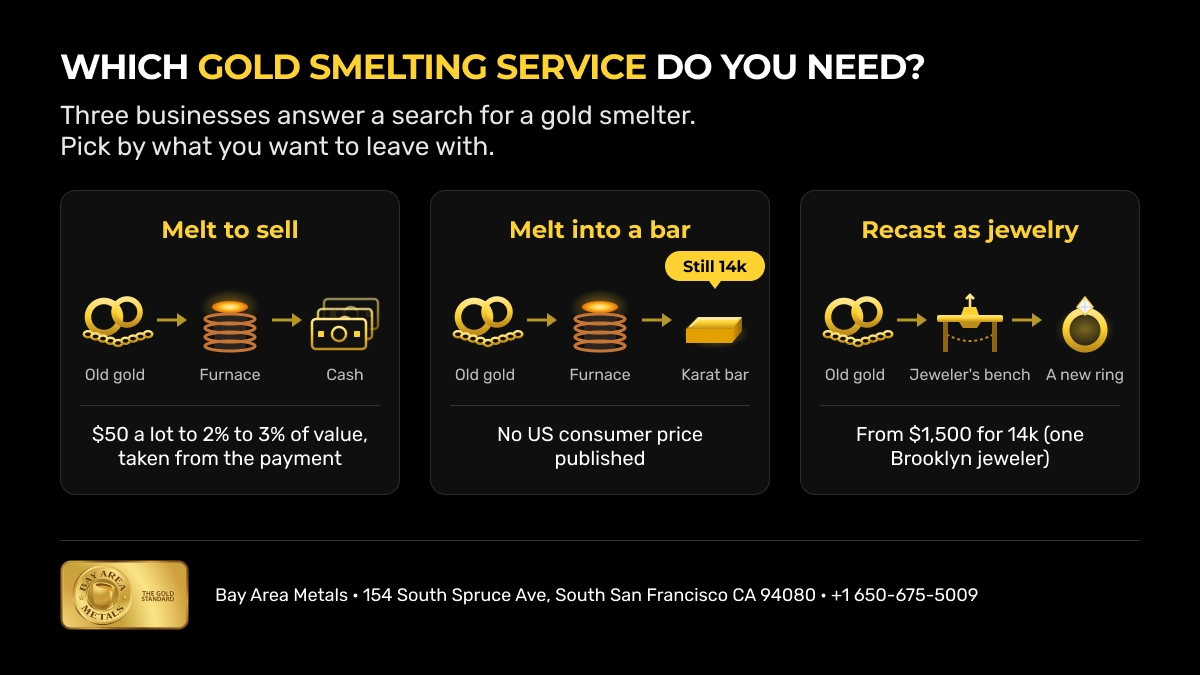
People who search for a gold smelter want one of three jobs: melting gold to sell it, melting it into a bar to keep, or recasting it as new jewelry. Each job goes to a different kind of business and costs a different amount.
Melting to sell comes with no separate bill, because the buyer melts the gold to measure it and takes the charge out of the payment. Published refinery charges in 2026 run from $50 a lot to 2% to 3% of the gold's value.
Melting gold into a bar does not make it purer. A bar melted from 14k jewelry is still 14k, and only refining raises the purity. No US business we found publishes a consumer price for this job.
Recasting old gold as new jewelry costs far more than melting it to sell, and some jewelers refuse the job because old gold casts with flaws. One Brooklyn jeweler's published price starts at $1,500 for 14k.
Melting gold at home loses money and carries a health risk, because a torch cannot separate gold from its alloy and some old solder gives off cadmium fumes. Any buyer melts and tests the gold again anyway.
A gold smelter is a business with a furnace that melts gold, and what the melt costs depends on who does it and what you leave with. Bay Area Metals is a refinery that buys gold. We have run our furnace in South San Francisco since 2012, and when you sell gold to us in person, you are welcome to watch us weigh, melt, and assay it. The prices below for other kinds of melting come from refiners and jewelers that publish theirs.
What does a gold smelter do?
A gold smelter melts gold into one uniform mass, which a refiner can then measure, refine, or reshape. Strictly, smelting means extracting metal from ore with heat and chemical agents, and the StoneX financial glossary separates it from melting, which only turns a solid into a liquid. A refinery like ours takes in scrap, jewelry, and dental gold, never ore, so in everyday use the two words mean the same thing.
Pure gold melts at 1,064°C (1,948°F), according to the Royal Society of Chemistry. Our gold smelting service uses induction furnaces, which heat metal with an electromagnetic field and melt any item into a single molten mass. Take out any gemstones you want to keep, but leave the cement and enamel on dental gold and old jewelry, because the furnace burns them off.
Why melt at all? A bag of rings, chains, and crowns holds many karats, and a test on one piece says nothing about the others. Mid-States Recycling, a US refiner, says in its FAQ that it melts scrap for one reason: to create a homogeneous alloy. Once the metal is uniform, a small sample represents the whole lot, and the assay on that sample sets the price. Our guide to how precious metal refining works follows the smelt through to the finished bar. Silver melts lower, at 962°C, and our silver smelting guide covers how its melt differs.
Which gold smelting service do you need?
The right service depends on what you want to leave with. A refinery pays you for your gold, a melt-and-return service gives you a bar of your own alloy, and a jeweler recasts your gold as new jewelry:
Melting gold to sell: what happens and what it costs
When you sell gold to a refinery, the melt is part of the sale. The refinery melts your gold to measure it, assays a sample, and pays you for the gold content it finds. The refinery's charge for the melt comes out of the payment, so you never see a separate bill. At a refinery that lets you watch, you also see each number that sets your price.
At Bay Area Metals, a sale runs in five steps:
Bring your gold in or ship it. We recommend an appointment, and if you ship, call us first. Bring a government-issued photo ID, because California law requires any buyer of used precious metals to check it (Business and Professions Code §21628).
Watch the weighing. We weigh your gold on a scale in front of you.
Watch the melt and the assay. We read the purity with an X-ray fluorescence (XRF) analyzer. When a lot needs a fire assay, we melt it into one bar in our induction furnace and assay a sample from the bar.
See the offer. We price your gold from its weight, its assayed purity, and the day's spot price.
Take payment. If you accept, we pay you the same day or the next, in cash, gold bars, or casting grain.
California adds one limit. A dealer must hold any piece engraved with initials or an inscription for seven days after reporting it to the state (BPC §21636.1, with the definition in §21627). An engraved wedding band therefore cannot go into the furnace the day you sell it. Jewelry without engraving, dental gold, and bench scrap fall outside the seven-day hold.
What does the melt cost when you sell?
Refineries that publish their charges price the melt and the assay together. Mid-States Recycling's karat gold schedule lists a melt and assay charge of $50 for a lot of 1 to 30 troy ounces, $100 for 30 to 79 ounces, and 75 cents an ounce from 80 ounces, and Mid-States pays 98% to 99% of the gold content. United Precious Metal Refining in New York charges $100 or 2% to 3% of the gold's value, whichever is larger, according to JCK in September 2026. A fixed charge takes a bigger share of a small lot, so ask any buyer how it charges before you hand over a single ring.
We publish no separate melt fee. We pay up to 99% of the daily LBMA spot price for gold, and that payout already accounts for the melt and the assay, so the offer you see is the amount you receive.
Every melt loses some weight. Mid-States explains that glass, enamel, and dirt burn off, and that base metals such as zinc and cadmium turn to gas at melting temperature, while gold itself does not burn off.
"All the jewelers come here to sell their gold for melting purposes. This place offers you the best prices!" Debbie G., Millbrae, CA
If your lot mixes many karats, our guide on bulk smelt or individual assay explains when melting everything together pays less than testing piece by piece. Never let anyone melt a coin worth more to a collector than its gold. We do not melt those coins, and our guide to selling gold coins explains how to tell the difference.
Can you melt gold into a bar and keep it?
Yes, but the bar keeps the karat of the jewelry you melted. Melting blends the metals in your pieces. It does not remove the copper, silver, and zinc alloyed with the gold, so a bar melted from 14k chains is still 58.3% gold. Only refining, by chlorination or electrolysis, raises the purity.
Some refiners and assay offices offer melt-and-return: they melt your pieces, assay the bar, stamp its weight and purity, and hand it back. We found no US business that publishes a consumer price for this job, so ask for a quote that covers the melt, the assay, and any metal lost.
A bar of your old alloy carries no refiner's hallmark, so a dealer will assay the bar again before buying, and a jeweler needs to know its exact alloy before casting with it.
Bay Area Metals does not list melt-and-return among its services. If you want bullion for your scrap, exchange the scrap instead. We exchange scrap gold for already-made bars or rounds, and we sell Metalor kilo bars and casting grain for investment or manufacturing. You leave with refined, stamped metal instead of a bar of your old alloy.
Can a jeweler recast your old gold into new jewelry?
Some jewelers will. Fitzgerald Jewelry in Brooklyn, which publishes its prices, starts its recycling fee at $1,500 for 14k and $1,900 for 18k, and charges extra for any metal it adds.
Other jewelers decline the job. Old jewelry carries solder, repairs, and alloys of unknown makeup, so a jeweler cannot stamp a karat on a piece cast from that metal without testing the metal first. The UK jeweler Lark & Berry warned in September 2026 that contaminants and oxidized metal leave tiny voids in a piece cast from old gold.
The other route is to sell your old gold for its metal content and have the jeweler cast the new piece from fresh casting grain of a known karat, which avoids the voids that old metal leaves. Jewelers who sell their bench scrap to us can take payment in casting grain, as our guide to gold refining for jewelers explains.
What does melting gold tell you about its purity?
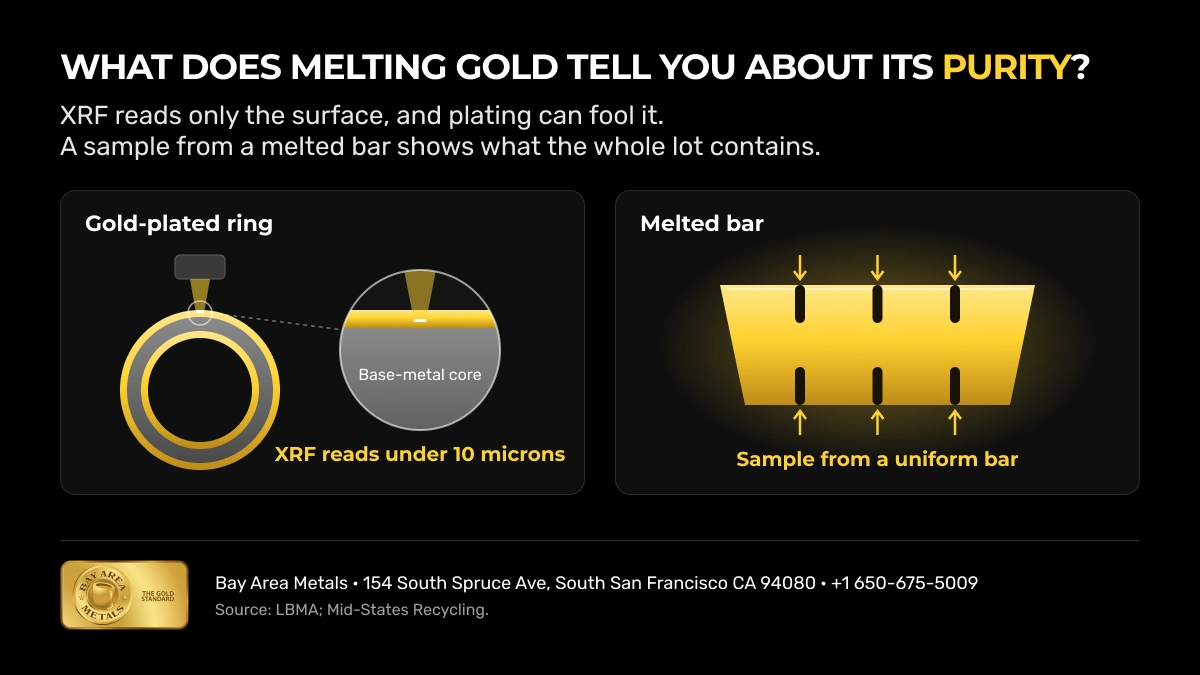
Melting gold into one bar makes an accurate purity reading possible. Before the melt, a tester reads only the surface of each piece. After it, a sample from the bar represents the whole lot.
The London Bullion Market Association says that an XRF analyzer reads metal less than 10 microns deep and that plating can fool it. A gold-plated or gold-filled piece can read as solid gold on the surface. Our scrap gold guide shows how to sort solid, filled, and plated pieces before you sell.
A melted bar removes the plating problem, because the sample comes from inside the metal. The refiner draws a sample by drilling the bar or by pulling molten metal into a pin tube, and Mid-States describes the industry protocol as three drill holes on the top of the bar and three on the bottom. A fire assay then melts the sample with lead, burns off the base metals, and weighs the gold that remains. The international standard ISO 11426 sets out the method, and our fire assay guide walks through it step by step.
Should you melt gold at home?
No. Melting gold at home costs you metal and money and gives you nothing a buyer will pay more for. A propane torch burns hot enough to melt gold, as Sciencing noted in 2022, but the flame separates nothing, so the copper and silver in a 14k chain stay in the lump.
Old jewelry also hides solder, and some older solders contain cadmium, a hazard the Santa Fe Symposium on jewelry manufacturing flagged in 1988. Cadmium turns to gas at scrap-melting temperatures, according to Mid-States, and OSHA calls cadmium highly toxic and a known cause of cancer.
If you then sell the lump, the buyer melts it again. A refinery has to make the metal uniform and assay it before paying, so a home melt adds nothing to the price, loses whatever spills or sticks to the crucible, and erases the karat stamps that would have helped you sort your pieces.
Sell your gold at our South San Francisco refinery
Bring your gold to Bay Area Metals, or start your sale on our gold page. On a walk-in sale, you watch us weigh, melt, and assay your gold, see an offer you are free to decline, and take payment the same day or the next, in cash, gold bars, or casting grain. Most walk-in sales take 20 to 45 minutes. If you plan to ship your gold or have questions about what to bring, call us or send a message through our contact form.
Contact Us: +1 650-675-5009 154 South Spruce Ave, South San Francisco CA 94080
Frequently Asked Questions
Author
Issac Makdessian is the owner and head refiner at Bay Area Metals, the family-owned precious metals refinery at 154 South Spruce Ave, South San Francisco. The refinery has bought, smelted, and refined gold, silver, platinum, and palladium since 2012, for individual sellers and for Bay Area jewelers, dental labs, and pawnshops. Author archive